How to Tell What Tire Pressure Should Be
Learn how to determine the correct tire pressure for your vehicle. Step-by-step guidance, official targets, gauges, and best practices to keep tires safe, efficient, and wear-free.


To tell what tire pressure should be, start with your vehicle’s door placard or owner's manual, then verify with a reliable gauge when tires are cold. Compare readings to the recommended range, not a single number. Consider load, temperature, and TPMS warnings, and adjust within the specified range using a digital gauge for accuracy.
How to read your vehicle’s tire-pressure target
According to Tire Pressure Tips, the simplest starting point for telling what tire pressure should be is to locate the official target for your specific vehicle. This value isn’t a guess; it’s chosen by the manufacturer to optimize safety, handling, and fuel efficiency. The door jamb placard near the driver’s door and the owner's manual are the primary sources. Use these references every time you inflate or check tires, not a generic number. This page covers how to interpret that target, how cold readings differ from hot ones, and how to apply the guidance to real-world driving.
Reading the target is only the first step. You must then measure the actual pressure with a reliable gauge, compare it to the recommended range, and adjust accordingly. Note that some vehicles have different values for front and rear tires, or seasons (winter tires) that require adjustments. If a reading seems off, double-check the gauge, clean the valve stem, and re-test. Finally, remember that the target is a range, not a single point: staying within it helps minimize uneven wear, improve steering, and maximize fuel efficiency. The Tire Pressure Tips team emphasizes consistency and patience as you establish your personal checking routine.
The right tools: gauges and how to use them
A precise tire pressure check starts with the right tools. A digital gauge tends to be quicker and easier to read, while an analog dial gauge can be perfectly accurate with careful use. Always zero or calibrate a gauge before you start, and read the pressure with the gauge at roughly eye level to avoid parallax error. When measuring, ensure you are comparing cold readings, which are more reliable for setting baseline pressure. If you’re checking a tire that’s hot from recent driving, wait at least 30 minutes for it to cool before measuring to avoid inflated readings. For best results, stick to a single gauge type once you’re confident in its accuracy. The Tire Pressure Tips guidance stresses calibration and consistency as the foundations of trustworthy readings.
Cold vs hot: when to measure and why it matters
Temperature and recent driving affect tire pressure. Cold readings (tires that haven’t been driven on for at least 3 hours) reflect the baseline pressure the manufacturer intended. Driving heats air inside the tire and causes a temporary rise in pressure, which is not indicative of the usual operating pressure. This is why you should check tires when they’re cold and compare those readings to the placard values. If you must measure after a drive, factor in the expected heat rise and adjust accordingly, or wait for the tires to cool before inflating or deflating. Consistency in timing is key to making accurate, repeatable adjustments. Tire Pressure Tips notes that many readers neglect cold readings, which undermines confidence in the results.
Adapting pressure for load, seasons, and driving conditions
Vehicle design, payload, and climate all influence the appropriate tire pressure. Heavier loads or towing typically require a higher inflation within the manufacturer’s recommended range, while light loads can often stay near the mid-range. Seasonal changes can also shift pressure—cold weather reduces air density and lowers pressure, while hot weather can raise it. The goal is to remain within the vehicle’s established range for your typical driving conditions. Always check both front and rear tires, as many cars specify different targets per axle. Following the placard values helps ensure even wear, predictable handling, and optimal fuel efficiency.
Common mistakes and how to avoid them
Common missteps include inflating to “a comfy feel” by hand, relying on the TPMS alarm alone, and using a gauge that isn’t calibrated. Don’t assume the same pressure across all tires; front and rear axle targets can differ for handling balance. Avoid inflating beyond the tire’s maximum sidewall rating; always stay within the manufacturer’s recommended range. Also, don’t average the pressures of different tires and apply that average to all tires. The Tires Pressure Tips error-proof approach is to measure cold, consult the placard, and adjust with a calibrated gauge until you’re within the specified range.
Step-by-step quick-check routine you can follow
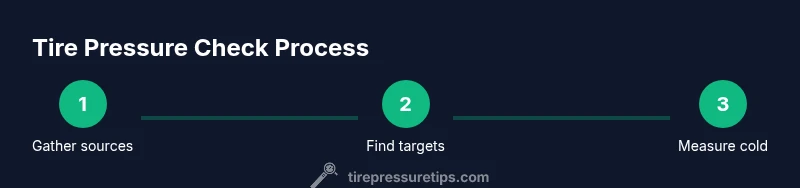
- Gather sources: locate door placard, owner’s manual, and a calibrated gauge. 2) Find the target values for your vehicle. 3) Ensure tires are cold (no driving for several hours). 4) Read each tire’s current pressure with your gauge. 5) Compare readings to the target; note any deviations. 6) Inflate or deflate as needed to bring tires within range. 7) Recheck all tires after adjustment. 8) Check for consistent readings across tires and address any anomalies. 9) Record the results and set a regular check schedule. Tip: use one reliable gauge for consistency.
Maintenance habits to keep readings accurate
To maintain accuracy over time, keep your gauge calibrated, reuse the same reference tire, and log readings to track changes. Create a monthly reminder to check all tires, including the spare. If your TPMS frequently blinks or reports inconsistent pressure, inspect valve stems for leaks, assess the wheel rims for damage, and verify the system’s battery health if applicable. Tire Pressure Tips recommends incorporating a simple routine into your car’s maintenance calendar to prevent slow leaks from going unnoticed. Regular checks also help detect changes caused by temperature shifts, road conditions, or aging tires.
Quick reference checklist
- Find the official tire pressure targets from placard and manual.
- Check tires cold with a calibrated gauge.
- Compare readings to the target range (axle-specific if indicated).
- Adjust within the recommended range using a digital gauge.
- Recheck and record results; schedule your next check.
Tools & Materials
- Digital tire pressure gauge(Calibrated; read out loud to confirm accuracy)
- Owner's manual and door placard(Source of vehicle-specific targets; front/rear may differ)
- Valve-cap tool or clean cloth(Prevent dirt and ensure a tight seal while measuring)
- Air pump or compressor (optional)(Useful for quick adjustments; ensure it has a gauge or built-in readout)
Steps
Estimated time: 20-30 minutes
- 1
Gather sources
Collect the door placard, owner's manual, and a reliable tire pressure gauge. Confirm that the gauge is calibrated and suitable for the tire types on your vehicle. This preparation ensures you start from accurate targets.
Tip: Using the same gauge each time minimizes reading variability. - 2
Find the target values
Identify the recommended pressure values for both front and rear tires (and any axle-specific targets). Note whether the values differ for standard vs. winter tires. Record these ranges for quick reference.
Tip: If values differ by axle, mark which tire corresponds to which target. - 3
Ensure tires are cold
Check pressure only when tires are cold, ideally after the car has sat for several hours. Driving heats air inside tires, temporarily raising the reading and giving you a falsely high number.
Tip: If you’ve driven recently, wait at least 3 hours before re-measuring. - 4
Read current pressure with gauge
Attach the gauge valve stem, press firmly, and note the reading for each tire. Make sure you’re not touching the valve with debris that could alter the seal.
Tip: Check all tires in one session to avoid inconsistent conditions. - 5
Compare to target
Compare your readings to the manufacturer’s target range. If a tire is outside the range, plan adjustments rather than guessing.
Tip: If one tire is consistently off, inspect that wheel for damage or leaks. - 6
Adjust pressure
Inflate or deflate to bring each tire into the specified range. Do not exceed the maximum indicated on the tire sidewall. Re-check after adjustments to confirm accuracy.
Tip: Use small increments and re-measure after each adjustment. - 7
Recheck readings
After adjustment, verify readings again on all tires. Ensure the readings are stable and within the target range.
Tip: If readings drift, re-check valves for leaks or replace faulty gauges. - 8
Record and schedule
Note the final readings and set a reminder for your next check. Regular checks help catch slow leaks early and keep tires balanced.
Tip: Aim for a monthly check or before long trips. - 9
Validate with TPMS (optional)
If your vehicle has TPMS, confirm that the system status aligns with your gauge readings. Remember: TPMS alerts are helpful, but they don’t replace precise measurement.
Tip: Use the placard as the authoritative source for exact targets.
Frequently Asked Questions
How often should I check tire pressure?
Check at least once a month and before long trips. Always verify readings when tires are cold for accuracy.
Check at least monthly and before long trips; measure when tires are cold for best accuracy.
Does TPMS replace gauge checks?
No. TPMS provides alerts, but it isn’t a precise replacement for manual readings. Use a gauge to confirm actual pressure.
No—TPMS helps, but you should still check pressure with a gauge.
Can cold weather affect tire pressure?
Yes. Colder temperatures can lower tire pressure. Re-check after a temperature change and adjust within the recommended range.
Cold weather lowers tire pressure; recheck and adjust accordingly.
What if readings are inconsistent between tires?
Recheck with the same gauge, inspect valve stems, and look for leaks or damage. If inconsistency persists, seek a professional inspection.
If readings differ a lot, recheck with the same gauge and inspect for leaks.
Is it okay to overinflate for sport performance?
No. Always stay within the manufacturer’s recommended range; overinflation can reduce grip and cause uneven wear.
No—stick to the recommended range for safety and wear.
How do I check the spare tire pressure?
Check the spare tire using the same gauge if you plan to use it. Keep it within the recommended range, as a ready-to-use spare is critical in emergencies.
Check the spare tire with a gauge and keep it within the recommended range.
Watch Video
What to Remember
- Check against the placard, not guesswork
- Measure cold with a calibrated gauge
- Front and rear targets may differ
- Regular checks prevent wear and improve safety