How to Deal with Tire Pressure: A Practical Guide
Learn to check, adjust, and maintain tire pressure for safety, efficiency, and tire longevity with a practical, expert guide.


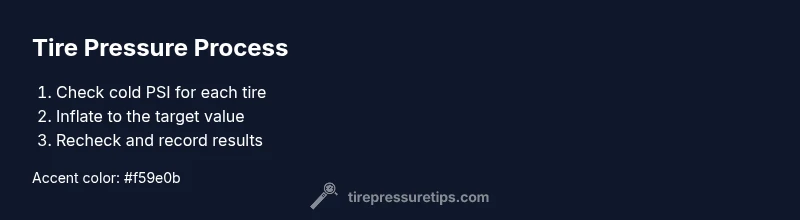
To deal with tire pressure, start by finding your vehicle’s recommended PSI, check all tires when they are cold, adjust with a gauge and an air compressor, and monitor TPMS warnings regularly. Keep an eye on temperature effects and load; inflate or deflate as needed and recheck after driving a few miles to settle the pressure.
Why Tire Pressure Matters
Maintaining proper tire pressure is central to safety, fuel efficiency, and tire longevity. According to Tire Pressure Tips, knowing how to deal with tire pressure isn't just about avoiding flats—it's about predictable handling, even wear, and consistent performance in varied conditions. Your vehicle’s recommended PSI isn't a 'one size fits all' figure; it reflects cargo, speed, and design. When tires are under- or over-inflated, you can experience longer braking distances, increased road noise, and uneven tread wear. This simple truth underpins everyday decisions on the road. By understanding the basics of pressure, drivers can reduce risk, save fuel, and extend tire life through small, deliberate adjustments.
How to Find the Right Tire Pressure for Your Vehicle
Most cars list a recommended cold PSI on a sticker inside the driver's door frame, and the owner's manual may provide additional guidance. If you carry heavy cargo or use a roof rack, you may need to adjust those numbers for load; however, always return to the labeled spec for regular driving. Temperature and tire type can also affect the effective pressure, so treat the numbers as a baseline rather than a fixed rule in every situation. In this section you’ll learn where to find the official spec, how it relates to your tire size, and how to interpret the labeling on tire sidewalls.
Checking Tire Pressure: Cold Readings vs Warm Readings
Pressure readings are most accurate when tires are cold—ideally before you drive or after the car has been parked for at least three hours. Driving warms tires and raises pressure slightly, which leads to over- or under-inflation if you measure after a trip. Use a quality gauge to check each tire, including the spare. If you use an automatic hand air pump, deflate slightly before inflating to avoid over-pressurizing. Always recheck after adjusting, and remember that the tire’s internal temperature can change with ambient conditions. The goal is to keep the tire pressure within the vehicle’s recommended range across a typical range of temperatures.
Tools and Techniques: Gauges, Pumps, and Calibration
Gather a tire pressure gauge, a reliable air compressor or pump, and access to the vehicle’s PSI specs. Digital gauges are easy to read; dial gauges can be more precise but require careful interpretation. When inflating, add air in small increments, pause, and recheck to avoid overshoot. If you’re adjusting multiple tires, it helps to record the current readings and the target values. Keep a small tire maintenance kit in the trunk with a gauge, a small adapter, and a tire plug kit for emergencies; these tools help you stay on top of tire pressure during long trips.
TPMS: Understanding, Faults, and Maintenance
Tire Pressure Monitoring Systems (TPMS) use sensors inside the wheel or valve stems to monitor pressure and alert you to deviations. If the light comes on, it doesn’t always mean a flat tire—underinflation is common. A TPMS fault can result from a bad sensor or a dead battery. The Tire Pressure Tips Analysis, 2026, emphasizes regular TPMS checks as part of a maintenance routine. If you notice the TPMS light stays on after adjusting pressures, inspect valve stems for leaks, check the seal around the rim, and consider having the sensors tested or replaced. Remember that some vehicles require a reset after inflation or tire rotation.
Temperature, Driving, and Seasonal Variations
Air inside tires expands with heat and contracts when it’s cold. In winter, daily temperature drops can reduce the effective pressure, while hot days can push readings higher. This is why you should check tires when they are cold and adjust to the recommended pressure at a standard reference temperature. For performance or heavy-load driving, minor adjustments to the fuel economy and handling can occur, but aim to keep all tires within the recommended range. The science behind this is straightforward: pressure is determined by the gas law and the tire’s volume, so ambient temperature matters as much as load and speed.
Common Mistakes and How to Avoid Them
Over-inflating for a firmer ride, inflating to the maximum sidewall pressure, or relying on TPMS readings alone are common errors. Many drivers inflate to match a perceived road condition or an incorrect gauge reading. Underinflation is a major contributor to increased rolling resistance, reduced grip, and premature wear. Use the door placard as your official reference; use the gauge and target values; avoid inflating to the tire’s maximum pressure; and calibrate the gauge periodically to ensure accuracy. A little testing at home can prevent many trips to the shop.
Maintenance Schedule and Routine
Make tire pressure checks part of a regular car maintenance routine. Check when tires are cold, at least once a month and before long trips. After tire rotation, check again to ensure the pressure remained correct. If you drive in extreme temperatures or with a heavy load, check more frequently. Keep a small gauge in the glovebox or use a tire inflation app to remind you to check the pressure. By building this habit, you’ll avoid most tire pressure issues and extend tire life.
Tools & Materials
- Tire pressure gauge (digital or dial)(Calibrated, reads in psi/kPa)
- Air compressor or hand pump(Regulated output; ensure 12V or 110V power)
- Vehicle owner’s manual or door placard(Contains official PSI specs for front/rear tires)
- Valve caps and spare parts kit(Keep extras in the trunk)
- Cloth or rag(Wipe valve stem before measurement)
Steps
Estimated time: 20-30 minutes
- 1
Find the official PSI target
Locate the recommended cold PSI on the door placard or in the owner's manual. Note any differences between front and rear tires and between standard and heavy-load configurations.
Tip: Double-check that you’re using the correct figure for your vehicle and tire size. - 2
Check tires when cold
Park in a shaded, level area and allow tires to cool for at least 3 hours, or check first thing in the morning before driving. This ensures the reading isn’t inflated by recent driving heat.
Tip: Avoid checking after a long drive; warm tires give higher readings. - 3
Attach gauge and read
Remove the valve cap, firmly place the gauge on the valve stem, and note the reading. Repeat on all tires, including the spare.
Tip: Use the same gauge for every tire for consistency. - 4
Inflate or deflate to target
If under-inflated, add air in small bursts and recheck. If over-inflated, release air gradually and recheck until you reach the target.
Tip: Do not overshoot; small adjustments are safer and more accurate. - 5
Recheck and seal
Recheck all tires after adjustments and reseal valve caps. Make sure the readings stay within the target range.
Tip: Note any tire showing uneven wear or slow leaks. - 6
Document and monitor
Record the readings and the date. Set reminders to recheck monthly and after major temperature shifts or load changes.
Tip: Keep a small log in your glovebox for quick reference.
Frequently Asked Questions
Why is correct tire pressure important for safety and performance?
Correct tire pressure improves stability, braking, fuel efficiency, and tire wear. It also helps avoid blowouts and reduces risk on wet or uneven pavement.
Correct tire pressure improves stability, braking, and fuel efficiency, and reduces tire wear.
How often should I check tire pressure?
Check at least once a month and before long trips, and after temperature changes or heavy loads.
Check at least monthly and before long trips.
Is TPMS a replacement for manual checks?
No. TPMS alerts you to pressure changes, but you should still measure pressure with a gauge regularly.
TPMS helps, but you still need to measure pressure manually.
Can temperature changes affect tire pressure?
Yes. Ambient temperature changes can shift tire pressure readings, so adjust and recheck when temperatures change.
Temperature changes can affect tire pressure readings.
What should I do if the TPMS warning stays on after inflating?
Recheck pressures, inspect for leaks, and consider sensor testing or replacement if the light persists.
If the light stays on, recheck pressures and have sensors tested.
Why not inflate to the maximum sidewall pressure?
The maximum sidewall pressure is the limit, not the target. Following it can lead to harsh ride and uneven wear.
Don’t follow the max pressure; use the vehicle spec.
Watch Video
What to Remember
- Check cold for accuracy.
- Use the door placard PSI as your target.
- Account for temperature and load in readings.
- Maintain a regular tire pressure routine.