How to Adjust Tire Pressure: A Practical Guide
Learn how to adjust tire pressure safely and accurately. Find your vehicle's recommended psi, use a reliable gauge, and follow a simple step-by-step process to improve safety, fuel efficiency, and tire life.


You can learn how to adjust tire pressure safely and accurately by locating your vehicle’s recommended psi, using a reliable tire pressure gauge, and adjusting each tire to ambient temperature. You’ll also understand how TPMS alerts affect readings and when to revisit pressures. Gather a gauge, a stable surface, and a vehicle-specific pressure chart before starting.
Why Proper Tire Pressure Matters
According to Tire Pressure Tips, proper tire pressure is a cornerstone of safety, efficiency, and long-term tire life. When tires run underinflated, they wear more on the edges, overheat more quickly, and require more energy to roll, which translates to worse fuel economy. Overinflated tires, by contrast, can create a harsher ride, reduce grip in wet conditions, and cause uneven wear that shortens tread life. Because tire pressure is not a one-size-fits-all setting, the exact numbers depend on your vehicle, load, and driving conditions.
Most passenger cars carry a recommended tire pressure on a sticker located on the driver's door jamb and in the owner's manual. This guide on how to adjust tire pressure helps you verify cold readings, account for temperature changes, and keep tires within the manufacturer's target. Start with model-specific guidance, not a generic rule of thumb. The Tire Pressure Tips approach emphasizes a practical, repeatable routine: check when the tires are cold, read with a reliable gauge, inflate or deflate in small steps, and recheck. Keeping a log of your readings over time makes it easier to spot slow leaks or seasonal shifts and protects your safety on the road.
How Temperature Affects Tire Pressure
Air expands when it warms and contracts when it cools. In tires, temperature changes can create pressure swings that are larger than many drivers expect. A tire that starts cold at the recommended psi can rise as you drive, especially in hot weather or after high-speed trips. Conversely, in cold weather, the same tires can drop several psi, which changes handling, braking distance, and ride quality. Because tire pressure specifications are written for cold readings, it's important to measure when tires are cold and then adjust if seasonal temperatures change.
This section also explains how to interpret a TPMS warning in light of temperature. A sensor might show a reading that seems low after a cold morning but reads okay later in the day if the tires rebound with warming. The key takeaway is that readings move with temperature, and your maintenance routine should account for that by checking pressures regularly across seasons.
Finding the Right Pressure for Your Vehicle
Your vehicle's manufacturer specifies the correct tire pressure. Look at the door jamb sticker on the driver's side, or consult the owner's manual for axle-specific numbers. Some vehicles have different front and rear pressures, while others use a single value for all four tires. Remember that load, speed, and tire type (summer vs. all-season) can influence the target range, so always verify the model-specific value rather than assuming a universal standard. For many drivers, the right target is the value printed on the sticker, not the maximum tire pressure printed on the tire sidewall. The Tire Pressure Tips guidance is to treat that sticker as the authority and to use it as the baseline for all adjustments. If you have aftermarket tires or rims, double-check compatibility and re-evaluate the target pressure with your tires' sidewall data.
Preparing to Adjust: Tools, Environment, and Safety
Before you begin, choose a level, shaded area away from direct heat sources and traffic. Park on a hard surface, apply the parking brake, and turn off the engine. Remove the valve caps from each tire and inspect the valve stems for damage or visible leaks. A clean, stable surface helps prevent slipping and ensures accurate gauge readings. If you are using a portable air pump, make sure the nozzle fits your valve stems to minimize air loss during readings. Finally, have a notebook or digital log ready to record readings so you can track changes over time.
Step-By-Step Quick Reference (Overview)
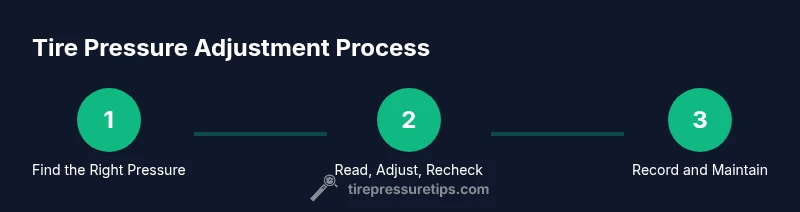
This overview helps you see where you’re headed before you start the detailed steps. You’ll locate the manufacturer’s recommended pressure, verify tires are cold, measure current pressure with a gauge, and adjust each tire to the specified level. Don’t forget to recheck after inflation and re-install valve caps.
Understanding TPMS and Readouts
Tire pressure monitoring systems (TPMS) provide a live indication of tire pressure, but they do not replace a physical gauge for precise readings. A TPMS warning often appears when a tire drops below the recommended level, or when sensor recalibration is required after a change. Use the TPMS alert as a prompt to check with a gauge, especially after seasonal shifts or after rotating tires. If readings differ significantly from the sticker value, you may need to calibrate TPMS or inspect for slow leaks, punctures, or valve stem issues. The Valve stem and sensor location are important to check during maintenance, and TPMS should be used in conjunction with a gauge for accuracy.
Authority Sources
For reliable guidance on how to adjust tire pressure, consult authoritative sources:
- https://www.nhtsa.gov/road-safety/tyres
- https://www.fueleconomy.gov/feg/maintainTirePressure.jsp
- https://www.consumerreports.org/automobile-t maintenance/tire-pressure-management/
These sources provide safety-focused, practical recommendations and emphasize using a gauge and manufacturer specs as the baseline for any adjustment.
Quick Tips for Consistent Maintenance
Establish a simple monthly routine to check tire pressure, especially with seasonal temperature changes. Always measure when tires are cold, use a reliable gauge, and compare against the vehicle’s sticker value. Keeping records helps identify slow leaks or gradual pressure loss due to weather or wear. Remember that TPMS can guide you, but a physical readout is your most accurate reference for adjusting tire pressure.
Tools & Materials
- Tire pressure gauge(Prefer digital or dial gauge for accuracy; calibrate periodically)
- Air pump or access to a compressor(Gas station compressor or portable unit with compatible nozzle)
- Vehicle owner’s manual or door jamb sticker(Location on driver’s door jamb or glove box; axle-specific values if provided)
- Clean cloth(Wipe valve stems and gauge ports to prevent dirt affecting readings)
- Notebook or digital log(Record readings, dates, and any changes over time)
Steps
Estimated time: 25-40 minutes
- 1
Find the correct tire pressure
Locate the recommended psi value for your vehicle from the door jamb sticker or owner's manual. Note whether the value differs by axle or tire type. Confirm if the figure applies to cold tires and remember any load-related adjustments.
Tip: Double-check if your model has different front and rear values; use axle-specific numbers if provided. - 2
Prepare the vehicle and tires
Park on level ground in a shaded area, turn off the engine, and engage the parking brake. Remove valve caps and inspect stems for damage or leaks. If you’ve driven recently, allow tires to cool for a while before measurement.
Tip: Cool tires read more accurately; avoid inflating while hot. - 3
Read current pressure with a gauge
Attach the gauge to each valve stem and read the pressure carefully. Record the value and compare it to the manufacturer’s specification. Repeat for all four tires (and the spare, if relevant for your setup).
Tip: Ensure a tight, straight seal between gauge and valve stem to avoid air loss during reading. - 4
Adjust to the recommended pressure
Inflate or deflate gradually to reach the target psi. Make small adjustments, then recheck with the gauge to confirm accuracy. If inflating, do it in short bursts and pause to read the gauge.
Tip: Avoid guessing; use incremental changes to hit the target precisely. - 5
Recheck all tires
After adjusting, recheck every tire to ensure uniformity and confirm the readings match the target for each axle. Don’t forget the spare if your vehicle uses one or carries a different load.
Tip: Even if one tire is off, normalize all four to the same reference when appropriate. - 6
Finalize and log readings
Reattach valve caps securely and record the final pressures with the date. Use a reminder to recheck regularly, especially with changing seasons or after long trips.
Tip: Keeping a log helps detect slow leaks or gradual changes over time. - 7
Observe TPMS after adjustment
If TPMS still shows warnings, recheck with the gauge or consult a professional. Remember, TPMS can guide you, but it isn’t a substitute for precise, gauge-based measurements.
Tip: If warning persists, there could be a sensor issue or a slow leak.
Frequently Asked Questions
Why is my TPMS light on after adjusting pressure?
TPMS can trigger when a tire drops below the target pressure or after recalibration. If you’ve adjusted pressure, recheck with a gauge to confirm the correct value. If readings remain inconsistent, there may be a leak or sensor issue.
TPMS can glow after adjustments if readings still fall outside the target. Recheck with a gauge; if problems persist, consider a tire leak check or sensor calibration.
Can I adjust tire pressure when the tires are hot?
It is best to measure and adjust tire pressure when the tires are cold. Hot tires can show artificially high readings due to air expansion, leading to underinflation after cooling.
Avoid adjusting hot tires; measure when cold to get an accurate reading.
How often should I check tire pressure?
Check tire pressure at least once a month and before long trips. Also recheck after seasonal temperature changes and following tire rotation or replacement.
Check monthly and before trips, especially after temperature shifts.
What if I can't reach the recommended pressure?
If you cannot reach the target PSI, inspect for slow leaks, valve issues, or damaged tires. Seek professional service if you suspect a leak or sensor problem.
If you can’t reach the target pressure, look for leaks or sensor issues and consult a professional.
Should I check the spare tire pressure as well?
Yes, check the spare or the tire you carry as a spare if your vehicle’s maintenance routine includes it. Spares can lose pressure over time just like regular tires.
Check the spare pressure; it’s part of a complete tire maintenance routine.
Watch Video
What to Remember
- Check cold tires before adjusting pressure.
- Use a reliable gauge for accuracy.
- Follow vehicle-specific PSI from the sticker/manual.
- TPMS supplements, not replaces, manual readings.
- Record readings and monitor seasonal changes.