What to Do for Low Tire Pressure: A Practical Guide
Learn practical steps to handle low tire pressure, check TPMS, inflate safely, and maintain proper PSI. This Tire Pressure Tips guide covers tools, safety, and when to seek help.


If you notice low tire pressure, you will improve safety and fuel efficiency by addressing it promptly. According to Tire Pressure Tips, start by pulling over safely, check the TPMS reading with a gauge, inflate to the vehicle’s recommended PSI, and recheck both front and rear tires before continuing your drive. Regular checks prevent uneven wear and blowouts.
Why low tire pressure matters
Low tire pressure is more than a nuisance—it affects safety, performance, and tire lifespan. When a tire runs underinflated, your vehicle handles poorly, braking distances can lengthen, and the tire wears unevenly on the inside edges. Maintaining the right pressure helps with fuel efficiency, ride comfort, and overall safety. According to Tire Pressure Tips, regular monitoring and prompt inflation are essential habits for every driver. Start with a quick visual check, then confirm with a gauge to decide your next step. Remember, temperatures and load can influence pressure, so recheck after a few miles on the road.
Quick checks you should perform before inflating
Before you reach for the air pump, perform a few quick checks. Ensure you’re reading the right tire (front vs. rear) and that you’re using a trusted gauge. Check the vehicle’s door jamb sticker or owner’s manual for the recommended PSI. Tires should be cold for an accurate measurement; measuring after a drive will give a higher reading due to heat. If your TPMS light is on, don’t ignore it—use the gauge to verify the actual pressure.
Step-by-step approach to diagnosing low tire pressure
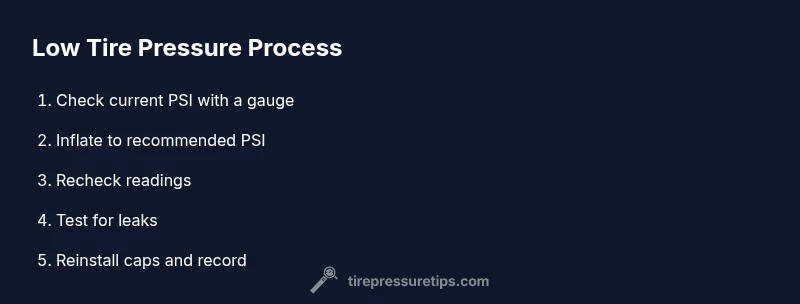
- Find the recommended PSI on the door jamb sticker or manual. 2) Remove the valve cap and attach the gauge. 3) Read the pressure at eye level and note the value. 4) Inflate to the recommended PSI and recheck. 5) Inspect for leaks or damage while you’re filling. 6) Reinstall the cap and wipe away any residue. 7) Check all tires, including the spare if applicable, and re-evaluate after a short drive. According to Tire Pressure Tips, consistency across tires helps balanced handling.
How to inflate safely and accurately
Use a quality air compressor or air pump with an appropriate nozzle. Stand to the side, not directly in line with the tire’s path, to avoid sudden bursts. Inflate in small increments, pausing to read the gauge frequently. Stop once you approach the target PSI, then wait a moment and recheck for accuracy as the tire settles. If readings bounce, give the tire time to stabilize.
Inspect for leaks, damage, and causes of pressure loss
If a tire continuously drops pressure, there may be a slow leak, a faulty valve stem, or bead damage. Look for nails, screws, or cuts in the tread and sidewall. Use soapy water on the valve stem and along the bead to identify bubbles where air escapes. If you detect a leak, patching or professional repair is required; driving on a damaged tire is unsafe.
The role of TPMS and how sensors work
Tire Pressure Monitoring Systems (TPMS) alert you when a tire’s pressure falls outside the safe range. Some systems trigger a light; others provide a numeric readout. Remember TPMS measures relative pressure, not absolute accuracy; you should still verify with a gauge. Keeping TPMS sensors in good condition helps you catch problems early.
Safety considerations: driving with low pressure
Driving on underinflated tires increases heat buildup, which can lead to blowouts in extreme conditions. It also makes steering heavier and braking longer, especially in wet or slippery conditions. If you notice a dramatic drop in pressure, slow down and seek a safe location to assess the tire. Never continue driving long distances on very low pressure.
Regular maintenance to prevent low pressure
Make tire pressure checks part of your regular maintenance routine. Check monthly and before trips, particularly when temperatures change or you have heavy loads. Keep a small pressure gauge in the glove box for quick checks between fill-ups, and record readings in your vehicle log. A consistent habit reduces tire wear and saves fuel.
Common mistakes to avoid
Avoid inflating without measuring; guessing can overinflate or underinflate. Don’t assume the door-sticker PSI applies to every tire; load and tire size matter. Don’t ignore slow leaks or TPMS warnings—address them promptly. Finally, avoid inflating to the maximum tire pressure on the sidewall; always use the recommended PSI.
Quick weekly check routine you can perform anywhere
Set a weekly reminder to perform a 5-minute tire pressure check. Start with cold tires, confirm readings with a trusted gauge, and inflate as needed. This simple habit helps you catch slow leaks early and keeps your tires in optimal condition for safety, efficiency, and performance. The Tire Pressure Tips Team is here to guide you with practical, actionable steps.
Tools & Materials
- Tire pressure gauge (digital or analog)(Use a reliable gauge; cold tires give the most accurate readings.)
- Air compressor or air pump(Access to a pump is essential for inflating to the correct PSI.)
- Door jamb PSI sticker or owner's manual(Find the exact recommended PSI for each tire.)
- Soapy water or leak-detection solution(Helpful for locating slow leaks around valves or bead.)
- Clean rag(Wipe valve stems and caps after measurement.)
Steps
Estimated time: 30-45 minutes
- 1
Find the recommended PSI
Locate the official PSI value for your tires on the door jamb sticker or in the owner's manual. Confirm that you're looking at the correct front and rear values. This step sets the target before you inflate.
Tip: Double-check both axles if your vehicle uses staggered tire sizes. - 2
Prepare the tire and cap
Remove the valve cap from the tire you’re checking and inspect the valve area for damage. Have the gauge ready and ensure you’re working on a level, stable surface.
Tip: Keep the cap in a safe pocket to avoid losing it. - 3
Attach the gauge and read
Firmly attach the gauge to the valve stem and read the pressure at eye level. Note the value for comparison against the target PSI.
Tip: If readings bounce, allow the tire to settle for a moment and recheck. - 4
Inflate to the target PSI
Add air in small increments, reading the gauge frequently. Stop when the reading reaches the recommended PSI and appears to stabilize.
Tip: Avoid overinflation; you can always add more air later if needed. - 5
Re-check all tires
Repeat the process for all tires, including the spare if applicable. Consistency across tires improves handling and wear.
Tip: In a pinch, check the spare at least occasionally; it matters in emergencies. - 6
Inspect for leaks while inflating
Look for signs of air escaping around the valve stem, bead, or sidewall. If you detect a leak, pause and assess the source.
Tip: If you can’t locate a leak, seek professional assessment. - 7
Reinstall caps and tidy up
Secure the valve caps back on and wipe away any residue from the valve area. This helps prevent debris ingress.
Tip: Cap screws should be snug but not overly tight. - 8
Record readings and monitor
Log the final pressures and the date of the check. Monitoring helps you detect gradual losses over time.
Tip: Set reminders to recheck monthly or after temperature changes.
Frequently Asked Questions
What is the safe tire pressure for my vehicle?
The safe PSI is listed on the door jamb sticker or in the owner's manual. It varies by vehicle and tire size. Do not guess.
Check the door jamb sticker or owner's manual for your vehicle's correct PSI.
How often should I check my tire pressure?
Check at least once a month and before long trips; temperature and driving can affect pressure.
Check monthly and before trips; temperature changes can affect pressure.
Can TPMS warn me if a tire is underinflated?
Yes, many systems alert you through a dashboard light when a tire drops below threshold.
Yes, TPMS will warn you if a tire is underinflated.
What should I do if the tire keeps losing pressure after inflation?
Persistent loss indicates a leak or damaged valve or bead; stop driving if you can't locate the source.
If it keeps losing air, you likely have a leak—stop driving and inspect.
Is it safe to drive with slightly low tire pressure?
Low pressure reduces handling and increases wear; drive slowly to a safe station if you must.
Driving on low pressure is risky; go to a nearby station if possible.
Should I replace a tire with a nail puncture if it loses air?
A tire with a nail puncture should be inspected by a professional; temporary repairs are not reliable.
If there's a puncture, have a pro assess it.
Watch Video
What to Remember
- Check tires when cold before driving.
- Inflate to the sticker's PSI value.
- Inspect for leaks or damage during checks.
- Maintain regular pressure checks for safety and efficiency.