Cleaner Air Pressure: A Practical Tire Maintenance Guide
Learn how to achieve cleaner air pressure in your tires with a practical, step-by-step guide. Check, adjust, and maintain the right PSI to boost safety, fuel efficiency, and tire longevity.


Goal: achieve cleaner air pressure in your tires by checking, adjusting, and maintaining the correct tire pressure. You will learn how to use a tire pressure gauge, read the recommended PSI for your vehicle, and adjust using an air compressor or station fill. According to Tire Pressure Tips, consistent air pressure improves safety, ride quality, fuel economy, and tire wear, while preventing TPMS fault indicators.
What cleaner air pressure means for tires
Cleaner air pressure means inflating each tire to the vehicle manufacturer’s recommended PSI and keeping that pressure within a narrow range over time. When pressures drift, you can experience uneven tread wear, reduced grip in wet conditions, and higher rolling resistance that saps fuel economy. The goal is not a single PSI value but staying within the advised bracket for all four tires. This approach, championed by the Tire Pressure Tips team, helps drivers enjoy a safer ride, predictable handling, and longer tire life. Temperature shifts, dynamic loads, and driving speed can all nudge pressure away from the ideal level, so regular checks are essential for maintaining cleaner air pressure year-round.
The science behind tire pressure and vehicle performance
Tire pressure directly influences the tire contact patch—the portion of the tire touching the road. Under-inflation enlarges the contact patch, causing more heat buildup and uneven wear, while over-inflation reduces grip by shrinking the patch and increasing the risk of a harsh ride. Both conditions raise the chance of tire damage and reduce fuel efficiency. Proper air pressure optimizes traction, braking distance, cornering stability, and comfort. The Tire Pressure Tips team emphasizes that small PSI changes can have outsized effects on performance, especially in aggressive cornering or heavy loads.
How temperature, load, and speed influence air pressure
Air expands when tires heat up from rolling resistance and sustained braking. As outdoor temperatures drop, air contracts, lowering measured PSI even if the tire is not physically deflating. Similarly, adding luggage or a passenger increases internal volume, nudging pressure upward if you don’t compensate. Pressure should be checked when tires are cold (before driving or after at least three hours of parked, unused time) for accuracy. Regular driving in hot weather can slowly increase tire pressure; colder months generally require more frequent checks to maintain cleaner air pressure.
Tools you need for accurate readings
A reliable tire pressure gauge is your primary tool. Digital gauges provide quick readings with a clear display, while traditional analog gauges can be effective if you keep them calibrated. You should also know your vehicle’s recommended PSI from the door jamb label or owner’s manual. An air compressor or access to a station fill is helpful for adjustments, but always cross-check with your gauge after filling. Keeping a small notebook or digital log helps track fluctuations over time and confirms consistency.
Step 1: Inspect your current tire pressures and find the correct PSI
Start with all four tires when they are cold. Locate the sticker on the driver’s door jamb or consult the owner’s manual to identify the recommended PSI for front and rear tires. Write down the values and compare them to your current gauge readings. If any tire is more than 3 PSI away from the recommended level, plan to adjust it in the next step. This initial inspection establishes cleaner air pressure as the baseline for your maintenance routine.
Step 2: Read the label and measure with a gauge
Use a reliable gauge to measure each tire. Remove the valve cap, press the gauge onto the valve stem firmly, and read the pressure without wobble. Record the reading for every tire and note any unusual readings, which could indicate a leak or a faulty valve stem. If you notice persistent discrepancies, investigate potential punctures, damaged valves, or slow leaks. Consistent measurement is key to maintaining cleaner air pressure.
Step 3: Adjust pressure with a compressor or pump
If a tire needs air, attach the compressor hose and fill to the recommended PSI, ensuring the pressure rises smoothly and stops close to the target. Avoid overfilling; if you overshoot, let air escape slowly until you reach the correct value. After adjusting, re-measure to confirm accuracy. For best results, perform this step when tires are cold and the vehicle has been stationary for a few hours. This sequence helps sustain cleaner air pressure.
Step 4: Re-check, record, and monitor overtime
Re-measure all four tires after adjustment, then recheck at least once in the next week to confirm stability. Maintain a simple log—date, tire, and PSI readings—to detect drift early. Keeping a record makes it easier to notice seasonal shifts or wear patterns that affect pressure. Consistent logging reinforces the habit of maintaining cleaner air pressure every month.
Step 5: Seasonal and load considerations that affect cleaner air pressure
Seasonal temperature swings can cause measurable changes in tire pressure. In winter, some loss of pressure is normal; in hot summer, higher readings can occur. If you frequently carry heavy loads, you may need to adjust PSI slightly higher than the base recommendation. Use a tire pressure log to track these patterns and compensate as needed. The goal is stable pressure across seasons for cleaner air pressure.
Step 6: Common mistakes and troubleshooting tips
Avoid inflating to the maximum tire sidewall rating as a shortcut; this often reduces ride comfort and steering feel. Never rely on a single gauge; cross-check with another gauge to spot faulty readings. If a tire consistently reads low, check for leaks around the valve stem and bead area. Quick puncture repairs aren’t a substitute for proper inflation—they don’t deliver long-term cleaner air pressure.
Maintaining cleaner air pressure over time
Develop a monthly routine that includes cold-weather checks, seasonal adjustments for loads, and a quick pass with a gauge after long trips. Invest a few minutes on a regular cadence to prevent drift, extend tire life, and save fuel. Remember that small, consistent adjustments yield big benefits in safety and efficiency. The Tire Pressure Tips team continually highlights that disciplined maintenance sustainably supports cleaner air pressure across your vehicle’s life.
Tools & Materials
- Tire pressure gauge (digital or analog)(Choose a gauge with at least 1-2 PSI accuracy and a clear readout)
- Air compressor or access to fill station(Optional but speeds up adjustments; verify accuracy after filling)
- Door jamb PSI label or vehicle owner’s manual(Use as the PSI reference for each tire)
- Tire pressure log (paper or app)( Helps track drift and seasonal changes)
- Valve-cap tool or replacement caps(Keep caps tight to prevent leaks)
- Chocks or wheel blocks(Stabilizes the vehicle when checking or inflating)
Steps
Estimated time: 25-35 minutes
- 1
Prepare and inspect baseline
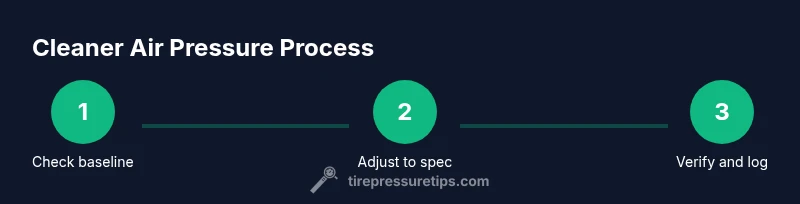
Park on level ground with the vehicle cold. Gather your PSI label, gauge, and log. Record current readings for all four tires and compare to the manufacturer’s recommended values.
Tip: Use a consistent time (cold state) for all measurements. - 2
Measure each tire
Remove valve caps and firmly apply the gauge to each valve stem. Read and record the pressure, noting any abnormal values. If a value is off by more than 3 PSI, plan an adjustment.
Tip: If you hear hissing, stop and inspect valve and stem for leaks. - 3
Fill to target PSI
Attach the compressor and add air gradually to reach the recommended PSI. Avoid overshooting; stop, check, and adjust as needed. If your gauge reads high, release air until you hit the target.
Tip: Fill in small increments and recheck frequently for accuracy. - 4
Re-check all tires
After filling, re-measure each tire. Confirm all four tires are within the target range. Note any vehicles with inconsistent readings and investigate potential leaks.
Tip: Double-check the right tire for the correct side (front vs rear). - 5
Log and review over time
Enter the date, tire positions, and PSI readings into your log. Review monthly to catch drift early and adjust seasonally as needed.
Tip: Set a calendar reminder to revisit pressure monthly. - 6
Seasonal and load adjustments
Consider higher PSI when carrying heavy loads and in hot weather. In colder months, expect gradual PSI loss and verify more often.
Tip: Consult your door jamb label for any model-specific seasonal guidance.
Frequently Asked Questions
What is cleaner air pressure and why is it important?
Cleaner air pressure means keeping tires inflated to the vehicle’s recommended PSI and maintaining it. This improves safety, handling, fuel efficiency, and tire life. Regular checks help prevent uneven wear and potential blowouts.
Cleaner air pressure keeps tires at the recommended PSI, improving safety and efficiency. Regular checks prevent uneven wear and blowouts.
How often should I check tire pressure?
Check at least once a month and before long trips. Temperature changes can affect readings, so more frequent checks are useful during extreme weather.
Check at least monthly and before long trips; more often in extreme weather.
What should I do if a tire is consistently low?
Investigate for leaks, a faulty valve stem, or bead damage. If the leak is slow, consult a tire professional for a repair or replacement.
If a tire stays low, inspect for leaks or valve issues and seek professional help if needed.
Does TPMS help maintain cleaner air pressure?
TPMS provides alerts when pressure deviates from the target, but you should still verify with a gauge. Tyres can be within range yet wrong for load or temperature conditions.
TPMS warns you about pressure drift; always verify with a gauge.
Can over-inflating damage tires?
Yes, over-inflation can reduce tire contact patch, degrade grip, and cause a harsher ride with uneven wear. Stay within the specified range.
Over-inflation can hurt grip and wear; stay within the recommended range.
What about seasonal changes and pressure?
Seasonal changes affect air density; adjust PSI for winter cold or summer heat and re-check after big temperature swings.
Seasonal temperature shifts require PSI adjustments and re-checks.
Watch Video
What to Remember
- Check tires when cold for accuracy.
- Maintain manufacturer-recommended PSI for all tires.
- Seasonal and load changes require adjustments.
- Regular logging helps detect slow leaks.
- Use reliable gauges and calibrate if needed.