Air Gauge Tire Pressure: A Practical Guide to Accurate Readings
Learn how to accurately check air gauge tire pressure, understand PSI, and maintain your tires for safety, fuel efficiency, and longevity with step-by-step guidance and practical tips.


With an air gauge, you will accurately read each tire's pressure and compare it to your vehicle's recommended PSI. This how-to explains how to choose the right gauge, measure when tires are cold, and adjust tire pressure safely for fuel efficiency and grip. Understanding these steps helps prevent flats, uneven wear, and poor handling. By following our guidance, you also protect your TPMS readings and prolong tire life.
Why air gauge tire pressure matters
According to Tire Pressure Tips, maintaining correct air gauge tire pressure is essential for safety, fuel efficiency, and tire longevity. When tires run at the recommended PSI, you get optimal grip, shorter stopping distances, and uniform wear across the tread. An accurate air gauge helps you verify these numbers on each tire, preventing underinflation or overinflation that can compromise handling. This section also clarifies how cold readings differ from warm readings and why a precise gauge reduces guesswork in everyday maintenance. The Tire Pressure Tips team emphasizes that relying on TPMS alone is not enough; actual tire pressure must be confirmed with a gauge to ensure accuracy, especially when you travel with heavy loads or in temperature extremes.
Understanding PSI and how readings change
Pounds per square inch (PSI) is the common unit used to measure tire pressure. A few key points help you interpret gauges correctly: (1) PSI targets come from your vehicle's door jamb sticker or owner's manual, (2) readings should be taken when tires are cold for accuracy, and (3) gauge accuracy can drift over time. Different gauges display PSI in slightly different formats, so you should learn how your specific tool presents numbers. Always record the baseline readings and compare them against the recommended value to decide whether to inflate or deflate. This reduces the risk of uneven tread wear and compensates for small gauge variances.
Types of air gauges: dial vs digital
Air gauges come in dial and digital varieties, each with pros and cons. Dial gauges provide a quick visual cue and are often cheaper, but their precision depends on your line-of-sight and dial readability. Digital gauges display exact numbers and can be easier to read in low-light conditions, but they rely on batteries. For most daily drivers, a reliable digital gauge is ideal for clear readings, while a traditional dial gauge remains a dependable backup. Regardless of type, ensure the gauge reads in PSI and calibrate it if you notice discrepancies across multiple tires.
How to perform a tire pressure check using an air gauge
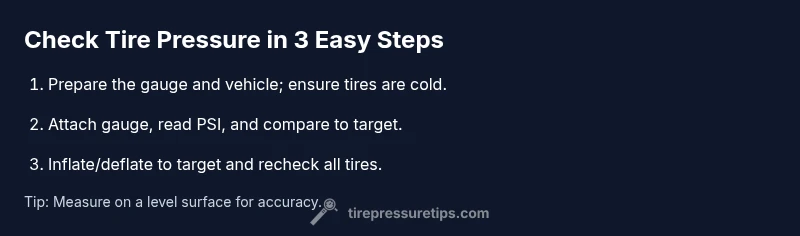
A thorough check involves several deliberate steps: prepare the vehicle, locate the correct PSI, remove valve caps, attach the gauge, take a reading, adjust as needed, and recheck. This narrative explains what to look for during attachment, how long to wait after inflation to obtain an accurate reading, and how to interpret a borderline reading. By keeping a small log, you can track changes over time and catch slow leaks early, which contributes to safer driving and better fuel economy.
Interpreting readings with TPMS and vehicle recommendations
TPMS provides a helpful alert, but it doesn’t always reflect the exact tire pressure on each wheel. Tire Pressure Tips analysis shows that relying solely on TPMS can lead to complacency or missed underinflation. Use the gauge to confirm the actual pressure and compare it to the door sticker. If one tire is consistently low or high, inspect for leaks, punctures, or valve stem damage. Adjust all tires to the recommended PSI, accounting for load and seasonal temperature changes, to maintain balanced handling and extended tire life.
Common mistakes to avoid
Common errors include checking after driving, which raises readings due to heat; ignoring variation between tires, which masks uneven wear; using an inaccurate gauge, which gives false numbers; and inflating to a rough feel instead of a precise target. Another frequent pitfall is not rechecking after inflation, or not costing in temperature effects when evaluating PSI. Avoid these by measuring cold tires, using the same gauge consistently, and confirming numbers with a second reading.
Maintenance tips to keep readings accurate
Keep gauges calibrated by testing them with a known reference pressure and replacing batteries in digital models before they fail. Store gauges in a dry, protected area to prevent corrosion or damage. Check tire pressures at least once a month and before long trips, especially when the weather changes. Proper inflation protects fuel economy, reduces tire wear, and improves overall vehicle handling.
When to adjust tire pressure for weather and load
Colder weather lowers tire pressure, while hot weather or heavy loads push pressure up. If you drive in winter, check tires more frequently and consider inflating slightly based on your manufacturer’s guidance. On a fully loaded vehicle, adjust pressure according to the load distribution indicated by your manual. Consistent, condition-aware adjustments help you maintain optimal contact patch and traction on varying road surfaces.
Quick comparison: gauge types and when to use them
Digital gauges provide quick, precise readings and are great for on-the-go checks. Dial gauges are simple, robust, and affordable, often preferred by DIY enthusiasts. For most drivers, a reliable digital gauge is the best all-around option, with a spare dial gauge as a backup. Whichever you choose, ensure it is in good condition and that you read the numbers at eye level for accuracy.
Tools & Materials
- Air gauge (dial or digital)(Choose a gauge that reads in psi and has a clear dial or digital readout)
- Vehicle's recommended tire pressure (PSI)(Find this on the door jamb sticker or owner's manual)
- Valve caps(Keep caps on after readings to prevent leaks)
- Chalk or marker(Useful for marking which tire is low during multiple checks)
- Level surface and cold tires(Park on a flat surface and ensure tires have not been driven recently)
Steps
Estimated time: 10-15 minutes
- 1
Prepare and locate PSI target
Park on a level surface and confirm the recommended PSI from the owner’s manual or door sticker. This gives you the target to aim for during inflation or deflation.
Tip: Check all four tires for a balanced setup; do not rely on a single reading. - 2
Remove valve cap and inspect
Unscrew the valve cap and inspect the valve stem for damage or corrosion. Place the cap in a safe spot to avoid losing it.
Tip: If the valve cap is damaged, replace it before inflating. - 3
Attach gauge and read
Place the gauge on the valve stem firmly and straight, then read the number without wobbling. Note the reading for each tire.
Tip: Take a second reading to confirm accuracy before inflating or deflating. - 4
Inflate or deflate to target PSI
If readings are low, inflate to the recommended PSI; if too high, release air gradually until you reach the target.
Tip: Inflate in small increments and recheck after each adjustment. - 5
Recheck all tires
After adjusting, recheck every tire to confirm consistency and ensure no leak occurred during the process.
Tip: Recheck after both cold and warm conditions if possible for comparison. - 6
Record and seal
Record the final readings for future reference and replace valve caps securely.
Tip: Note any tires that require more frequent attention due to leaks.
Frequently Asked Questions
Why should I check tire pressure when tires are cold?
Cold tires provide the most accurate reading because heat from driving increases tire pressure. Checking after driving can lead to overinflation readings that do not reflect normal operating conditions.
Check tires when they're cold to get an accurate pressure reading for safe inflation.
What is the difference between a dial gauge and a digital gauge?
Dial gauges are reliable and inexpensive but can be harder to read precisely. Digital gauges are easy to read and often more precise, especially in low light, but require batteries and occasional calibration.
Dial gauges are simple and robust; digital gauges are easier to read and more precise.
How often should I check tire pressure?
Check at least once a month and before long trips. More frequent checks are wise when temperatures swing, after adding or removing loads, or when TPMS alerts.
Check at least monthly and before long trips.
What should I do if the TPMS warns about low pressure?
Trust the TPMS as a warning signal but verify with a gauge. Small leaks can trigger the warning; confirm the actual pressure and inflate to the correct PSI if needed.
If TPMS warns low pressure, verify with a gauge and adjust as needed.
Can overinflating tires cause damage?
Yes. Overinflated tires wear more in the center tread and can reduce grip in certain conditions. Inflate to the manufacturer’s PSI target and recheck regularly.
Overinflation can cause uneven wear and worse grip; stay near the recommended PSI.
Does air pressure vary with temperature?
Yes. Colder temperatures lower tire pressure and heat raises it. Adjustments may be needed with seasonal changes to maintain the target PSI.
Temperature changes affect tire pressure; monitor and adjust accordingly.
Watch Video
What to Remember
- Check cold tires first to avoid heat-inflation bias
- Use a reliable air gauge and stick to the target PSI
- Inflate/deflate in small increments and recheck
- Record readings for future reference
- Temperature and load affect tire pressure and readings