Are Air Pressure: Practical Tire Maintenance Guide
Learn how to check tire pressure, interpret readings, and adjust to vehicle specs, including TPMS and temperature effects. A practical, easy-to-follow guide by Tire Pressure Tips for safer driving and better tire life.


You will learn how to check tire pressure, interpret readings, and adjust to your vehicle’s specifications, including TPMS considerations and temperature effects. This quick guide covers essential tools, safe inflation practices, and common mistakes to avoid so you can maintain correct air pressure for safety, efficiency, and longer tire life.
Are air pressure basics
Understanding tire pressure starts with the question of what are air pressure and how it relates to tire performance. Tire pressure refers to the amount of air inside the tire, typically expressed in psi, kPa, or bar. The key is that what you read on a gauge is the tire’s internal pressure at the moment of measurement, not the surrounding air pressure. The Tire Pressure Tips team emphasizes that accurate readings hinge on checking tires when they are cold and using a reliable gauge. Are air pressure values the same for every vehicle? Not at all. They vary by vehicle, tire size, load, and temperature. This section lays the groundwork for practical checks and explains why correct air pressure matters for grip, rolling resistance, and tire longevity.
How air pressure affects tire wear, fuel economy, handling
Maintaining proper tire pressure directly influences the size and shape of the tire’s contact patch with the road. When tires are underinflated, more of the tire’s surface is squeezed onto the road, causing uneven wear on the tread shoulders and higher rolling resistance. Overinflation reduces the contact patch, which can shorten tread life and worsen ride comfort. Correct air pressure also optimizes fuel economy by reducing rolling resistance and improving braking response. In dry and wet conditions, consistent pressures help maintain predictable handling, steering response, and cornering stability. The goal is to keep all tires within the manufacturer-recommended range as posted on the door placard or in the owner's manual.
Temperature changes and tire pressure
Temperature plays a critical role in tire pressure. As air cools, its molecules contract, and tire pressure drops; as it heats up, pressure rises. For most passenger tires, a drop of a few psi can occur with a 20–30 degree Fahrenheit temperature change. Because tires heat up from driving, it’s important to check pressure when the tires are cold, typically before a trip or after the car has sat for several hours. If you must inflate before a trip in the morning, account for the expected rise in pressure after driving a short distance and recheck once cool. This understanding helps you avoid chasing inaccurate readings and prevents unsafe inflation.
Tools and methods for checking pressure
To check tire pressure accurately, you’ll need a reliable gauge, such as a digital or analog tire pressure gauge, and access to an air source. Start with clean, dry valves and remove the valve cap to expose the valve stem. If you’re inflating, use a compressor with a gauge to add air in small increments and recheck frequently. For best results, check all tires, including the spare if you plan an extended trip. Record readings to track changes over time and factor in temperature when comparing against the recommended range.
Reading PSI, kPa, and target ranges
Tire pressures are commonly shown in psi in the United States and in kPa or bar in other regions. If your gauge shows a different unit than your vehicle’s specification, convert carefully or use a gauge that displays multiple units. The target range is not a single number for all tires; it is the range printed on the door placard or in the owner’s manual, which accounts for vehicle weight, axle load, and intended use. Always aim to inflate within that range, not to exceed it, unless the tire’s load and speed rating require it. Remember that readings can vary slightly between gauges, so using the same gauge consistently helps you track changes reliably.
Vehicle-specific pressures and TPMS interactions
Many modern vehicles use TPMS to alert you when a tire is underinflated. TPMS shows a warning when pressure falls below a threshold that varies by vehicle. It’s essential to know that TPMS is a safety alert, not a precise measurement tool; always verify with a gauge. Some vehicles require resetting the TPMS after inflating or rotating tires. Always consult the owner’s manual for specific reset procedures and keep the placard values handy for quick checks before long trips.
Safe inflation practices and common mistakes
Avoid inflating beyond the tire’s maximum rated pressure printed on the sidewall. Do not rely solely on a gauge reading while the tires are hot, since driving heats tires and raises pressure. When inflating, start from the low end of the recommended range and add air in small increments, rechecking after each adjustment. A common mistake is inflating to match the number seen on a gauge without considering the vehicle’s recommended range, which can lead to over- or underinflation. Always compare readings to the manufacturer’s spec and adjust all tires evenly.
Creating a simple weekly maintenance routine
A practical approach is to perform a quick tire pressure check once a month and before any long trip. Start with the tires cold, record each tire’s pressure, and compare with the placard. If you notice a drop of more than 1–2 psi across two adjacent tires, investigate potential leaks or punctures. Keep a compact gauge in the glovebox so you can verify readings on the road if you suspect an issue. Integrating this routine into your driving habits reduces risk of blowouts, improves fuel economy, and extends tire life.
TPMS and tire pressure maintenance
TPMS is a valuable helper but does not replace hands-on measurement. Use a gauge to confirm TPMS readings and address any discrepancies by inflating to the target range and performing a recheck after the tires cool. If a TPMS warning persists after inflating, there may be a sensor problem or a slow leak that requires professional inspection. Regular maintenance of TPMS sensors, including battery checks where applicable, helps ensure reliable alerts and safer driving.
Practical scenarios and quick tips
Before a winter road trip, check tire pressures more frequently as temperature fluctuations can change readings. Always keep your spare tire at the recommended pressure and verify its condition during routine checks. If you notice significant pressure loss after a puncture or nail, replace or repair promptly. Quick tips include using the same gauge for all checks, avoiding overfilling, and documenting readings to notice gradual changes over time.
Tools & Materials
- Tire pressure gauge (digital or analog)(Ensure calibration is recent; check at least once a year or after long storage.)
- Air compressor or access to an air pump(Prefer a compressor with a built-in gauge; inflate in small increments.)
- Vehicle owner's manual or door placard(Use the recommended psi values listed by the manufacturer.)
- Valve cap removal tool (optional)(Helpful if you frequently remove caps for cleaning or testing.)
- Notepad or mobile device for logging(Track readings over time to observe trends and leaks.)
Steps
Estimated time: 30-45 minutes
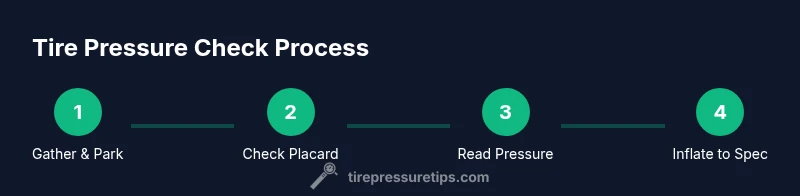
- 1
Gather gear and park safely
Pull over on a flat, level surface away from traffic. Gather your gauge, air source, and placard. Ensure the engine is off and the tires are cold before starting; this prevents readings from being skewed by recent driving heat.
Tip: Engage the parking brake and place chocks behind the wheels if you’re inflating on a slope. - 2
Find the target pressure
Locate the recommended tire pressure on the driver door placard or the owner's manual. Note the front and rear values; some vehicles have different pressures for each axle. Record the values for reference while you work.
Tip: If your vehicle uses a load-based spec, inflate to the value for your typical load. - 3
Remove valve caps and prepare the gauge
Take off the valve caps and keep them in a safe place. Attach your gauge to the valve stem, ensuring a snug seal to prevent air leakage during measurement. If using a gauge with multiple units, select psi for consistency with the placard.
Tip: Make sure the valve stem is clean and dry for an accurate seal. - 4
Take the measurement
Read the gauge once firmly attached and note the value for each tire. Repeat on all four tires (and the spare) to establish a baseline. If any reading seems off, recheck with the same gauge to confirm.
Tip: Take multiple readings on each tire to confirm accuracy. - 5
Inflate or deflate to the target range
Compare readings to the recommended range. Inflate in small increments or deflate as needed, rechecking after each adjustment. Avoid inflating to the maximum value unless the placard requires it for specific conditions.
Tip: Inflate until all tires are within the specified range, not just close to one value. - 6
Recheck after tires cool
If you inflated while cold, recheck after the tires cool down again to verify the final pressure. If you inflated hot, recheck when the tires are cold to avoid over-inflation readings.
Tip: Record the final numbers for future reference. - 7
Replace caps and store data
Replace the valve caps to keep debris out of the stems. Log the readings in your log or app so you can monitor changes over time and identify potential leaks.
Tip: Keep your gauge in the glovebox for quick checks before long trips. - 8
Check the TPMS status
If a TPMS warning appears, verify with a gauge first. If readings are within spec and the light remains on, there may be a sensor fault or a leak that needs professional inspection.
Tip: Refer to the owner’s manual for TPMS reset steps if needed.
Frequently Asked Questions
Why is tire pressure important for safety and efficiency?
Proper tire pressure improves grip, braking, fuel economy, and tire wear. Underinflation increases heat buildup and reduces control, while overinflation can lead to a harsher ride and uneven wear. Regular checks help maintain optimal performance.
Proper tire pressure improves safety and efficiency by improving grip and fuel economy. Regular checks help prevent under- or overinflation issues that affect handling.
What is the difference between a TPMS warning and an exact pressure reading?
TPMS provides a warning when a tire is below a threshold but does not reveal the exact pressure. Always verify with a physical gauge to confirm the precise pressure and adjust accordingly.
TPMS gives a warning, but you should measure with a gauge to know the exact pressure and adjust as needed.
How often should I check tire pressure?
Check tire pressure monthly and before long trips. Also check after significant temperature changes or if you notice a change in handling or fuel economy.
Check your tires monthly and before long trips; also check after weather changes or any changes in how the car feels.
Can I overinflate a tire to fix a low reading?
No. Overinflating beyond the recommended range can cause uneven wear and reduce traction. Inflate only to the vehicle's specified range and recheck after the tires cool.
No, you should not overinflate. Always stay within the recommended range and recheck when cool.
How does temperature affect tire pressure in daily use?
Temperature changes affect air density and tire pressure. Colder conditions typically lower readings; warmer days raise them. Check pressures when tires are cold and adjust expectations for seasonal shifts.
Temperature changes can raise or lower tire pressure; check when cold and adjust for seasonal changes.
What should I do if a TPMS sensor seems faulty?
If a TPMS warning persists after confirming correct pressures, have the sensor system inspected by a professional. Sensor faults can trigger false warnings or fail to alert you when needed.
If TPMS seems faulty, get a professional check to confirm sensor health and system accuracy.
What to Remember
- Check tires regularly and before long trips.
- Use manufacturer-specified pressures from the placard.
- Account for temperature when checking or inflating.
- TPMS aids safety but does not replace direct measurements.
- Maintain uniform pressures across axles for balanced handling.