Air Pressure for Car Tires: A Practical How-To Guide
Practical guide to air pressure for car tires: find the right PSI, measure accurately, understand temperature effects, and maintain safe, fuel-efficient tire inflation with a step-by-step approach.


You will learn how to check air pressure for car tires, interpret PSI values from door jamb placards and TPMS, and adjust pressure across loads and temperatures. You'll also discover common mistakes and tools needed to keep tires properly inflated for safety, fuel efficiency, and even tread wear.
What is air pressure for car tires and why it matters
Air pressure for car tires is the internal force that keeps the tire's shape under load and helps transmit power to the road. Proper air pressure improves handling, braking, and comfort. According to Tire Pressure Tips, correct air pressure also protects tire tread from uneven wear and can boost fuel efficiency. When pressure is too low, the tire flexes more, generating heat and wearing the edges; when too high, the center wears faster and traction can feel loose in wet conditions. Most drivers can locate the recommended PSI on the driver's door jamb placard or in the owner's manual; if unsure, use the vehicle’s current tire size and load as a guide. This sets the groundwork for why air pressure for car tires matters for safety and performance. In this guide you’ll learn how to find the right PSI, how to measure it, and how to adjust pressure consistently to keep your tires performing their best.
How to find the correct PSI for your vehicle
Each vehicle has an official tire pressure specification called the recommended cold PSI. Start by checking the placard on the driver's door jamb, the glove box, or the fuel filler cap; the numbers indicate the front and rear tire pressures for cold tires. The same values often appear in the owner's manual. If you drive with different tire sizes or a heavy load, the recommended PSI may shift; in that case use the chart in the manual. Do not inflate to the maximum PSI printed on the tire sidewall; that's the maximum safe pressure the tire can hold when fully loaded, not a target for daily inflation. For many cars, the recommended cold PSI sits in a comfortable range around typical passenger-car pressures, but exact numbers vary. Remember: tire pressure is dynamic—temperature, load, and driving distance affect it. Always check when the tires are cold, ideally before a drive of more than a couple of miles.
Temperature and seasonal effects on air pressure
Air pressure for car tires changes with temperature as air expands with heat and contracts in cold conditions. In practice, you’ll notice lower readings on cool mornings and higher readings after a long drive in the heat. The key takeaway is to check tire pressure when tires are cold and use this value as your baseline. Temperature can cause fluctuations even within a single day, so consider checking before a trip or after the vehicle has cooled for at least three hours. By understanding this effect, you can avoid misinterpreting readings and keep air pressure for car tires consistent across seasons.
Tools and methods to check tire pressure
A reliable tire pressure gauge is essential. Digital gauges are quick and easy to read, while analog gauges give a tactile, budget-friendly option. An in-tube or standalone air compressor lets you adjust pressure without visiting a service station. Always use a calibrated gauge and verify the exact readings against the placard. When checking, ensure the engine is off and the tires are cold for accuracy. Also have a clean valve stem and no leaks in the valve core. A notebook or smartphone helps log readings over time, which can reveal gradual pressure loss or a failing TPMS sensor.
Quick checklist for inspection and inflation
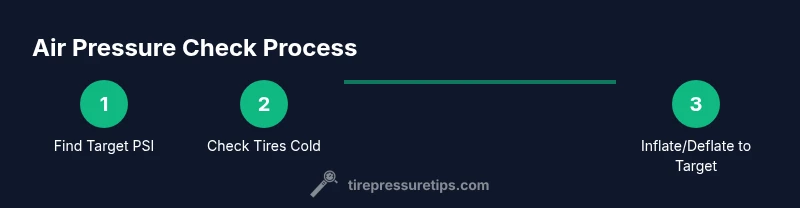
- Find the target PSI on the placard or manual for cold tires.
- Wait until tires are cold (no driving for at least three hours).
- Remove the valve cap and attach a gauge firmly.
- Read the pressure and compare with the target; if low, add air in small increments.
- Recheck after inflation and replace the valve cap firmly.
- Do not exceed the recommended PSI; avoid inflating to the tire sidewall maximum.
- Check all four tires and the spare if present, ensuring uniform pressure.
Common mistakes to avoid when inflating tires
- Inflating while tires are hot, which gives falsely high readings.
- Ignoring the placard in favor of a single “max PSI” from the tire sidewall.
- Using damaged or inaccurate gauges that give inconsistent results.
- Over-inflating due to aiming for a higher number without considering load or season.
- Neglecting the spare tire; pressure in the spare matters for emergencies and safe handling.
TPMS: warnings and sensors basics
Tire Pressure Monitoring System (TPMS) provides alerts when pressure falls below or rises above a threshold. While TPMS is a valuable safety feature, it should complement, not replace, manual checks with a gauge. If TPMS readings diverge from your gauge readings, inspect the sensors, valves, and seals for leaks or malfunction. In some cases, recalibration or sensor replacement may be necessary to restore accurate feedback and ensure reliable indications for air pressure for car tires.
Real-world impacts: safety, fuel economy, and tire wear
Maintaining correct air pressure for car tires reduces the risk of blowouts and improves braking response. Proper inflation also contributes to smoother handling and predictable steering. Fuel economy benefits come from less rolling resistance and even tread wear, which prolongs tire life. Conversely, underinflation causes uneven wear on the edges, reduces fuel efficiency, and can heat the tire, increasing the chance of failure. Overinflation can lead to a harsher ride and uneven wear on the center of the tread. By consistently checking and adjusting, you maximize safety, efficiency, and tire longevity.
Regular maintenance habits for ongoing accuracy
Make tire pressure checks part of your regular maintenance routine. A quick weekly glance can catch slow leaks, valve cap loss, or a failing TPMS sensor. Pair pressure checks with seasonal tire rotation and tread inspection to ensure all tires wear evenly. Keeping the air pressure for car tires within the recommended range also helps maintain handling characteristics and braking performance across road conditions. If you drive a vehicle with variable load, recheck PSI after carrying a heavy cargo or towing, and adjust accordingly to preserve safety and performance.
Tools & Materials
- Tire pressure gauge(Choose a gauge with a 0-60 psi range; digital or analog is fine.)
- Air compressor or inflator(Prefer one with a built-in gauge; ensure it can reach target PSI.)
- Owner's manual or door jamb placard(Use as the definitive source for target PSI values.)
- Valve cap and valve-core tool(Keep caps on to prevent leaks; carry a spare core if available.)
- Notebook or digital log(Record readings to track pressure changes over time.)
Steps
Estimated time: 30-45 minutes
- 1
Identify target PSI for each tire
Locate the recommended cold PSI on the door jamb placard or in the owner's manual for your vehicle and tire size. Note separate values for front and rear tires if listed.
Tip: Always start with cold tires before taking readings. - 2
Prepare the vehicle and tools
Park on a level surface, apply the parking brake, and gather your gauge, inflator, and log. Ensure the tires are not hot from recent driving.
Tip: If you must drive to the gas station, read the pressure after the tires cool down for the most accurate result. - 3
Remove the valve cap and attach gauge
Unscrew the valve cap and press the gauge onto the valve stem firmly to get a reading. Remove the gauge straight away to avoid losing air.
Tip: Check all four tires and the spare if your vehicle uses one. - 4
Read current pressure
Note the pressure shown on the gauge. Compare it to the target PSI; if the measurement is off, plan inflation or deflation accordingly.
Tip: Take readings from all tires to ensure even pressure across the axle. - 5
Inflate or deflate to target
If underinflated, add air in small increments; if overinflated, release air until you reach the target, then recheck.
Tip: Make adjustments in small steps; avoid overshooting the target PSI. - 6
Recheck after adjustment
Re-measure all tires to confirm accuracy. Tighten valve caps and store your tools.
Tip: Check tires again after a short drive to confirm stabilization. - 7
Document and monitor
Record the final PSI readings for future reference. Note any recurring changes that might indicate leaks.
Tip: Set a monthly reminder to recheck pressure. - 8
Check the spare tire
Ensure the spare is inflated to its recommended pressure as a readiness step for emergencies.
Tip: Don’t neglect the spare; a ready spare matters in a pinch.
Frequently Asked Questions
How often should I check tire pressure?
Check tire pressure at least once a month and before long trips. Also recheck after seasonal temperature changes or significant load shifts.
Check monthly and before long trips, and after big temperature changes or loads.
Can TPMS readings be wrong?
Yes, TPMS sensors can be faulty or miscalibrated. Always verify with a handheld gauge and inspect sensors if readings don’t match.
TPMS can err; verify with a gauge and inspect sensors if readings don’t match.
Is it safe to inflate to the max PSI on the tire sidewall?
No. The maximum printed on the sidewall is the limit for safety under load, not the target for regular inflation.
No, don’t inflate to the sidewall max; use the placard value.
Does temperature affect tire pressure?
Yes. Cooler temperatures lower pressure and hotter temperatures raise it. Check readings when tires are cold and adjust as seasons change.
Temperature affects PSI; check when tires are cold and adjust for seasons.
What about the spare tire?
Keep the spare inflated to its recommended pressure and check it periodically as part of routine maintenance.
Keep the spare in good pressure too and check it regularly.
Watch Video
What to Remember
- Check tire pressure when tires are cold.
- Use placard/manual values to set target PSI.
- Rely on TPMS as a guide, not the sole source.
- The Tire Pressure Tips team recommends logging readings for trends.