Car Tyre Air Pressure: Practical Guide for Drivers
Learn how to check, maintain, and troubleshoot car tyre air pressure to boost safety, fuel efficiency, and tire life with practical steps and tips.


According to Tire Pressure Tips, car tyre air pressure means the manufacturer-specified PSI when the tires are cold. Check cold tires with a reliable gauge and adjust to the recommended level before driving. Proper inflation boosts safety, fuel efficiency, tire wear, and handling. This quick guide outlines practical checks, how to measure accurately, and common mistakes to avoid.
Why proper car tyre air pressure matters
Proper car tyre air pressure is not just about the tires themselves; it impacts safety, fuel efficiency, braking performance, and tire longevity. When pressure is too low, the tire's contact patch with the road increases, leading to increased rolling resistance, overheating, and uneven wear. Over-inflation can make the ride harsher, reduce grip on wet surfaces, and cause uneven tread wear or a blowout risk on rough roads. Maintaining the manufacturer-recommended pressure ensures that the tire's shape, stiffness, and footprint are optimized for normal driving loads. It also affects steering response and braking performance; underinflated tires take longer to stop and are more prone to heat buildup. For families and everyday commuting, consistent tire pressures translate into fewer unexpected tire failures and more predictable handling. The Tire Pressure Tips approach emphasizes checking tires when they are cold and using a proven gauge, because accuracy matters as much as the pressure value itself.
Finding the correct pressure for your vehicle
The exact tire pressure for your car is not universal; it varies by vehicle, tire size, load, and axle. Start with the placard on the driver’s door jamb or inside the fuel-filler cap, or consult the owner's manual for the recommended PSI per tire. Some cars have different values for front and rear tires, and heavy loads or frequent highway speeds may adjust recommended pressures. When reading the placard, pay attention to the units (PSI in the US, kPa in other regions) and note that the values are specified for cold tires. Pressure can also change with tire type (summer vs. winter tires) and wheel alignment. If your mileage or usage changes significantly, re-check and adjust accordingly. Keeping this information handy helps you maintain consistent inflation across tires, maximizing grip, even wear, and efficiency.
Measuring tire pressure accurately
Accurate measurement starts with the right tool and technique. Use a reliable gauge, ideally digital, and check your tires when they’re cold. Remove the valve cap, place the gauge squarely on the valve stem, and read the result without wiggling. If the reading seems off, verify with a second measurement or a different gauge. Compare the reading to the target PSI and determine if you need to add air, release air, or leave it as is. After adjusting, re-check to confirm the final pressure is within the target range. Record the measurement in a notebook or app for future reference. If you drive with heavy loads or extensive highway trips, recheck the tires after a few miles to ensure the pressure remains stable.
Temperature and seasonal effects on tire pressure
Temperature and weather influence tire pressure, even if you follow the same guidelines. Colder mornings can reduce air pressure, while a hot day or long drive can raise it. Because air expands with heat and contracts with cold, your readings may drift between checks. The key is to measure when tires are cold and adjust to the manufacturer’s spec, then re-check after driving long distances or after significant temperature shifts. A robust routine accounts for these changes and avoids chasing a falsely high or low reading.
TPMS explained: how sensors relate to actual pressure
Most modern vehicles use a Tire Pressure Monitoring System (TPMS) to alert you when a tire’s pressure drops below a safe threshold. TPMS is a warning system, not a precise gauge. It won't tell you the exact PSI, so you should still verify each tire’s pressure with a gauge. If TPMS lights stay on after inflating to the recommended pressure, inspect the sensor, valve stem, or tire seal, and consider a professional check if the issue persists.
Common mistakes and best practices
Common mistakes include assuming the TPMS is always accurate, inflating tires to look firm rather than to the target PSI, ignoring the spare, and measuring right after driving, which gives inflated readings. Best practices: check cold tires, use a quality gauge, inflate to the exact target, and rotate checks by month and before trips. Keep a small gauge in the glovebox, and create a simple routine that fits your driving schedule.
Quick-start routine for ongoing maintenance
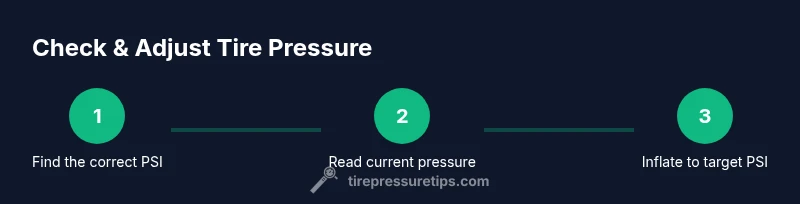
To maintain safe tire pressures, follow a simple routine: (1) locate the PSI in the placard, (2) measure cold, (3) adjust to target, (4) check all tires including spare, (5) record the date, and (6) revisit monthly or before long trips. A 15- to 25-minute check per month is plenty; schedule it into your calendar and treat it as essential car maintenance.
Tools & Materials
- Tire pressure gauge(Digital gauge preferred for accuracy; calibrate periodically)
- Vehicle owner's manual or door jamb placard(Contains the exact PSI per tire)
- Air compressor or service station access(Use to adjust pressure if needed)
- Valve caps and cleaning cloth(Keep valve area clean when measuring)
- Wheel chocks(Use on slopes or driveways for safety)
Steps
Estimated time: 15-25 minutes
- 1
Find the correct PSI
Consult the placard or manual to know the target pressure for each tire. Note whether the values differ by axle or load, and remember pressures apply when tires are cold.
Tip: Always measure when cold, after the vehicle has been parked for at least a few hours. - 2
Prepare the tire and gauge
Remove the valve cap and wipe the valve stem area to remove dirt. Ready your gauge and a clean surface for an accurate reading.
Tip: Keep the valve cap on hand to replace after measurement. - 3
Read the current pressure
Attach the gauge to the valve stem straight on and read the pressure. Take a second reading to confirm accuracy.
Tip: Take multiple readings if the gauge is new or uncertain. - 4
Adjust to target PSI
If low, add air until you reach the target; if high, release air and recheck. Recheck after any adjustment.
Tip: Never exceed the tire’s maximum printed pressure. - 5
Check all tires and the spare
Repeat for the other tires and the spare if you have a dedicated inflator or gauge. Ensure all have correct PSI.
Tip: Spare tires often have different specs; verify individually. - 6
Record and schedule maintenance
Log the date and target PSI, and set a monthly reminder for checks or before long trips.
Tip: Routine checks prevent unexpected flats and improve performance.
Frequently Asked Questions
How often should I check car tyre air pressure?
Aim to check all tires once a month and before long trips. Check when cold for the most accurate reading.
Check the tires monthly and before trips, making sure they are cold.
Is TPMS a replacement for manual checks?
No. TPMS warns you when pressure is low, but you should verify exact psi with a gauge.
TPMS helps flag issues, but you still need a gauge to confirm the numbers.
What happens if I drive with under-inflated tires?
Under-inflation can reduce fuel economy, increase wear, and raise the risk of a blowout.
Driving on low pressure wears tires faster and can be unsafe.
Can temperature affect tire pressure?
Yes. Colder temperatures lower pressure; check when tires are cold and adjust as needed.
Temperature changes affect pressure; check when cold.
Should I check the spare tire pressure?
Yes. The spare usually has its own recommended PSI; inspect it occasionally.
Don’t forget the spare; it needs the right pressure too.
Watch Video
What to Remember
- Check cold tires first for accuracy
- Inflate to the manufacturer spec per tire
- Use a reliable gauge and recheck after adjustment
- TPMS helps but does not replace manual checks
- Make tire pressure checks a monthly habit