Air Pressure Quotes: A Practical Tire Guide
Master air pressure quotes for tires with a practical guide. Learn to read PSI quotes, compare with placards, and adjust inflation safely to protect tire life and fuel efficiency.


Goal: Learn how to interpret air pressure quotes for tires, compare the vehicle’s recommended pressures with the tire sidewall limits, and safely adjust inflation using a gauge and correct technique. This guide covers reading quotes about PSI, practical checks, and mistakes to avoid, so you can maintain optimal fuel economy and tire wear.
Understanding air pressure quotes and why they matter
Air pressure quotes are the PSI figures and limits printed on tires, as well as the recommended numbers published by vehicle manufacturers. They guide you to inflate a tire to a safe, efficient level for everyday driving. The key idea is that the quote on the sidewall (maximum inflation) is not a target; it’s a ceiling. The real target comes from the vehicle placard, which sets the operating PSI for front and rear tires under typical loads. Reading quotes accurately means knowing where to look and when to apply them. According to Tire Pressure Tips, reading air pressure quotes correctly starts with confirming your vehicle's recommended PSI from the door jamb placard and then cross-checking with the tire's own limits. Weather, load, and driving style can shift the exact target slightly, so a flexible approach is worth adopting to maintain safety, fuel efficiency, and even tread life.
Where quotes show up on the car and tires
Quotes appear in several places: the vehicle placard on the door jamb or inside the fuel door, and the tire sidewall that lists the maximum inflation pressure. The placard gives the operating PSI for each axle, often with separate values for front and rear tires. The sidewall quote is the maximum limit, not the recommended operating pressure. In addition, modern vehicles equipped with TPMS translate air pressure quotes into dashboard notifications when a tire falls outside safe ranges. Understanding these different quotes helps prevent underinflation or overinflation, both of which can compromise steering, braking, and tire wear.
How to compare quotes with manufacturer recommendations
Start with the placard on the driver’s door jamb, then check the owner’s manual for any vehicle-specific notes. Compare this recommended PSI to the quote printed on the tire sidewall. If the two sources disagree, follow the placard—the car is designed around those values. If a tire is frequently carrying a higher load or you drive at higher speeds, you may need a slightly different target, but always confirm with the manufacturer’s guidance. The goal is a stable, predictable tire pressure that supports safe handling, even wear, and efficient fuel use. Throughout this process, keep PSI in mind as the primary unit; conversion to kPa is optional for technical readers, but consistency matters for accuracy.
Tools you need to read and apply air pressure quotes
Before you begin, gather these essentials: a reliable tire pressure gauge (digital or analog), an inflator or air compressor, and the vehicle’s placard or owner’s manual for reference. If you work in varying temperatures, a gauge with a small bleed valve helps fine-tune pressure. A chalk line or soap bubbles can help detect slow leaks, while a notebook keeps a log of the quotes you’ve applied. For TPMS-equipped vehicles, you’ll also want access to the vehicle’s TPMS settings or menu to verify sensor status after adjustments. Having the right tools reduces guesswork and helps you apply air pressure quotes with confidence.
Step-by-step overview (context for the full guide)
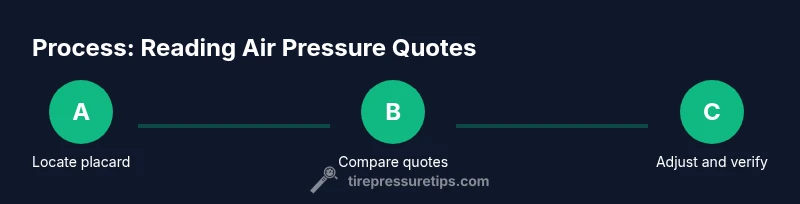
This section previews the practical steps you’ll perform in the dedicated STEP-BY-STEP section. You’ll learn how to check cold tire pressures, compare values to the placard, adjust with care, and verify the result. The sequence emphasizes safety and accuracy: never rely on hot tires, avoid dumping air rapidly, and recheck after adjustments. The goal is to have all four tires at an even, vehicle-recommended level that matches the quotes you read from the placard and the tire label.
Common mistakes and how to avoid them
Common errors include inflating to the tire’s maximum pressure instead of the vehicle’s recommended PSI, reading a hot tire rather than a cold one, and ignoring weather-related changes that shift quotes. Another frequent mistake is not rechecking after a temporary adjustment, which can let pressures drift back. To avoid these pitfalls, always measure cold tires, use a calibrated gauge, and compare readings across all four tires. Document the values and note any anomalies, such as a slow leak that would require a maintenance check.
Weather, temperature, and seasonality effects on quotes
Air pressure quotes are sensitive to temperature. Colder weather compresses air, lowering tire PSI, while heat expands air and raises PSI. In practice, you may notice a noticeable drop in pressure in winter and a rise in summer. The effect varies with tire type, load, wheel size, and vehicle. Because quotes from the placard assume standard conditions, you should recheck pressures when the seasons change or after driving long distances in hot weather to keep within the recommended range.
Practical examples and recommended practices
To illustrate how quotes apply in real life, consider two typical scenarios using illustrative ranges. Front and rear tires may have slightly different operating quotes on the placard, while the sidewall lists the maximum. For example, you might see quotes in the range that keeps the vehicle safe and efficient without including specific, real-world numbers. In practice, you’ll set pressures within the recommended band and recheck on a regular maintenance schedule. Remember that quotes are tools to guide you toward consistent pressure, not a fixed number you should chase at all times.
Tools & Materials
- Digital or mechanical tire pressure gauge(Use cold tires for accuracy; verify against a known reference.)
- Inflation equipment (air compressor or hand pump)(Prefer a gauge-integrated pump to minimize error.)
- Vehicle owner’s manual or door placard(Contains exact PSI by axle and operating guidance.)
- TPMS reset tool or access to vehicle menu(Only if you need to reset sensors after adjusting pressures.)
- Notebook or digital log(Record readings and dates for trend tracking.)
Steps
Estimated time: 15-25 minutes
- 1
Prepare tools and locate references
Gather your gauge, inflator, placard or manual, and a notebook. Inspect tires for visible damage before starting. This ensures you have the right quotes and the means to apply them safely.
Tip: Double-check gauge accuracy by comparing to a known standard or another gauge. - 2
Check cold tire pressures
Measure all four tires after they’ve cooled for several hours or after a road trip. Avoid readings when tires are hot, as heat skews the numbers.
Tip: If you’ve just driven, wait at least 3 hours before checking. - 3
Compare with placard and sidewall quotes
Refer to the door jamb placard for axle-specific operating PSI and compare it to the tire’s maximum inflation on the sidewall. Decide which value governs your target.
Tip: If in doubt, prioritize the placard values; they reflect the vehicle’s design and load handling. - 4
Adjust pressure to target
Add air or release small amounts in 1–2 psi increments, then recheck each tire. Repeat until all four tires align with the recommended PSI.
Tip: Make tiny adjustments and recheck; avoid sudden rapid changes. - 5
Recheck and document results
Recheck all tires for consistency and log the final readings. Verify TPMS status if you adjusted pressures on TPMS-equipped tires.
Tip: Keep a record for future reference and seasonal changes.
Frequently Asked Questions
What are air pressure quotes in tires?
Air pressure quotes are the PSI figures associated with tire inflation guidance. They include the vehicle’s recommended operating PSI and the tire's maximum inflation limit. Understanding both helps ensure safe handling and efficient wear.
Air pressure quotes are the PSI guidelines for tires, including your vehicle’s recommended pressure and the tire's maximum; they guide safe inflation.
Where should I look for the correct quotes?
Begin with the door jamb placard on the driver’s side, then consult the owner’s manual for any special notes. The tire sidewall shows the maximum inflation limit but is not the target to follow.
Check the door placard for the correct PSI, then verify with the tire sidewall limit if needed.
Can front and rear quotes differ?
Yes. The vehicle manufacturer may specify different operating PSI for front and rear tires based on load distribution. Always compare both axles to the placard and follow those values.
Front and rear PSI can be different; follow the placard values for each axle.
What if the TPMS shows a warning but quotes seem fine?
TPMS reflects real-time pressure changes. If it warns, recheck all tires and address any leaks or slow losses. Quotes are a guide; sensor readings are the dynamic reality.
If TPMS warns, recheck all tires and address leaks; quotes guide you, TPMS shows the current state.
Does weather affect air pressure quotes?
Weather and temperature changes influence tire pressure. Colder air lowers PSI, heat raises it. Plan seasonal checks and adjust as conditions change.
Yes, temperature affects tire pressure; recheck in different seasons.
How often should I check tire pressure quotes?
Check at least monthly and before long trips, especially when temperatures shift. Keep notes to detect slow leaks or pattern changes over time.
Check at least monthly and before long trips, especially if it’s changing with the weather.
Watch Video
What to Remember
- Check cold tires first for accuracy.
- Always follow the placard-recommended PSI.
- Use a calibrated gauge to apply quotes precisely.
- Recheck after adjustments to prevent drift.
- Weather and load affect quotes; plan seasonal checks.