What Causes Low Tire Pressure: A Practical Troubleshooting Guide
Discover the main causes of low tire pressure, how temperature, leaks, and TPMS affect it, plus step-by-step fixes to keep tires safe and efficient.


Low tire pressure is typically caused by slow leaks, punctures, or temperature-related loss, plus sensor issues. Begin by checking with a gauge, look for damage, and fill to spec. If the leak continues, seek professional help.
What causes low tire pressure
According to Tire Pressure Tips, the question of what causes low tire pressure centers on a few reliable culprits, including slow leaks, punctures, temperature-related contraction of air, bad valve stems, and TPMS sensor faults. For drivers, the practical implication is simple: underinflation changes how the tire contacts the road, increases rolling resistance, and can compromise safety. The specific phrase you’ll hear most often is the fact that air expands and contracts with temperature: cold mornings can show lower readings until tires warm up. When you first notice a drop in PSI, your best immediate step is to measure with a trusted gauge and compare to the vehicle’s recommended PSI.
Tire Pressure Tips emphasizes that addressing the root cause quickly reduces safety risks, saves fuel, and minimizes uneven wear on the tread. By understanding the core sources of low tire pressure, you can diagnose more quickly and take corrective action before a minor issue becomes a costly repair.
Common causes of low tire pressure
In many cases, what causes low tire pressure is a combination of factors rather than a single event. The most frequent culprits include slow leaks from nails or screws that puncture the tread, a damaged valve stem that leaks, and rims that have corroded or bent, creating tiny channels for air to escape. Temperature shifts also play a big role; as outside temperature drops, air inside tires contracts, lowering PSI even if there’s no actual leak. A faulty TPMS sensor can misreport pressure, making tires seem underinflated when they aren’t fully in need of air. Finally, natural wear and aging tires can develop small tread separations or bead leaks that gradually reduce pressure over weeks.
If you routinely see low readings after sitting overnight, it’s more likely a slow leak or valve problem than a sudden puncture. Remember to verify by rechecking after the tires have cooled for at least a few hours to avoid temperature-related variance.
Temperature, driving, and wear: how they influence tire pressure
Temperature has a measurable effect on tire pressure. In colder weather, air molecules take up less space, which reduces PSI. Conversely, hot weather can cause a slight rise in pressure. Driving itself can also impact readings: cycles of heating and cooling as tires roll and rest can mask small leaks that only appear after several days. Tire wear contributes too: worn tread can reveal puncture-prone areas, while sidewall damage may silently leak air. Understanding this interplay helps you schedule checks at optimal times and avoid misreading the TPMS as a failure.
How to check tire pressure accurately
Accurate checks require a few deliberate steps. Always check tires when they’re cold, ideally before driving or after at least three hours of no driving. Remove the valve cap, attach a reliable gauge, and compare the reading to the vehicle manufacturer’s recommended PSI printed on the door placard or owner’s manual. If you’re within 1-2 PSI of the target, you’re in good shape; if not, inflate to the spec and recheck after a short drive to ensure the readings stabilize. For a slower-leak diagnosis, you can apply a soapy water test along the bead and around the valve stem to identify bubbles.
Tire Pressure Tips recommends keeping a portable gauge in the glove box for quick checks, and always recheck after filling, because temperature can affect readings even within minutes.
Diagnosing leaks and slow leaks
Not every tire leak is obvious; a slow leak can occur through a puncture, bead, or valve stem. Start with a visual inspection for nails, screws, or embedded debris. If nothing is visible, apply soapy water around the bead, valve stem, and around the rim; watch for steady bubbles that indicate air escaping. If you find a leak, you can often seal small punctures with a tire repair kit, but larger injuries or bead leaks require professional service.
If a tire consistently loses air, factor in rim damage and potential wheel misalignment as contributing factors. Keeping a log of PSI over days helps you determine whether a slow leak is present and how quickly it escalates under different temperatures.
Checking TPMS and sensor issues
TPMS sensors are designed to alert you when a tire drops below the recommended pressure. However, a faulty sensor or a dead battery can produce false readings or fail to alert you at all. If you suspect TPMS issues, verify readings with a physical gauge rather than relying solely on the dashboard light. Replacing or recalibrating TPMS sensors often requires professional service, as the system’s electronics and air-pressure sensing logic are calibrated for each vehicle.
Don’t ignore a TPMS warning if you recently rotated tires or replaced them; sensor reprogramming may be needed. Regularly inspect sensors and valves for corrosion or damage, especially in areas with harsh winters or road salt.
Quick fixes and safety steps
When you identify low tire pressure, start with inflating to the manufacturer’s recommended PSI and rechecking once the tire has cooled. If the tire loses air shortly after inflation, inspect for punctures, bead leaks, or loose valve stems. For persistent leaks, consider a temporary sealant only as a stopgap and seek professional assessment. Never drive long distances on underinflated tires, as this increases the risk of blowouts and loss of control.
Always carry a spare and a reliable gauge, and keep the tires inflated to the correct specs as part of your routine maintenance. If you’re unsure about the repair, prioritize safety and call a professional—driving on a suspected compromised tire is not worth the risk.
Prevention and maintenance tips
Prevention is the best cure for low tire pressure. Schedule regular tire pressure checks, ideally monthly and before long trips, and monitor for seasonal changes. Rotate tires as recommended, inspect valve stems for wear, and replace them when the metal valve is corroded or damaged. Consider using a tire pressure monitoring system (TPMS) that provides continuous feedback, especially in areas with dramatic temperature fluctuations. Have tires serviced if you notice persistent air loss, visible beads, or unusual wear patterns.
By treating tire pressure as a core maintenance item, you’ll improve fuel efficiency, prolong tire life, and reduce the risk of tire-related incidents on the road.
When to seek professional help
If your tires continue to lose air after routine checks and inflation, it’s time to seek professional help. A certified technician can perform a leak test using air-down and dye tests, inspect the wheel bead seal, and evaluate rim integrity. If the tire is damaged beyond repair, replacement may be required. Recurrent slow leaks might indicate a failing TPMS system or hidden structural damage that needs a comprehensive diagnosis.
Professional service also ensures that the tire pressure readings are calibrated correctly for your vehicle, maximizing safety and performance.
Final practical takeaways
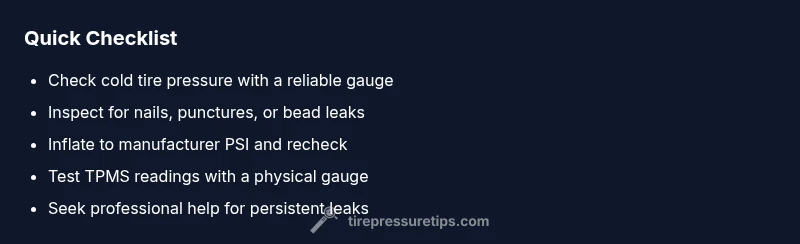
- Regularly check cold tire pressure to avoid temperature distortion.
- Inspect for punctures, damaged stems, and bead leaks using soapy water.
- Inflate to the manufacturer’s PSI and recheck after a short drive.
- Verify TPMS readings with a physical gauge to avoid misinterpretation.
- Seek professional help for persistent leaks or TPMS faults to ensure safety and proper repair.
Steps
Estimated time: 20-45 minutes
- 1
Check cold tire pressure with a gauge
Record the PSI on all tires when they’re cold, then compare to the manufacturer’s spec. If a tire reads low, proceed to inflation checks and visual inspection.
Tip: Use a digital gauge for accuracy and keep it in the glove box. - 2
Inspect for obvious leaks or damage
Look for nails, screws, or punctures on the tread. Check the sidewalls and around the valve stem for signs of wear or cracking.
Tip: Use soapy water to reveal slow leaks—watch for continuous bubbles. - 3
Inflate to the recommended PSI
Fill each tire to the vehicle’s specified PSI, not the maximum on the tire sidewall. Recheck after tires have cooled to confirm stability.
Tip: Avoid overinflation; check again after driving a short distance. - 4
Check for TPMS issues
If tires still read low after inflation, verify TPMS readings and look for dashboard warnings. Consider recalibrating or replacing sensors if needed.
Tip: Some resets require a scan tool at a shop. - 5
Monitor over time
Keep a log of PSI readings across days and seasons to identify patterns and differentiate between temporary changes and leaks.
Tip: Temperature logs help explain daytime vs overnight changes. - 6
Seek professional help if needed
If you find persistent leaks or multiple tires are affected, schedule a professional leak test and maintenance.
Tip: Safety first—driving with suspected leaks is risky.
Diagnosis: Tire loses air gradually or shows low reading on gauge
Possible Causes
- highSlow puncture from nail/screw/foreign object
- mediumValve stem leak or faulty TPMS sensor
- highTemperature changes causing air contraction
- lowWheel or rim damage allowing slow leak
Fixes
- easyInspect tires for objects, use soapy water to find leaks, and seal/repair as needed
- mediumReplace faulty valve stem or TPMS sensor if leak persisted
- easyFill tires to recommended PSI and monitor for 24-48 hours
- hardProfessional leak test and potential tire replacement
Frequently Asked Questions
What is considered low tire pressure for my vehicle?
Low tire pressure is defined by the vehicle’s recommended PSI, usually printed on the door placard. If your tires read below this value after cold inflation, they’re underinflated and should be topped up. Regular checks help you stay at the right level.
Low tire pressure means your tires are below the manufacturer’s recommended PSI, usually shown on the door placard. Check with a gauge and inflate to spec.
How often should I check tire pressure?
Check tire pressure at least once a month and before long trips. Temperature changes and daily use can cause slow fluctuations, so regular checks help prevent underinflation.
Check your tires monthly and before trips to catch slow leaks and temperature-related drops.
Can temperature alone cause low tire pressure?
Yes, temperature affects tire pressure. Colder temperatures lower PSI; warmer days can raise it. Always check when tires are cold to get an accurate baseline.
Yes, temperature can lower or raise tire pressure; always check when tires are cold to get an accurate reading.
What should I do if I find a slow leak?
If you find a slow leak, seal small punctures with a repair kit if appropriate, inflate to spec, and monitor. If the leak persists or is near the bead or sidewall, seek professional service.
Seal small leaks with a repair kit if possible and see a pro if it keeps leaking.
Is TPMS a sign of a leak or a sensor issue?
TPMS can warn of low pressure, but a faulty sensor may misreport. Check readings with a gauge to confirm, and have sensors recalibrated if needed.
TPMS can signal a problem, but use a gauge to confirm; sensors may need recalibration.
When should tires be replaced due to low pressure?
If a tire has irreparable slow leaks, bead damage, or worn tread that compromises safety, replacement is usually advised. In some cases, repair is possible if the damage is limited.
If leaks can’t be repaired or tread is worn, replace the tire for safety.
Watch Video
What to Remember
- Check cold tires first to get an accurate reading
- Identify leaks with soap tests and inspect stems/beads
- Inflate to manufacturer PSI and recheck after cooling
- TPMS readings should be verified with a gauge
- Seek professional help for persistent leaks or sensor issues