What Causes Tire Pressure to Drop: A Practical Troubleshooting Guide
Learn the common causes of tire pressure drop, how to diagnose leaks, and a practical step-by-step fix to keep tires properly inflated and safe.


Tire pressure commonly drops due to small leaks, temperature changes, or gradual seepage from valves and rims. Start by checking all tires when they're cold, inspect for punctures, and re-inflate to the vehicle’s recommended PSI. If the leak persists, seek professional repair. Also check valve cores, rims, and TPMS sensors, since faulty screws or sensor leaks can misreport or lose air. Keep in mind cold-weather effects can drop pressure by a few PSI overnight.
Why Tire Pressure Drops Matter
According to Tire Pressure Tips, maintaining correct tire pressure is essential for safety, fuel efficiency, and tire life. When air pressure falls, tires deform more at the contact patch, increasing heat, wear, and the risk of a blowout. The Tire Pressure Tips team emphasizes that small, recurring losses add up over time, especially for drivers who commute long distances or encounter varied weather. Regular checks catch creeping leaks early and prevent underinflation from becoming a daily problem. This section explains why staying on top of pressure matters beyond a simple number on the gauge. We'll cover how underinflation affects handling, braking, and tire longevity, and how to interpret the TPMS readings in your vehicle. For most cars, the recommended PSI is printed on the door placard or in the owner's manual. When you keep tires inflated to that spec, you improve fuel economy, reduce tire wear, and maintain consistent handling in rain, snow, or heat. Tire pressures are influenced by temperature, load, and driving style; understanding these factors helps you decide when to inflate or adjust pressures. As you read, remember: proper tire pressure is a simple, ongoing habit with big safety and cost benefits. Based on Tire Pressure Tips Analysis, 2026, regular checks are the best defense against unexpected deflation and unsafe driving conditions.
What Causes Tire Pressure to Drop
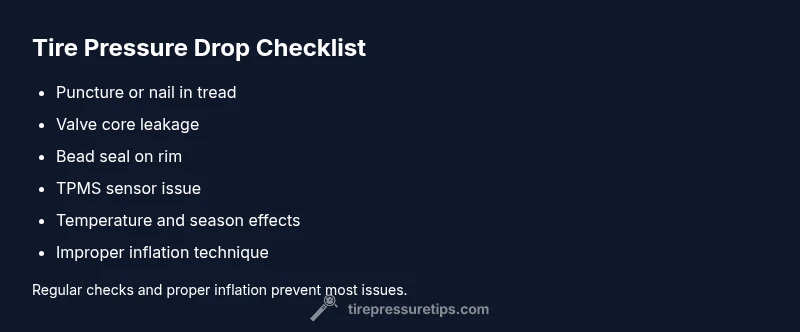
Many drivers wonder what causes tire pressure to drop. The answer is rarely a single culprit; more often, a combination of small leaks, temperature shifts, and aging components. Punctures from nails or sharp debris can create slow leaks that only become noticeable after several days. Valve stems and cores can degrade or loosen, allowing air to escape slowly. The bead where the tire seals to the rim can lose seal with corrosion or improper mounting. Temperature plays a big role: as outdoor temps fall, air inside the tire contracts, reducing the pressure by several PSI overnight. Road wear and driving habits also influence how quickly a tire loses air. Finally, TPMS sensors can malfunction or display inaccurate readings if the sensor is weak or battery is dying. Based on Tire Pressure Tips Analysis, 2026, addressing all these potential causes with a systematic check is the best way to prevent unforeseen drops and keep you safe on the road.
Common Leaks to Inspect
Leaking tires are often the result of tiny but persistent breaches. Start by inspecting the tread and sidewall for nails, screws, or cuts. Look at the valve stem for cracks or a loose core. The wheel rim can develop corrosion that lets air escape at the bead. Also check for signs of bead seating issues after a tire rotation or mounting. If you notice a hissing sound or find bubbles when spraying soapy water, that’s a leak you can fix or patch. In many cases, a slow leak from a puncture will require plugging or patching from inside the tire. If you can't locate a visible leak, consider the possibility of a bead leak or a faulty TPMS sensor contributing to inaccurate readings. Regular inspection and prompt repairs save money by preventing tire damage and improving fuel efficiency.
Diagnostic Approach: How to Find the Root Cause
When you notice a pressure drop, take a structured approach. Start with the simplest checks and escalate. Step 1: Confirm the pressure reading with a reliable gauge when the tire is cold. Step 2: Visually inspect for obvious damage or punctures. Step 3: Apply soapy water to the valve, stem, bead, and tread area to identify leaks. Step 4: If no leak is found, have the TPMS sensor and core checked for leaks or sluggish readings. Step 5: If a leak is confirmed, decide on patching, plugging, or professional repair depending on leak size and location. Step 6: After repair, re-inflate to spec and re-check once the tire has cooled. If the tire loses air again, a more thorough inspection of the rim and bead may be necessary. A quick follow-up at a shop ensures a safe fix and prevents a flat.
Step-by-Step Fix for the Most Common Cause
- Locate the leak: With the tire cold, inspect the tread and sidewall for signs of puncture and use soapy water to confirm. 2. Decide repair method: If the puncture is repairable, patch or plug from the inside or professional service. 3. Address valve issues: If the leak comes from the valve stem, replace the valve core or stem. 4. Inspect the bead: Ensure the tire is properly seated on the rim; reseat or repair if bead leaks are detected. 5. Inflate to spec: Refill to the recommended PSI on the door placard and allow the tire to cool before rechecking. 6. Test again: Drive 5–10 miles and recheck the pressure to confirm a stable reading.
Prevention and Maintenance for Stable Tire Pressure
To prevent future drops, build a routine. Check tire pressure when the tires are cold at least once a month and before long trips. Use a trusted gauge and verify with your TPMS if available. Maintain proper load and avoid overloading; rotate tires per manufacturer schedule; Replace worn valves; Keep rims clean. In cold weather, check more frequently as temperature shifts affect pressure. Consider keeping a small air compressor or a portable gauge in the car for emergencies. A proactive approach saves money and reduces risk.
Steps
Estimated time: 25-40 minutes
- 1
Verify tire is cold and gauge accuracy
Ensure the car has been stationary for several hours and use a consistent gauge to check each tire. Record the reading and compare to the vehicle’s recommended PSI.
Tip: Use the same gauge for consistency; small discrepancies can change your interpretation. - 2
Inspect for visible damage
Look for nails, screws, cuts, or bulges on the tread and sidewalls. Any obvious damage should be addressed before re-inflating.
Tip: Carry a flashlight and mirror to spot hidden damage around the bead area. - 3
Test for leaks with soapy water
Spray soapy water on the valve, stem, bead, and tread edges. Bubbles indicate leaks that need patching, plugging, or professional repair.
Tip: Move slowly around the entire tire to avoid missing tiny leaks. - 4
Assess valve core and TPMS
If no leak is found, tighten or replace the valve core. Check TPMS sensor and battery health if readings seem unreliable.
Tip: If you suspect TPMS issues, a quick sensor test at a shop can save guesswork. - 5
Inflate to the recommended PSI
Fill the tire to the factory-recommended psi and allow it to cool. A hot tire can show higher numbers than the cold reading.
Tip: Always recheck after 10–15 minutes of driving when the tire has cooled. - 6
Recheck and monitor
Drive a short distance and recheck the pressure to ensure stability. If it drops again, seek professional help.
Tip: Document readings and dates to identify trends over time.
Diagnosis: Tire pressure is dropping between checks or TPMS light on
Possible Causes
- highSlow leak from puncture or nail
- mediumValve stem or core leak
- lowBead leak or rim sealing issue
- lowTemperature change causing air contraction
Fixes
- easyInspect tire surface for puncture and patch/plug as needed
- easyCheck valve stem and core; replace if faulty
- mediumInspect rim bead and seal; reseat tire if necessary
- easyInflate to spec after cold soak; re-check after driving 5-10 miles
Frequently Asked Questions
Why does my tire lose air while parked?
Punctures, slow leaks, valve issues, rim bead leaks, and temperature shifts can all cause air loss even when a vehicle is stationary. A methodical check helps identify the exact cause.
Tires can lose air due to punctures, valve leaks, or temperature changes; a methodical check helps find the exact cause.
Can a faulty TPMS cause inconsistent readings?
Yes. A failing TPMS sensor or battery can report incorrect pressures or fail to warn at the correct level. Always verify with a manual gauge when in doubt.
Yes, a bad TPMS can misreport pressure, so verify with a manual gauge if needed.
Is it safe to drive on underinflated tires?
Driving on underinflated tires increases heat buildup and risk of blowouts. It should be avoided; inflate promptly and inspect for damages if you must travel.
No, it's unsafe to drive on underinflated tires; inflate as soon as possible.
Should I trust TPMS readings over a manual gauge?
TPMS is a helpful guide, but it's not perfect. Use a reliable gauge to confirm each tire's pressure and address any discrepancies.
TPMS is useful, but always verify with a gauge.
What tools do I need to fix a tire leak at home?
A quality tire pressure gauge, soapy water for leak detection, patch or plug kits for punctures, and basic hand tools. For bead leaks or damaged valves, professional service is recommended.
Get a tire gauge, soap water, and a patch kit; see a pro for bead leaks.
When should I replace a tire due to pressure issues?
If a tire cannot be repaired after a puncture, shows repeated rapid pressure loss, or has structural damage, replacement is warranted.
If it can’t be fixed safely, replace the tire.
Watch Video
What to Remember
- Check tires when cold to get accurate readings
- Inspect for leaks and fix promptly
- Use a reliable gauge and verify TPMS
- Inflate to spec and recheck after cooling