Low Tire Pressure in Cold Weather: What to Do
Urgent, practical steps to diagnose and fix low tire pressure during cold weather. Learn quick checks, safe inflation, TPMS tips, and prevention to protect tires and fuel economy.


In cold weather, tire pressure drops as air contracts. Check all tires when cold with a reliable gauge, compare to the vehicle’s recommended PSI on the door jamb label, and inflate to spec. If pressure remains low, inspect for leaks or punctures and consult a professional if needed.
Understanding why cold weather lowers tire pressure
When temperatures fall, the air inside tires contracts and the rubber also becomes stiffer, causing a noticeable drop in PSI. This effect is most pronounced during morning checks and after the car has sat overnight. The Tire Pressure Tips team notes that winter pressure loss is common, but it’s predictable when you know how to measure and adjust correctly. Remember, the goal is to keep tires at the vehicle’s recommended PSI, usually found on the driver door jamb label and in the owner's manual. If you see a drop as soon as the thermometer sinks, you’re observing a normal winter phenomenon that calls for a quick, disciplined response to maintain safe handling and fuel efficiency. By treating cold-weather pressure like a routine maintenance reminder, you prevent underinflated tires from harming tread wear or increasing rolling resistance.
How to accurately check tire pressure in cold weather
The first step is to ensure the tires are cold — drive-in tires can heat up and give a misleading reading. Use a reliable tire pressure gauge (digital is easiest to read) and compare readings to the PSI listed on your door jamb label. Check all four tires, including the spare, since cold air losses can be uneven. Record the numbers, then inflate each tire to the recommended PSI using a pump with a built-in gauge or a separate gauge for verification. After inflating, recheck within a few miles of driving to confirm the pressure has settled. If you’re unsure about the numbers, consult your vehicle manual or the Tire Pressure Tips guide for model-specific recommendations.
Immediate actions when you discover low pressure
If a tire reads low, don’t ignore it. Inflate to the vehicle’s recommended PSI, then recheck after a short drive (about 3–5 miles) to allow the tire to seat properly. If the pressure drops again, look for obvious causes: a nail hole, a cracked valve stem, or bead leaks where the tire seals to the rim. Small leaks are repairable, but large punctures usually require professional service or tire replacement. Always consider safety first: if you notice rapid loss or irregular wear, stop driving and seek help to avoid a blowout.
Diagnostic signs: TPMS, leaks, and valve issues
A blinking or steadily illuminated TPMS light can indicate low pressure or a sensor fault. If the light comes on after inflating, recheck to ensure you hit the exact target PSI; a slight over- or under-inflation can trigger the light. Inspect the tire visually for nails, screws, or cuts, and feel around the valve stem for looseness or damaged threads. Don’t overlook the rim itself—a bent rim can prevent a proper seal and cause slow leaks. If no obvious leak is found but pressure keeps dropping, the issue may lie with the TPMS sensor or its battery, which may require professional diagnosis.
Step-by-step winter pressure remediation plan
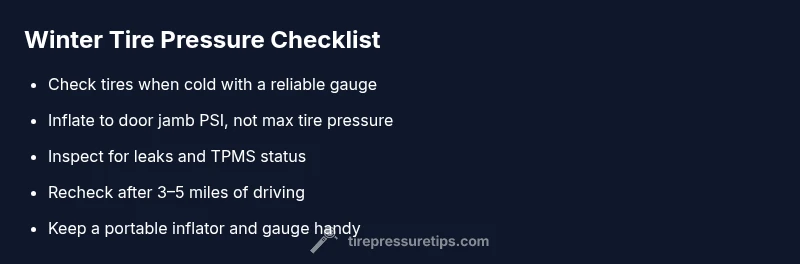
- Locate the official PSI requirement on the door jamb label or owner's manual. 2) Check all tires when cold with a gauge. 3) Inflate to the recommended PSI, not exceeding the max rating on the tire sidewall. 4) Recheck after about 3–5 miles of driving to allow the tire to warm slightly and settle. 5) If the tire returns to underinflated, inspect for leaks or punctures using soapy water around the valve stem and bead area. 6) Check TPMS status and reset/calibrate according to the manual if needed. 7) If you can’t find a leak, consult a professional for a thorough inspection of the tire, rim, and TPMS.
Safety and maintenance tips for winter tires
Safety first: never drive on visibly cracked, cut, or bulging tires, especially in cold weather when rubber is more susceptible to damage. Use a high-quality gauge and keep a portable air compressor in your car for emergencies. Regularly inspect tire sidewalls, tread depth, and the tire valve caps, as loose caps can allow slow leaks. Schedule seasonal checks to align with temperature changes, and avoid sudden pedal or steering inputs while tires are underinflated. Finally, remember that TPMS batteries can fail in cold weather; have the system inspected if warning lights behave abnormally.
When to seek professional help and prevention tips
If you continue to see pressure loss after inflating or notice sidewall damage, embedded objects, or a persistent TPMS warning, it’s time to visit a tire professional. Regular winter checks help prevent breakdowns: check tires monthly, before long trips, and after significant temperature swings. Keep the spare tire properly inflated and test your TPMS upon completion of any tire service. Preventive maintenance, including rotation and alignment checks, extends tire life and improves winter safety.
Steps
Estimated time: 30-45 minutes
- 1
Find the recommended PSI
Locate the exact cold-inflation PSI on the door jamb label or in the owner’s manual. This is the target you should aim for when tires are cold.
Tip: Use a flashlight to read small print on the label if needed - 2
Check tires when cold
Before driving, test all four tires with a reliable gauge. Temperature can skew readings, so cold checks are essential for accuracy.
Tip: Do not rely on readings after a long drive - 3
Inflate to specification
Using a pump, bring each tire to the exact PSI recommended. Do not exceed the max rating on the tire sidewall.
Tip: Take breaks between tires to maintain accuracy - 4
Recheck after driving a bit
Drive about 3–5 miles to allow tires to seat and pressure to settle, then recheck. If it drops again, inspect for leaks.
Tip: Check after your first loop around the block - 5
Inspect for obvious leaks
Look for nails, screws, or objects in the tread and around the valve stem. Use soapy water to find slow leaks.
Tip: Tap the tire around the bead to listen for air hiss - 6
Check TPMS status
If the TPMS light remains after inflation, confirm the sensor is functioning and correctly calibrated.
Tip: Refer to the manual for reset steps or visit a shop - 7
Decide on professional help
If leaks are found, or you suspect a faulty TPMS, schedule service promptly to prevent a blowout.
Tip: Don’t delay if you notice rapid pressure loss - 8
Prevent future issues
Keep tires inflated to spec in winter, check monthly, and consider a cold-weather TPMS check as part of maintenance.
Tip: Consider keeping a small gauge in your glove box
Diagnosis: Tire pressure drops after cold weather or TPMS warning
Possible Causes
- highAmbient temperature drop causing legitimate pressure loss
- mediumSlow leak from nail puncture, bead leak, or valve stem
- lowTPMS sensor fault or calibration issue
Fixes
- easyMeasure cold tire pressure with a gauge and inflate to the vehicle spec
- easyInspect tires for punctures, bead leaks, or valve leaks; repair or replace as needed
- mediumCheck and recalibrate or replace TPMS sensors if warning persists after proper inflation
Frequently Asked Questions
Why does cold weather cause tire pressure to drop?
Cold air contracts and tire rubber stiffens, reducing PSI. This is normal in winter, but you should recheck and inflate to the recommended PSI to maintain handling and fuel economy.
Cold weather lowers tire pressure because air contracts. Check and inflate to the recommended PSI to stay safe.
Is it safe to drive on underinflated tires in winter?
Short trips at reduced speeds are not ideal, and prolonged underinflation increases the risk of tire failure and poor handling. Inflate to the recommended PSI before long drives.
Driving on underinflated tires is risky; inflate to the recommended PSI before long trips.
How often should I check tire pressure in winter?
Check at least once a month and before trips during winter, as temperatures can oscillate quickly and affect PSI.
Check monthly and before trips in winter.
What if TPMS stays on after inflation?
TPMS can trigger from temperature changes. If the light remains after inflating to spec, have the sensor or battery checked by a professional.
If TPMS stays on after inflation, get it checked.
How can I prevent low tire pressure in winter?
Regular checks, inflating to spec, and inspecting for leaks are the best prevention. Consider winter-specific maintenance and TPMS diagnostics.
Check regularly, inflate to spec, inspect for leaks.
Should I adjust tire pressure for winter loads?
Always use the vehicle’s cold-inflation PSI for your load and driving conditions. Do not guess or set pressures by feel, as cold-weather changes can differ by tire size and vehicle.
Use the official cold-inflation PSI for your load; don’t guess.
Watch Video
What to Remember
- Check tire pressure when cold to verify accuracy
- Inflate to door jamb PSI, then recheck after a short drive
- Inspect for leaks or TPMS issues if pressure drops again
- Practice seasonal maintenance to prevent winter pressure losses