How Long for Low Tire Pressure to Go Away: A Practical Troubleshooting Guide
Learn how long it typically takes for a low tire pressure warning to disappear after inflating, plus practical steps to diagnose leaks, reset TPMS, and stay safe on the road.


A low tire pressure warning usually clears after you inflate the tire to the manufacturer’s recommended PSI and drive a short distance. If the light stays on, you may have a slow leak, a faulty valve stem, or a TPMS sensor issue. Start by rechecking all tires with a reliable gauge.
Why Low Tire Pressure Affects Safety and Performance
According to Tire Pressure Tips, low tire pressure can compromise handling, braking, and fuel efficiency. Even a small drop in PSI can increase rolling resistance and heat buildup, which over time wears tire tread unevenly. The question of how long for low tire pressure to go away is not only about the number on the gauge; it’s about whether the system has reset after inflation and whether a slow leak is ongoing. When you’re pressed for time, prioritizing safe driving and immediate pressure restoration helps prevent skidding, tire blowouts, and poor fuel economy. Regular checks and adherence to vehicle manufacturer recommendations are essential to maintain optimal performance. Keep in mind that temperature changes can temporarily affect tire pressure, so verify pressures when the tires are cold for accuracy. Tire Pressure Tips emphasizes a routine that combines quick checks with periodic professional inspections to minimize risk.
How TPMS Works and When It Will Trigger Again
The Tire Pressure Monitoring System (TPMS) monitors each tire’s air pressure and alerts you when a tire is underinflated. Different systems—direct TPMS with sensors in each wheel and indirect TPMS based on wheel speed sensors—have varying reset behaviors. After inflating a tire to the correct PSI, most vehicles require you to drive a short distance so the TPMS sensor recalibrates and the warning light can be cleared. If the tire pressure returns to a low level, the light may come back, indicating a slow leak or a faulty sensor. In cool weather, the PSI can drop again, triggering the light even without a puncture. Knowing how TPMS reacts helps you interpret the warning more accurately and prevents unnecessary repairs.
Quick, Safe Checks You Can Do Now
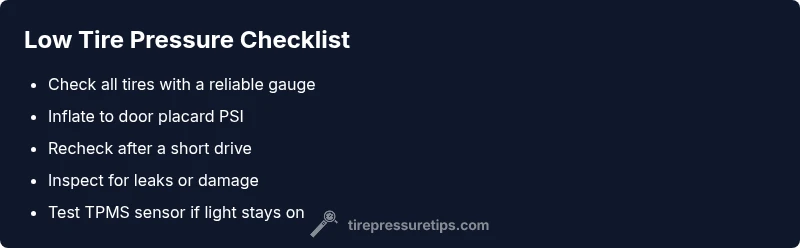
Before you drive, perform these checks safely, starting with the simplest tasks:
- Pull over on a flat surface and inspect each tire exterior for obvious damage, bulges, or embedded objects.
- Use a reliable digital or dial gauge to measure PSI on all four tires, comparing to the door placard value.
- Check the valve stems for corrosion or a loose core; tighten or replace as needed.
- If a tire is noticeably low, inflate to the correct PSI, then recheck after a short drive to see if it holds pressure.
- Don’t forget the spare tire; it can also lose air over time and may require attention.
If You See the Warning, Start Here: Immediate Actions
When the TPMS or low-pressure warning appears, proceed with caution and follow these steps:
- Confirm which tire is underinflated by checking all four pressures with a gauge.
- Inflate the affected tire to the recommended PSI on the door placard.
- Drive for a short distance to allow the TPMS to recalibrate; recheck the tire pressures after the drive.
- If the warning persists, inspect for slow leaks (nails, screws, or punctures) and note any changes in tire appearance or temperature.
Diagnosing the Cause of a Slow Leak
Slow leaks are the most common reason a light reappears after inflation. Start by inspecting the tire bead, sidewall, and tread for small punctures or embedded objects. The valve stem is another frequent culprit; a loose or damaged valve core can let air escape slowly. If you can’t find an obvious source, consider submerging the tire in water to look for escaping bubbles around the bead or valve. Temperature shifts can also cause temporary pressure drops, which is why you should verify pressures when tires are cold.
Remedies for Common Causes: Fixes You Can Try
Common fixes are often straightforward but must be executed carefully. If you identify a puncture or object in the tire, have it repaired by a professional if the damage is within repairable guidelines. For valve stems, replacing the stem or valve core may be sufficient. If the TPMS sensor is suspected to be faulty or not recalibrating, a diagnostic check with specialized equipment is recommended. In some cases, the issue is transient: re-inflate to the correct PSI and monitor across several days, especially during temperature swings.
When to Seek Professional Help and What to Expect
If the light returns after conservative checks and inflation, schedule a professional inspection. Experts can test TPMS sensors, inspect the wheel for leaks around the bead, and verify the vehicle’s computer is receiving accurate readings. If a tire cannot hold air reliably, a repair or replacement may be necessary. Regular maintenance by a qualified technician can prevent recurring issues and keep your tires performing at their best.
Prevention and Maintenance to Keep Low Tire Pressure at Bay
Proactive maintenance reduces the odds of repeated low-pressure events. Establish a routine to:
- Check tire pressures monthly and before long trips, using a gauge you trust.
- Calibrate pressure when temperatures change significantly, especially in winter and summer.
- Rotate tires as recommended by the vehicle manufacturer to promote even wear and pressure retention.
- Inspect tires for wear, punctures, and valve integrity during each check, and replace damaged components promptly. Keeping your tires at the correct pressure improves safety, fuel economy, and overall vehicle performance.
Steps
Estimated time: 30-60 minutes
- 1
Check all four tires with a gauge
Use a reliable tire gauge to measure PSI on each tire. Compare against the manufacturer’s recommended PSI on the door placard or owner’s manual.
Tip: Take notes of each tire’s pressure for reference. - 2
Inflate to the recommended PSI
Inflate any underinflated tires to the recommended level, ensuring even pressure across the tread area.
Tip: Avoid overinflation; use the gauge as your guide. - 3
Recheck after a short drive
Drive a few miles or for about 10 minutes to allow the TPMS to recalibrate (if your system is direct). Recheck pressures to confirm stability.
Tip: If the pressure changes significantly after driving, note potential leakage. - 4
Inspect for leaks or damage
Look for nails, screws, or punctures; inspect the valve stem and bead area for leaks or damage.
Tip: If you suspect a leak, avoid driving long distances until repaired. - 5
Test TPMS sensor function
If a tire holds air but the warning remains, a sensor fault is possible; a professional diagnostic is recommended.
Tip: Some vehicles require battery-powered TPMS to recalibrate after maintenance. - 6
Seek professional help when in doubt
When in doubt about repairs or sensor integrity, contact a qualified tire shop or dealership.
Tip: Persistent warnings warrant a safety check before any long trip.
Diagnosis: TPMS warning light or low tire pressure remains after inflating to the recommended PSI
Possible Causes
- highSlow leak in one or more tires
- mediumTPMS sensor fault or failed calibration
- lowTemperature-related pressure drop
Fixes
- easyRecheck all tires with a reliable gauge and inflate to the door placard value; drive a short distance and recheck
- mediumInspect tires for punctures, beads, and valve stems; repair or replace as needed
- easyIf the light persists, have a professional test the TPMS sensors and system calibration
Frequently Asked Questions
Why does my TPMS light come back after inflating a tire?
A reappearing TPMS light after inflation usually signals a slow leak, a faulty valve stem, or a TPMS sensor issue. Recheck pressures, inspect for leaks, and consider professional diagnostics if the light persists.
If the TPMS light returns after inflation, it often means a slow leak or a sensor issue; recheck all pressures and seek professional help if it won’t reset.
How long should I drive after inflating to reset TPMS?
Most systems reset after driving a short distance with the tires at the correct PSI. If it doesn’t reset, check for leaks or sensor problems and follow up with a technician if needed.
Drive a short distance after inflating to let the system recalibrate; if it doesn’t reset, check for leaks or sensor faults.
Can temperature changes cause the low tire pressure warning to reappear?
Yes, temperature changes can cause PSI to vary, triggering the warning again as air contracts in cold weather or expands in heat. Recheck pressures when temperatures stabilize.
Temperature changes can trigger PSI variations and warnings; recheck once temperatures stabilize.
Is TPMS sensor replacement expensive?
Sensor replacement costs vary by vehicle and location, but a malfunctioning TPMS sensor can require diagnostic and part replacement. Check with a local shop for a precise estimate.
TPMS sensor replacement costs vary; get a local estimate after a diagnostic.
What should I do if a tire keeps losing air?
If a tire consistently loses air, inspect for punctures, bead leaks, or valve stem issues. Seek professional repair or tire replacement if needed.
If air loss persists, inspect for punctures and leaks and consult a professional.
Watch Video
What to Remember
- Check pressures regularly and after temperature changes.
- Understand TPMS behavior and what triggers a reset.
- Address slow leaks promptly to prevent tire failure.
- Use the right gauge and proper inflation technique to ensure accuracy.