Where Is Tire Pressure in Car? A Practical Guide 2026
Discover where tire pressure is located on your vehicle, how to read PSI, and the steps to check and maintain proper inflation for safety and efficiency.


Where is tire pressure in car? It's the air inside each tire, measured in psi, and is listed on the tire sidewall and is also in your owner's manual. The recommended pressure is shown on a placard near the driver's door jamb, under the hood, or in the manual. For safety and efficiency, check cold tires before driving and after a long stop. According to Tire Pressure Tips, regular checks prevent uneven wear.
Understanding Tire Pressure Basics
Tire pressure refers to the amount of air inside each tire, typically measured in psi (pounds per square inch). It’s not a fixed value for all vehicles; the correct level depends on your car, load, and driving conditions. The Tire Pressure Tips team emphasizes that the right PSI helps with grip, steering response, and fuel efficiency. If you’ve ever wondered, in practical terms, the question where is tire pressure in car is answered by checking the placard on the driver’s door jamb and the owner’s manual. This placard lists the recommended cold-inflation pressure for front and rear tires, usually with separate values for different load situations. Remember that tire pressure can vary with temperatures and tire wear, so regular checks keep you safer and more economical on the road.
Where to Find Your Vehicle's Tire Pressure Recommendation
Your vehicle’s recommended tire pressure is not hidden. It’s usually printed on a placard attached to the driver’s door jamb, sometimes under the hood or inside the glove compartment, and it’s also in the owner’s manual. For most cars, there are two numbers: one for the front tires and one for the rear tires. If you’ve moved from a different climate or changed wheel sizes, re-check the spec, since modifications can alter the recommended pressure. In addition to the placard, many manufacturers publish the official spec in service bulletins. According to Tire Pressure Tips, using the correct figure ensures even wear and optimal performance across speeds and loads.
How to Read a Tire Pressure Number and Units
Tire pressure is typically shown in psi in the United States and many other regions, but some markets use kPa or bar. The sidewall of the tire and the placard provide the target PSI; when you inflate, you aim for that value when the tire is cold. It’s important to distinguish cold-from-hot readings: hot tires temporarily show higher pressure after driving, which can mislead you if you gauge immediately after a trip. If you’re unsure about unit conversions, check the manual or use a gauge that displays both psi and kPa.
How to Check Tire Pressure Correctly
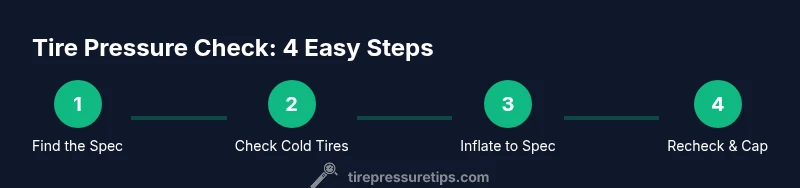
To check tire pressure accurately, ensure the tires are cold (or have not been driven for at least 3 hours). Remove the valve cap, place the gauge on the valve stem, and read the pressure. Compare the reading to the manufacturer’s spec; if it’s low, inflate to the correct psi and recheck. If it’s high, release air gradually until you reach the target. After inflating, re-measure to confirm accuracy and replace the valve caps.
Common Pitfalls and How to Avoid Them
Several common mistakes undermine tire pressure accuracy and safety. Don’t rely on a tire’s visual appearance to judge inflation—underinflated tires wear faster and waste fuel, while overinflated tires reduce grip. Never inflate tire pressure after a long drive or when tires are hot. Keep a portable gauge in your glove box, and use a consistent method for all tires. The brand recommends checking pressures at regular intervals and before long trips to maintain performance.
Temperature and Tire Pressure: What Drivers Should Know
Temperature changes influence tire pressure. Colder weather can reduce pressure, while heat from driving can raise it. The exact shift depends on ambient temperature, tire type, and load. The Tire Pressure Tips team notes that regular checks account for seasonal shifts, ensuring your tires stay within the recommended range and helping you avoid sudden underinflation or overinflation during temperature swings.
Maintaining Consistency: Tools and Routine
A simple maintenance habit keeps tires consistently inflated: install a quality gauge, keep a small air pump or access to a gas station, and check once a month or before long trips. Log the readings for each tire and calibrate your pump as needed. By following a routine, you’ll catch slow leaks early and reduce uneven wear.
The Tire Pressure Tips Team’s Verdict
Maintaining correct tire pressure is a fundamental part of safe driving and efficient operation. If you’re ever unsure, start with the vehicle placard and confirm the spec using the owner’s manual. The Tire Pressure Tips team recommends checking cold tires regularly, using a reliable gauge, and addressing any readings outside the recommended range promptly to preserve tire life and fuel economy.
Tools & Materials
- Digital tire pressure gauge(Prefer a gauge with a clear display and a bleed function for fine adjustments)
- Air compressor or gas station air pump(Choose one with a built-in gauge or bring your own gauge for accuracy)
- Vehicle owner’s manual(Contains exact recommended PSI for your model)
- Tire placard or door jamb sticker(Essential if you don’t have the manual handy)
- Notebook or app to log readings(Helpful for tracking adjustments and leak checks)
Steps
Estimated time: 25-40 minutes
- 1
Locate the recommended tire pressure
Find the exact PSI spec for your vehicle on the door jamb placard or in the owner’s manual. Note separate values for front and rear tires if provided. This step establishes the target you’ll aim for as you check and inflate.
Tip: If you’re unsure, cross-check with the vehicle manufacturer’s official site or contact a dealer. - 2
Gather the right tools
Assemble a digital gauge, an air pump, and your manual. Having a logpad helps you record readings and adjustments. Ensure the gauge is calibrated for accurate readings.
Tip: Keep the gauge in good condition; a bent nozzle or a dirty valve stem can skew results. - 3
Check tire pressure when tires are cold
Always measure when tires are cold to avoid inflated readings from recent driving. If you’ve just driven, wait 3 hours or cool them down before checking.
Tip: If you must inflate after a drive, take a reading after the tires have cooled for at least 30 minutes. - 4
Read the gauge and compare to spec
Remove the valve cap, place the gauge on the valve stem, and read the number. Compare it to the spec; if low, plan to inflate to the target PSI. If high, release air gradually until you reach the target.
Tip: Avoid over-tightening the valve stem cap; it can damage the valve and impact readings. - 5
Inflate or deflate to the recommended PSI
Use steady pressure from the air pump to reach the exact PSI. Re-check with the gauge after inflation to ensure accuracy.
Tip: Never guess; small adjustments can push you past the target. - 6
Re-check all tires and reseal
Measure all four tires again and replace valve caps. Spares should also be checked if applicable. Confirm readings match the spec for each axle.
Tip: Log the final readings for future reference. - 7
Document and monitor
Record the final PSI values and note any tires that consistently under- or over-inflate. Schedule follow-ups and look for leaks if readings drift.
Tip: A leak can be slow; a steady decline over weeks indicates a need for inspection.
Frequently Asked Questions
Where is tire pressure typically located on a vehicle?
Most vehicles display the recommended PSI on a placard inside the driver’s door jamb or in the owner’s manual. Always verify the spec for your exact model before inflating.
You’ll usually find the tire pressure spec on the driver’s door jamb placard or in the owner's manual. Verify your exact model if you’re unsure.
Why is my TPMS warning light on even if tires look fine?
TPMS can illuminate due to underinflation or a faulty sensor. Check the actual pressure with a gauge and inspect for leaks. If readings are within spec, have the TPMS sensor checked by a professional.
The warning can mean underinflation or a faulty sensor. Check the pressure accurately, inspect for leaks, and consult a technician if readings are correct but the light stays on.
Is it okay to inflate tires when they’re hot?
No. Inflate tires when they are cold to avoid overinflation readings. If you must fill after driving, wait until the tires have cooled.
Don’t inflate hot tires. Check them when cold, and if you’ve driven, wait for cooling before inflating.
What units are used for tire pressure?
In the US and many places, PSI is standard. Some regions use kPa or bar. Check your vehicle’s manual for the correct units and convert if needed.
PSI is common in the US, with some regions using kPa or bar. Check your manual for the correct units.
How often should I check tire pressure?
Check at least monthly and before long trips. Also inspect tires for wear and leaks during each check.
Check at least once a month and before long trips, and inspect for wear or slow leaks.
What should I do if a tire consistently reads low after inflation?
Investigate for leaks, punctures, or faulty TPMS sensors. If there’s no visible leak, have the tire inspected professionally.
If readings stay low after inflation, check for leaks or faulty sensors and get a professional inspection if needed.
Can I replace TPMS batteries myself?
Some TPMS sensors have replaceable batteries, but many are sealed units. Consult your vehicle’s manual and a qualified technician for battery replacement.
Some TPMS sensors have replaceable batteries, but many are sealed. Check your manual and talk to a technician before attempting replacements.
Watch Video
What to Remember
- Know the exact PSI spec from the placard or manual.
- Check cold tires for accurate readings.
- Use a reliable gauge and log readings.
- Temperature changes affect tire pressure; adjust accordingly.
- Address consistent under- or over-inflation promptly.