Tire Pressure Without Gauge: Practical Guide
Learn how to estimate tire pressure without a gauge using placards, TPMS cues, and safe visual checks. Includes practical steps, warnings, and when to inflate properly.


You can estimate tire pressure without a gauge by using the vehicle’s recommended cold pressures from the placard, relying on TPMS cues, and noting obvious signs of underinflation. It isn’t precise, but these indicators help you decide when to inflate or seek a gauge. Always aim to verify pressures with a gauge as soon as possible.
Why tire pressure matters and how to think about estimation
According to Tire Pressure Tips, maintaining the correct tire pressure is essential for safety, fuel efficiency, and tire longevity. When you drive with underinflated tires, you increase rolling resistance, which can raise fuel consumption and heat buildup. Overinflated tires, on the other hand, can reduce grip and accelerate uneven wear. This section explains why guessing the exact psi without a gauge is risky and how to use available cues to decide when to inflate and when to seek a precise measurement. The guidance here is designed for quick, practical decisions between formal checks, not to replace a gauge. The Tire Pressure Tips team emphasizes the importance of targeting the manufacturer’s spec to ensure optimal performance.
The limitations of estimating tire pressure without a gauge
Estimating pressure without a gauge relies on indirect cues, which vary with temperature, tire type, and load. The door placard provides the official cold-pressure range for your vehicle, but ambient heat, recent driving, and tire wear can skew how the tire feels and how the TPMS reads it. Visual checks and ride feel can signal whether inflation is clearly too low or too high, but they cannot replace precise measurements. This section outlines why those signs exist and how to interpret them safely without a gauge.
How to use TPMS and placards to approximate pressure
Your first reference should be the placard on the driver’s door jamb or in the owner’s manual, which lists the recommended cold psi for front and rear tires. If your TPMS indicates a low-pressure condition, treat it as a priority cue, especially after temperature changes or heavy loads. Compare TPMS readings to the placard values, and note any significant deviations. Remember that TPMS alerts are designed to warn you about pressure changes, not to provide an exact psi under all conditions.
Practical, step-by-step methods you can use now (no gauge required)
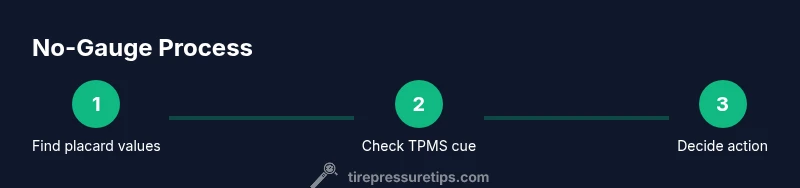
Use a four-step mental model when you’re without a gauge: (1) Verify the official spec from the placard, (2) Observe the TPMS warning or reading, (3) Inspect the tire’s exterior for obvious signs of underinflation (flattened contact patch, sidewall sag, excessive wear), and (4) Decide if you can wait for an actual gauge or if you should inflate at a safer nearby location. This section expands on those steps with examples, cautions, and how to combine cues to act responsibly.
Safety reminders and when to seek a gauge immediately
If you notice excessive vibration, a shifting handling feel, or visible damage such as bulges or cuts, stop and seek a professional gauge check as soon as possible. Do not rely on estimation in adverse weather, during long trips, or when the tires look visibly underinflated. A precise measurement with a proper gauge is the safest path to proper inflation and tire longevity.
Authority sources and further reading
- National Highway Traffic Safety Administration (NHTSA): Tire care and safety guidance: https://www.nhtsa.gov/equipment/tires
- Consumer-focused tire maintenance guidance from major publications: https://www.consumerreports.org/cars-maintenance/how-to-check-tire-pressure/
- Safety and tire maintenance considerations from industry resources: https://www.nsc.org/road-safety/safety-topics/tires
Tools & Materials
- Vehicle door placard with recommended psi(Found on the driver’s door jamb or inside the owner’s manual cover)
- Flat, level parking surface(Best on tires that are cool; avoid after road use)
- Notebook or mobile app for logging estimates(Optional for tracking changes over time)
- Clean cloth or rag(Useful to wipe residue from the tire or placard)
Steps
Estimated time: 12-18 minutes
- 1
Locate the official tire pressure spec
Find the recommended cold psi on the driver’s door placard or in the owner’s manual. Note separate values for front and rear tires if the vehicle requires different pressures. This is your baseline for any estimation when you lack a gauge.
Tip: Double-check both front and rear values when your vehicle has a four-tork configuration or variable load settings. - 2
Check the TPMS cue
If a TPMS light is illuminated, use it as a cue to investigate. A low-pressure indication plus typical driving at moderate speeds suggests inflation is needed. If the light is steady on, compare it to the placard values as soon as possible.
Tip: TPMS is a warning system, not a precise measure; treat any warning as a priority signal to check pressure with a gauge. - 3
Conduct a quick visual and feel check
Inspect tires for flattened contact patches, visible sag, or excessive bulges. A tire that looks flatter than normal or feels heavier to push could indicate underinflation. Use these cues to decide whether you can safely continue to drive without a gauge.
Tip: If you notice irregular wear or sidewall damage, stop and seek professional assessment immediately. - 4
Estimate based on the condition and temperature
Hot tires or high ambient temperatures can raise apparent pressure; cold checks are more accurate. If you recently drove, wait for tires to cool before making a rough estimate, and plan to verify with a gauge later.
Tip: Avoid inflating or deflating based on a hot reading; wait at least 10-15 minutes for a cooler check when possible. - 5
Decide action based on available cues
If TPMS indicates low pressure and you have clear visual signs of underinflation, prioritize inflation with a gauge as soon as possible. If no gauge is accessible, limit high-speed driving and long trips until you can confirm psi precisely.
Tip: Plan routes to a location where you can accurately measure and adjust tire pressure if needed. - 6
Seek precise measurement as soon as possible
As soon as you can obtain a tire-pressure gauge or visit a service center, perform a proper check and adjust to the manufacturer’s recommended psi. Keep a gauge in your vehicle to avoid guessing in the future.
Tip: Carrying a tire gauge or a portable inflator with gauge is the simplest long-term solution.
Frequently Asked Questions
Can I accurately determine tire pressure without a gauge?
No. Without a gauge you cannot measure the exact psi. You can use placard references, TPMS cues, and visual signs to assess whether inflation is needed, but a gauge is essential for precision.
No—the exact pressure can only be measured with a gauge. You can estimate using the placard and TPMS cues, but for accuracy, check with a gauge.
Why should I not rely solely on TPMS readings?
TPMS warnings indicate a pressure change, not the exact value. Temperature, load, and tire type affect readings. Use TPMS as a trigger to check PSI with a gauge when possible.
TPMS tells you there's a change, not the exact pressure. It’s a warning, not a measurement.
What are signs of underinflation I can notice without a gauge?
Visible flattening of the tire’s contact patch, uneven wear, or a noticeably heavier steering feel can indicate underinflation. If the tire looks deflated, stop and verify with a gauge when you can.
Look for flattening at the contact patch or odd tire wear, and a heavier steering feel as clues.
Is it safe to drive to a nearby gas station to check pressure?
If the tire shows obvious underinflation or damage, limit driving and seek a gauge check promptly. If you must drive, do so slowly and avoid high speeds or long distances.
Only drive slowly and cautiously if you suspect underinflation, and get a gauge check as soon as possible.
How often should I check tire pressure?
Check at least once a month and before long trips. Temperature changes and seasonal shifts can affect pressure, so a quick check during changeovers is wise.
Check monthly, and before big trips—pressure changes with temperature.
What should I do if I can't find the placard?
If the placard isn’t accessible, refer to the vehicle’s manual or contact the dealer for the recommended pressures. Do not inflate to guess values.
If you can’t find the placard, check the manual or ask a dealer for the specs.
Watch Video
What to Remember
- Check the placard before inflating.
- TPMS aids estimates, but isn’t a precise gauge.
- Visual and ride cues help triage but require a gauge for accuracy.
- Inflate or seek a gauge promptly if you suspect underinflation.
- Always verify with a tire gauge when possible.