Tire Pressure Gauge and Pump: A Practical How-To Guide
Learn how to choose, use, and maintain a tire pressure gauge and pump for accurate readings, safer inflations, and improved fuel efficiency. This step-by-step guide covers gear selection, reading accuracy, inflation technique, troubleshooting, and seasonal considerations.


With this guide, you will master using a tire pressure gauge and pump to keep tires at the correct PSI, improve fuel efficiency, and extend tire life. You'll learn how to choose a gauge, read readings accurately, operate a pump, verify results, and troubleshoot common issues with TPMS alerts and seasonal temperature changes.
Why a tire pressure gauge and pump matter
Maintaining correct tire pressure is a cornerstone of safe driving, fuel efficiency, and tire longevity. A reliable tire pressure gauge and pump let you verify psi accurately, adjust pressure as needed, and respond quickly to seasonal temperature changes that can affect tire inflation. According to Tire Pressure Tips, accurate measurement begins with using a gauge that suits your needs and a pump that delivers consistent airflow. This combination helps you avoid underinflation, which can cause uneven wear, poor handling, and increased rolling resistance, and overinflation, which can reduce traction and comfort. In practice, regular checks become a small part of your routine—yet they deliver big returns in performance and safety for every trip. Think of your gauge and pump as essential maintenance tools, just like a wrench or a jack, because tire health influences braking, steering, and road grip. Emphasizing regular checks is especially important for families, commuters, and drivers who put many miles on their vehicles.
In this guide, we’ll cover gauge types, how to read psi correctly, how to choose a pump that matches your tires, and a practical, step-by-step approach you can use on any vehicle. You’ll also learn common pitfalls and how to avoid them, including how to account for cold tires and how TPMS readings relate to actual pressure. Tire Pressure Tips emphasizes that precision matters; a small error in gauge reading can lead to improper inflation, which may compromise safety and shield you from the best fuel economy. The goal is a practical, repeatable process you can perform in minutes, with confidence that your tires are at the right pressure.
15
Tools & Materials
- Tire pressure gauge (digital or analog)(Choose one with a wide measurement range (e.g., 10-70 psi) and a stable head that fits valve stems.)
- Air pump or compressor(Prefer a pump with a built-in gauge or a separate gauge for verification.)
- Valve core tool or a clean rag(Keep valve stems clean; use rag to wipe dust before attaching gauge.)
- Owner’s manual or placard with recommended PSI(Check front door placard or manual for vehicle-specific pressures.)
- Notebook or app to record readings(Optional, but helps track PSI changes over time.)
- Tire placard for seasonal guidance(Useful for noting seasonal adjustments.)
Steps
Estimated time: 30-45 minutes
- 1
Gather tools and prepare the vehicle
Collect your gauge, pump, and a clean rag. Park on a level surface away from traffic, set the parking brake, and turn off the engine. If you’re checking multiple tires, decide the sequence before you begin to minimize time with hot tires.
Tip: Verify the gauge faces zero before starting to ensure accuracy. - 2
Identify the correct PSI
Look up the vehicle’s recommended tire pressure from the owner’s manual or the door placard. Remember that the recommended pressure is for cold tires and can differ between front and rear tires or between load conditions.
Tip: Do not use the gauge after a long drive; PSI rises with heat. - 3
Remove the valve cap and attach the gauge
Carefully unscrew the valve stem cap and place it in a safe location. Place the gauge on the valve stem and press straight on to avoid air leaks. If using a cap with a built‑in valve core, ensure it threads on snugly.
Tip: If air leaks around the gauge, press harder and ensure a clean seal. - 4
Read the pressure
Read the PSI on the gauge once it stabilizes. For analog gauges, hold steady and note the pointer position; for digital gauges, read the number on the display. Repeat on all tires to establish a baseline.
Tip: Take a second reading to confirm consistency. - 5
Inflate or deflate as needed
If the reading is below the recommended PSI, connect the pump and add air in short bursts, checking frequently. If above, use the valve stem core to release air gradually and recheck.
Tip: Inflating in 2-3 psi increments reduces overshoot. - 6
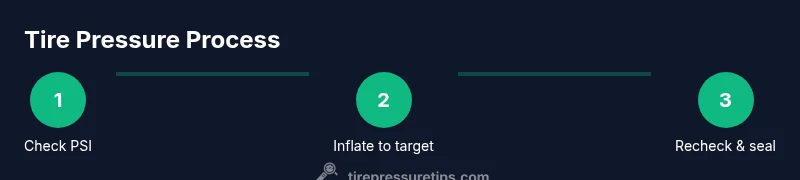
Recheck and seal
After inflating or deflating, recheck all tires once more and replace valve caps securely. Keep a record of your final PSI readings for future reference.
Tip: Record date, tire, and PSI to notice trends over time.
Frequently Asked Questions
Should I check tire pressure when tires are cold or hot?
Check tire pressure when tires are cold for the most accurate reading. Driving heats tires and raises the PSI, which can lead to under-inflation if you inflate after driving. Wait at least three hours after driving or check before you drive in the morning.
Check tires when cold for the most accurate reading; driving warms tires and can give you a false high PSI.
What is the difference between a digital gauge and a dial gauge?
Digital gauges display a numeric PSI reading and are easy to read, while dial gauges use a needle against a numbered scale. Digital gauges can offer quicker readings and often store last values, but both can be accurate if calibrated.
Digital gauges give you a quick number; dial gauges require reading a dial, but both work well if accurate.
How often should I test my tire pressure?
Check tire pressure at least once a month and before long trips. More frequent checks are wise when the seasons change or if you notice handling changes, uneven wear, or a TPMS warning.
Check monthly and before trips, especially during seasonal changes or if you notice handling changes.
Can I rely on TPMS readings instead of a gauge?
TPMS provides a warning when pressure is too low or too high, but it does not give an exact psi. Always confirm with a gauge to set the correct pressure.
TPMS warns you but won’t tell you the exact PSI; use a gauge to set proper pressure.
How do temperature changes affect tire pressure?
Temperature changes can cause air to expand or contract, altering PSI. In cold weather, pressures drop; in heat, they rise. Regular checks help compensate for these shifts.
Colder temperatures lower PSI; hotter days raise it. Check often during season changes.
Watch Video
What to Remember
- Check cold tires to get accurate readings
- Use a reliable gauge and verify with a pump
- Follow vehicle-specific PSI targets from placards or manual
- Inflate in small steps and recheck for accuracy
- Maintain your tools and record readings for trends