How to Use a Tire Pressure Pump: A Practical Guide
Learn step-by-step how to use a tire pressure pump to inflate tires to the recommended PSI, using a gauge for accuracy, and maintain safe, efficient driving. Includes pump types, safety tips, and maintenance.


Using a tire pressure pump allows you to inflate tires to the recommended PSI accurately and safely. This guide covers pump types, valve compatibility, and how to verify pressure with a gauge. You’ll learn a repeatable, maintenance-friendly routine for any vehicle so you avoid under- or over-inflation. How to use a tire pressure pump is straightforward when you follow these steps.
Why correct tire pressure matters
Understanding why correct tire pressure matters is the foundation of safe driving. Proper inflation influences how the tire contacts the road, handling, braking distance, fuel efficiency, and tire wear. Under-inflated tires flex more, heat up, and wear at the edges; over-inflated tires ride on the center tread, reducing grip and causing uneven wear. The right pressure helps maximize tread life and ensures the tire's load rating is honored. For most passenger cars, the recommended PSI is found on the driver's door jamb placard or in the owner's manual; tire sidewalls show maximum pressure but not the required operating pressure. Check tires when they are cold, because heat from driving raises PSI. Seasonal changes also affect pressure: cold weather lowers PSI, while hot weather raises it. Regular checks help you catch slow leaks from nails or valve stem failures. In practice, knowing how to use a tire pressure pump correctly is a simple, repeatable habit that keeps tires in the safe range.
When Tire Pressure Tips analyzes common driving habits, we see that a quick, routine inflation check saves both wear and fuel costs over time. Adopting a consistent routine reduces the chance of driving on under- or overinflated tires and improves overall vehicle safety. This section lays the groundwork for a practical inflating routine that you can apply at home, at a gas station, or on the roadside. Implementing this habit is a small effort with meaningful benefits for your safety and vehicle performance.
note
Tools & Materials
- Tire pressure pump(Manual, foot, or electric pump with a compatible nozzle)
- Tire pressure gauge(Digital gauge recommended; ensure accuracy within ±1 psi)
- Valve adapters(Presta-to-Schrader adapters if needed for non-car valves)
- Valve caps(Keep caps on after inflation to prevent leaks)
- Owner's manual or door placard(Source for the correct target PSI)
Steps
Estimated time: 10-15 minutes
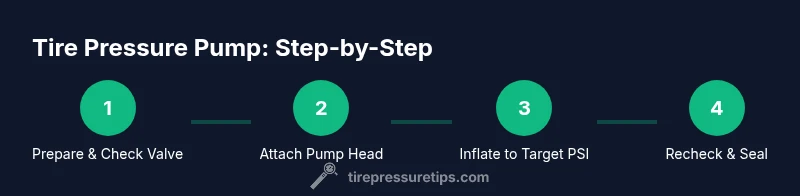
- 1
Identify valve type and prepare tools
Locate the valve stem on the tire and determine whether it is Schrader or Presta. Gather your pump, gauge, and any adapters before you start. If you drive a bike or a vehicle with unusual valves, confirm compatibility to avoid leaks. This step prevents compatibility issues that slow you down later.
Tip: Carry a small adapter kit in your glove box for Presta vs Schrader valves. - 2
Remove valve cap and inspect
Twist off the valve cap and wipe away dust or debris from the valve stem. A dirty valve can compromise the seal when you attach the pump head. If you see cracks or damage, do not inflate and seek professional help. Re-seat the cap after inspection if no issues are found.
Tip: Inspect for cracks or corrosion on the valve stem; damaged valves can cause leaks. - 3
Attach pump head securely to the valve
Place the pump head on the valve and press firmly to create an airtight seal. If using a manual or foot pump, engage the locking mechanism or lever to hold the head in place. A poor seal will allow air to escape during inflation.
Tip: A quick wiggle confirms the head is seated; a loose head wastes effort and distorts readings. - 4
Inflate and monitor pressure
Begin pumping and watch the gauge as pressure rises toward the target. Make small, controlled strokes and pause to check the reading frequently. If your pump has a gauge, ensure you’re reading in the correct units (psi or kPa) and avoid overfilling.
Tip: Inflate slowly and take breaks if you’re using a high-volume air source to prevent overheating the pump seal. - 5
Adjust to exact target pressure
Aim to reach the exact target PSI listed for your vehicle. If you’re overinflating, release air slowly (some pumps have a release valve); if underinflated, add pressure in small increments. Recheck with the gauge after adjustments.
Tip: Aim for within 1–2 psi of the target for best accuracy. - 6
Remove pump, reseal, and recheck
Carefully remove the pump head while keeping the tire stable. Refit the valve cap securely and recheck the tire pressure once more to confirm stabilization. If readings drift, re-check after a short drive or cooler period.
Tip: Recheck to ensure the tire remains at the target after the seal settles. - 7
Repeat for all tires and finalize
Repeat the same process on the remaining tires, prioritizing the ones most likely to be underinflated (often the rear tires). After inflation, drive a short distance and recheck to confirm stability. Store your pump and gauge together in a dry place.
Tip: Keep a small log of PSI readings over time to spot leaks early.
Frequently Asked Questions
Do I need a separate air compressor or gauge to use a tire pressure pump?
A pump with an integrated gauge can work, but a separate, accurate tire gauge helps ensure you hit the exact target PSI. Manual pumps often require a separate gauge, while electric pumps may include one. Always verify readings with a reliable gauge.
Yes, having a separate gauge helps verify accuracy, even if your pump has a built-in gauge.
How do I know the correct PSI for my tires?
The correct PSI is listed on the vehicle’s door placard or in the owner's manual. Some tires also show a maximum PSI on the sidewall, but that is not the operating pressure. Use the placard as the target, not the maximum.
Check the door placard to find the recommended PSI for your tires.
What should I do if my pump won’t seal to the valve?
Check for a bent or damaged valve stem and ensure there’s no dirt blocking the seal. Re-seat the head and try again. If leaks persist, use a different nozzle or an adapter and inspect the valve for damage.
Try re-seating the head and cleaning the valve; if it still leaks, use an adapter or consult a tire professional.
Can I inflate my tires while the car is running?
No. Inflate with the vehicle off and on a stable surface to avoid movement. If you’re inflating near the engine, be aware of hot surfaces and fumes.
It’s best to inflate when the engine is off and the car is stationary.
Is it safe to inflate tires to the maximum PSI listed on the sidewall?
No. The maximum PSI printed on the sidewall is not the recommended operating pressure. Inflate to the vehicle’s specified PSI to maintain safety and performance.
Never inflate to the sidewall maximum; use the recommended PSI instead.
Watch Video
What to Remember
- Check tires when cold to get accurate readings
- Use a gauge to verify target PSI, not the tire sidewall maximum
- Attach pump securely to avoid air leaks
- Inflate in small increments until you reach the target pressure
- Recheck all tires after inflation for consistency