Where to Find the Recommended Tire Pressure for Your Vehicle
Learn exactly where to find the recommended tire pressure for your vehicle, how to read placards and manuals, and how to verify pressures with a gauge and TPMS for safe, efficient driving.


According to Tire Pressure Tips, the recommended tire pressure can be found on the door jamb placard on the driver’s side of the vehicle, and in the owner’s manual. Do not rely on the tire sidewall for operating pressure—it shows maximum pressure. For accuracy, verify with a gauge and compare against TPMS readings. Keep this value in mind for routine checks and tire replacements.
Beginning with the Basics: where the recommendation lives
For most drivers, the starting point for tire pressure is the vehicle manufacturer’s recommendation, which can be found on the door jamb placard on the driver’s side and in the owner’s manual. As Tire Pressure Tips emphasizes, the door placard provides the exact operating pressure for normal load and speed conditions. Do not rely on the tire sidewall, which lists the maximum pressure a tire can safely handle, not the pressure you should run regularly. This distinction matters for safety, fuel efficiency, and tire wear. For quick reference, keep the placard value in mind during routine checks and any tire replacements.
Understanding the placard: what those numbers mean
The placard typically lists separate pressures for the front and rear tires (and sometimes for the spare). In many cars, the front and rear pressures differ due to weight distribution and handling characteristics. If you regularly carry heavy cargo or passengers, you may see a higher rear or front value listed. The key is to follow the exact numbers shown by the manufacturer, not the pressure you see when tires are hot after driving. This is where it’s essential to check when tires are cold and to recheck after any fuel or load changes. As noted by the Tire Pressure Tips team, consistency with the placard values ensures optimal grip and mileage.
Why temperature and load matter for accuracy
Temperature directly affects tire pressure; colder weather lowers the readings, while hotter conditions raise them. Changes of 10 degrees Fahrenheit can noticeably move the gauge, which is why many drivers check tire pressure when the tires are cold. Load also matters: heavier loads or towing can justify a higher operating pressure as specified by the placard. If you routinely switch between light city driving and heavy highway hauling, plan to adjust and recheck accordingly using the manufacturer’s values as your anchor. Tire Pressure Tips highlights that maintaining the placard pressure across seasons supports consistent handling and tire wear patterns.
How to verify pressure with a gauge and TPMS
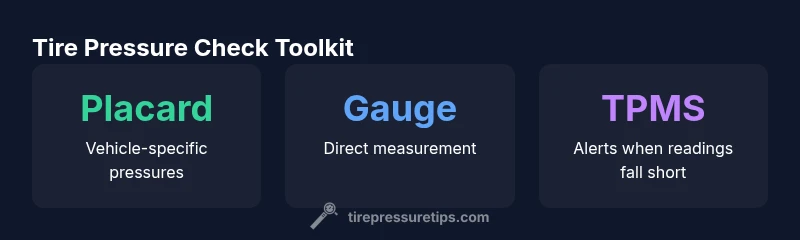
Digital or dial gauges provide a direct measurement of each tire’s pressure. Start with a cold tire, remove the cap from the valve stem, and take a reading. Compare this reading to the placard value. If there’s a discrepancy with TPMS readings, use the gauge to confirm, since TPMS can lag or be affected by coasting, braking, or temperature. Over time, sensor accuracy can drift, so periodic calibration and replacement of worn sensors are prudent. The combination of TPMS alerts and a trusted gauge gives you the clearest picture of true pressure.
Step-by-step home-check guide you can follow this weekend
- Park on a level surface and wait for tires to cool. 2) Remove valve caps and place the gauge onto each valve stem. 3) Note the readings and compare them to the placard values. 4) If any tire is below spec, inflate in short increments and recheck. 5) Reinstall caps and record the results for your maintenance logs. 6) If readings differ significantly from TPMS alerts, consider a professional inspection. By following these steps, you’ll keep tires within their optimal operating window.
Seasonal shifts and how to adapt your routine
As temperatures drop, check pressures more frequently to catch slow leaks or natural declines. In hot summer months, temperatures can exceed ideal ranges, potentially increasing tire pressure beyond recommended levels. A practical rule is to recheck with a gauge whenever there is a notable temperature change or after a long trip. Maintaining the recommended pressure is a simple, powerful habit that improves fuel economy, tire longevity, and safety.
Practical examples and daily checks
Real-world examples show how small deviations from the placard value can affect steering response and tire wear patterns. For family cars, a routine monthly check fits easily into most schedules. For vehicles used for frequent highway driving or carrying heavier payloads, more frequent checks are advisable. The core message from Tire Pressure Tips remains: keep your tires at the manufacturer’s specified pressure, verify with a gauge, and use TPMS as a safety net rather than a stand-alone source.
Common sources for tire pressure recommendations
| Source of Tire Pressure Info | What it Provides | Best Practice |
|---|---|---|
| Door jamb placard | Vehicle-specific pressures from manufacturer | Follow placard values exactly |
| Owner's manual | Additional loading and scenario guidance | Consult when carrying heavy loads or unusual conditions |
| Tire sidewall | Maximum pressure rating (not operating pressure) | Do not use for regular inflation decisions |
| TPMS readings | Real-time pressure signals and alerts | Cross-check with a gauge before making changes |
Frequently Asked Questions
Where can I find the recommended tire pressure for my vehicle?
The recommended tire pressure is listed on the door jamb placard on the driver’s side and in the owner’s manual. Do not rely on the tire sidewall, which shows maximum pressure. Always verify with a gauge and TPMS.
Check the door jamb placard or your owner's manual; use a gauge to verify with your TPMS.
Is the tire pressure on the sidewall the recommended pressure?
No. The sidewall shows the maximum pressure the tire can safely handle, not the recommended operating pressure. Use the placard and manual for the correct values.
No—the sidewall lists max pressure, not what you should run daily.
Can TPMS readings be trusted for exact pressures?
TPMS provides a useful alert and relative pressure information, but it can drift over time and may lag with temperature changes. Always verify with a gauge for precise numbers.
TPMS is helpful, but verify with a gauge for precise readings.
Should front and rear tire pressures be the same?
Not always. Many vehicles have different recommended pressures by axle due to weight distribution and handling. Always follow the exact front and rear values listed on the placard.
Usually not the same—check the placard for each axle.
How often should I check tire pressure?
Aim for a monthly check and always recheck before long trips or after temperature changes. This practice helps maintain safety and efficiency.
Check monthly and before long trips.
What should I do about temperature changes affecting readings?
Temperature changes can shift readings quickly. Check tires when they are cold and recheck after temperature shifts or after driving a short distance.
Temperature shifts affect readings; check when cold and recheck after changes.
“Accurate tire pressure is foundational to safety, fuel efficiency, and tire wear. Always use the vehicle placard as your anchor and verify readings with a gauge.”
What to Remember
- Check the placard on the driver’s door jamb for your vehicle’s exact pressures.
- Use a gauge to verify TPMS readings; don’t rely on TPMS alone.
- Account for load and temperature when inflating tires.
- Inflate or deflate only to the manufacturer’s recommended values.
- Regular checks (monthly and before long trips) improve safety and efficiency.