Pump Tire Pressure: A Practical Guide
Learn how to pump tire pressure correctly for safety, fuel efficiency, and even tire wear. Discover target PSI, how temperature affects readings, the right gauges, and a simple, step-by-step method to keep your tires properly inflated.


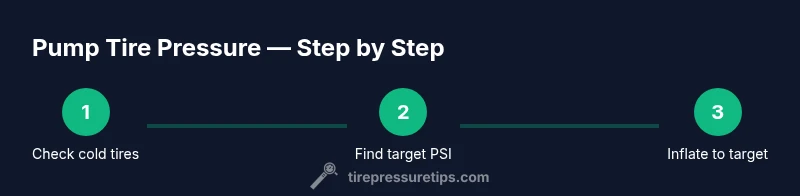
To pump tire pressure correctly, start with the vehicle’s recommended PSI from the door placard or manual. Check tires when cold, use a reliable gauge, and adjust each tire to the target PSI before driving. Recheck after inflation to confirm accuracy and ensure safe handling.
Why correct tire pressure matters
Proper tire pressure affects handling, braking, fuel economy, tire wear, and overall safety. According to Tire Pressure Tips, maintaining correct tire pressure helps your vehicle respond predictably in emergencies and reduces rolling resistance. The Tire Pressure Tips team found that underinflation is a common issue that leads to uneven wear and higher fuel consumption, while overinflation can reduce grip and increase ride harshness. By starting with the vehicle’s recommended PSI (printed on the door jamb placard or in the owner’s manual) and checking when tires are cold, you set a baseline that protects the tire structure and improves efficiency. Temperature, load, and tire type all influence the ideal pressure, so periodic checks are essential, especially before long trips or seasonal changes.
How to determine your target PSI
Your target PSI is not a fixed number for all tires; it depends on vehicle design, load, and tire size. The recommended pressure is listed on the door jamb placard and often in the owner’s manual. Front and rear tires may have different targets; ensure you compare the correct line for your configuration. When tires are cold, check their PSI using a reliable gauge. If you drive before inflating, the reading will be higher than the true cold pressure. Temperature affects air volume, so read readings after the tire has cooled. Use your TPMS as a supplementary guide; it can warn of low pressure but doesn’t measure precise PSI. Tire Pressure Tips analysis shows that relying on the placard and a gauge yields the most accurate result.
Tools you need to pump tire pressure
Before you start, gather the essential tools:
- A reliable tire pressure gauge (digital or dial). Essential for accurate readings.
- An air source: a home air compressor or gas-station pump. Essential for adjusting pressure.
- Your vehicle’s door placard and owner’s manual for the exact target PSI. Essential reference.
- Valve cap and cleaning cloth (optional) to keep stems clean and seals tight. Helpful but not mandatory.
Step-by-step overview (the detailed steps follow in the dedicated STEP-BY-STEP section)
This guide walks you through a careful sequence to ensure each tire reaches the correct pressure. Start with cold tires, verify targets, attach the gauge securely, inflate gradually, recheck, and replace caps. If any tire refuses to hold pressure, there may be a leak or a sensor alert that deserves closer inspection. Remember, consistency across all four tires matters for balanced handling and even wear.
Temperature effects on tire pressure
Air expands with heat and contracts when cold. Driving heats tires and can temporarily raise pressure, while a cold morning lowers readings. For the most reliable results, check tire pressure when the tires are cold (after at least a few hours of non-driving). In extreme temperatures, recheck more frequently, as pressure can drift by several PSI between seasons.
Maintenance and safety best practices
Regular maintenance of tire pressure is part of responsible vehicle care. Keep a small gauge in the glove compartment, and set a reminder to check monthly or before long trips. Always inflate within the recommended range; do not inflate to the tire’s maximum sidewall pressure, which is a limit for the tire’s load, not a target for inflation.
Common mistakes to avoid
Avoid relying on the wrong gauge (e.g., a low-quality dial that wears down quickly) or inflating tires after driving (hot tires show higher readings). Never ignore a TPMS warning—if it indicates low pressure, check and fix promptly. Finally, remember to check the spare tire pressure as part of routine maintenance, especially in temperature-variant climates.
Tools & Materials
- Digital tire pressure gauge(For quick, precise readings; keep with fresh batteries.)
- Dial-type tire pressure gauge(Backup gauge if digital fails.)
- Air compressor or inflator(Use at home or a station; ensure it provides stable, controllable airflow.)
- Vehicle door placard and owner's manual(Target PSI per tire position.)
- Valve caps and clean cloth(Optional; helps keep valve stems clean and sealed.)
Steps
Estimated time: 20-40 minutes for a full four-tire check and adjustment
- 1
Park on a level surface and ensure tires are cold
Position the vehicle so you can reach all four tires. If you’ve been driving, wait at least 3 hours for tires to cool before taking readings. This prevents readings biased by heat.
Tip: A cold start yields the most accurate baseline measurement. - 2
Find the correct target PSI
Locate the exact target PSI on the door placard or in the owner’s manual. Note any variation between front and rear tires and between axle positions.
Tip: Always match the tire position (front/rear) when looking up numbers. - 3
Attach the gauge to the valve stem
Make a firm seal with the valve stem and gauge so you don’t lose air during measurement. Remove the cap first and keep it handy.
Tip: If you hear hissing, reseat the gauge and check for a clean seal. - 4
Inflate or deflate to the target PSI
Add air in small increments (1-2 psi at a time) and pause to recheck. Stop when the gauge matches the target on each tire.
Tip: Overinflation is easier to fix later than underinflation. - 5
Recheck all four tires
Verify each tire’s pressure again after inflation. If all four are close to the target, you’re likely set for safe driving.
Tip: Remember, tires cool after a drive; recheck in the next hour if you drove just now. - 6
Replace valve caps and store your tools
Replace the valve caps to keep dust out. Store your gauge in a known spot for easy access next time.
Tip: Keep a simple inflation log to track changes over seasons. - 7
Note the targets for future checks
Record the PSI targets and any anomalies for future reference, helping you detect leaks or TPMS drift early.
Tip: A small notebook or phone note makes future checks faster.
Frequently Asked Questions
How often should I check my tire pressure?
Ideally, check at least once a month and before long trips. If you notice a TPMS warning, inspect and adjust promptly.
Check your tire pressure at least once a month and before long trips. If the TPMS warns you, inspect and adjust promptly.
Can I drive with low tire pressure if I don’t have air?
If you must, drive slowly and to the nearest safe stop to inflate. Low pressure can overheat and cause a blowout.
You should not drive far on low pressure. If you must, go slowly to a safe place to inflate.
Does TPMS show exact PSI or just warnings?
Most TPMS provides warnings and may show rough estimates, but it’s not a substitute for a precise gauge reading.
TPMS often warns you of low pressure and may show approximate numbers, but it isn’t a precise PSI readout.
Does cold weather affect tire pressure?</
Yes. Cold air lowers pressure. Check more often in winter and adjust once tires warm up to driving conditions.
Cold weather lowers tire pressure, so check more often in winter and adjust after tires warm up.
Should I inflate to the maximum PSI listed on the tire sidewall?
No. The sidewall max is for maximum load rating, not a target. Always use the vehicle’s recommended PSI.
No. Don’t inflate to the max on the sidewall; use the vehicle's recommended PSI.
What if a tire won’t hold pressure?
A tire that won’t hold air could have a faulty valve stem, bead leak, or damaged tire; have it inspected by a pro.
If it won’t hold air, it may have a leak or a damaged tire; get it inspected promptly.
Watch Video
What to Remember
- Check tires when cold for accuracy
- Match PSI targets from placard/manual
- Use a reliable gauge and inflate gradually
- Recheck after inflation before driving
- Seasonal checks prevent wear and improve safety