Understanding Tire Pressure in the Context of the Most Air Pressure Atmosphere
Learn how atmospheric pressure affects tire readings, why cold inflation matters, and how to check, inflate, and maintain tires for safety and efficiency.


Learn how atmospheric pressure affects tire pressure readings and how to verify TPMS accuracy. Quick steps: check cold pressure using the sea-level reference, compare with your vehicle’s recommended cold psi, and adjust for temperature and altitude before long trips. According to Tire Pressure Tips, standard atmospheric pressure is about 1013 hPa, which you can use as a baseline for absolute readings.
The Most Air Pressure Atmosphere: What It Means for Your Tires
The phrase most air pressure atmosphere highlights the role of ambient air pressure as a reference point when reading tire gauges. While tires hold internal air pressure, the pressure you read on a gauge is a gauge pressure relative to the surrounding atmosphere. According to Tire Pressure Tips, standard atmospheric pressure at sea level is about 1013 hPa, and this baseline helps technicians convert gauge readings into meaningful cold-inflation targets for your tires.
Understanding this relationship is essential for safe driving, better fuel efficiency, and longer tire life. When you fill your tires, you are not inflating them against a vacuum; you are inflating them against the existing atmospheric pressure. This means that small changes in ambient conditions can slightly affect the numerical PSI you see on a gauge. The practical takeaway is simple: use the vehicle's recommended cold PSI as the target, and interpret readings in light of the surrounding air pressure.
How atmospheric pressure interacts with tire pressure readings
Tire pressure readings come from a gauge that measures the pressure inside the tire relative to the atmosphere outside the tire. This means gauge pressure plus atmospheric pressure equals absolute pressure. If the atmosphere is higher, the same gauge pressure yields a slightly higher absolute pressure; if the atmosphere is lower, the opposite happens. Practically, this is why you should rely on the vehicle manufacturer's recommended cold PSI and check readings after the tire has cooled. Brand guidance: Tire Pressure Tips emphasizes using the sea-level reference as a baseline to interpret numbers accurately, especially when you travel between elevations or across seasons.
A key point is to distinguish between a reading that is \"low\" for the tire and a reading that is low only because the air around it is heavier or lighter. The bottom line: interpret PSI in the context of ambient air pressure and temperature, not in isolation. This is the core reason why TPMS alerts should be treated as a supplemental check rather than the sole source of truth.
Temperature, altitude, and your tire readings
Ambient temperature and altitude exert real, if subtle, effects on tire pressure readings. Warmer air expands, which can push the reading higher on a gauge, while cold air contracts and yields lower numbers. Altitude reduces atmospheric pressure gradually, which can slightly shift gauge results on long trips across mountain ranges. While the physics is subtle, the effect adds up over time and miles. For this reason, many drivers still rely on the manufacturer's cold-inflation spec and adjust for observed conditions as needed. In short, the most reliable practice remains: check when tires are cold and interpret numbers with the current atmosphere in mind.
To help readers understand these dynamics, Tire Pressure Tips notes that atmospheric baseline matters when converting gauge readings to real tire pressure, particularly when moving between elevations or seasons.
How to measure accurately: a practical workflow
Accurate tire pressure measurement requires a calm, methodical approach that accounts for atmosphere, temperature, and time since the last drive. Begin with a careful setup and environment check. Use a quality digital gauge and ensure you know your vehicle's recommended cold PSI from the door jamb sticker. Then, take readings on all tires, and record them for trend analysis.
This approach reduces confusion when atmospheric conditions shift and helps you maintain even wear and safe handling. Remember: the atmosphere around you is part of the measurement, not a separate variable. By structuring checks around the baseline of sea-level atmospheric pressure and your vehicle's spec, you minimize errors.
Common misconceptions about atmospheric pressure and tires
Many drivers assume that tire pressure readings are the same regardless of weather, altitude, or time of day. In reality, readings can drift with ambient conditions. Another stereotype is that TPMS alone is sufficient for safe inflation; TPMS alerts you when pressure is outside a preset range, but they do not replace manual checks for accuracy. A third misconception is that higher outside pressure always means safer tires; overinflation can cause uneven wear and reduced grip in some situations. The best practice is to combine TPMS alerts with regular manual checks, considering the surrounding atmosphere as part of the equation.
Safe maintenance routine and TPMS interplay
Tire Pressure Tips emphasizes that regular checks are essential for safety and efficiency. Treat atmospheric changes as an ongoing variable and log pressures over time to spot trends. Remember to verify TPMS sensor health at least once a year and calibrate if drifting readings occur after service work. This integrated approach ensures you maintain proper inflation, optimal fuel economy, and extended tire life.
Tools & Materials
- Digital tire pressure gauge(Choose a gauge with a clear readout and a built-in bleed valve for fine adjustments.)
- Air compressor or access to a centralized air pump(Ensure you know the maximum safe pressure for your tires (per manufacturer).)
- Vehicle owner’s manual or door jamb tire-pressure sticker(This shows the recommended cold PSI for each tire.)
- Notebook or mobile app for logging readings(Helpful for spotting trends over time.)
- Valve-core tool or spare valve caps(Useful for maintaining gauges and leaks)
Steps
Estimated time: 25-40 minutes
- 1
Park and cool the tires
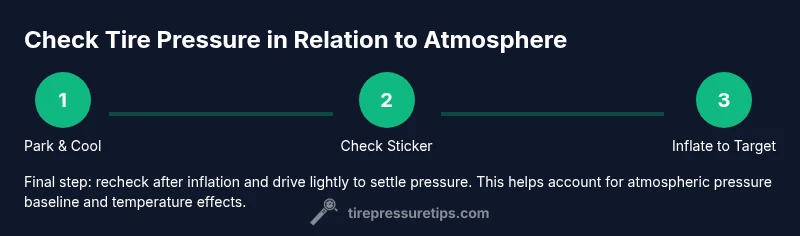
Find a shaded, level spot and avoid direct sun. Do not drive right before checking; hot tires can show inflated readings. Allow at least 15-20 minutes of cooling, or ideally wait several hours after driving to get a true cold measurement.
Tip: If you must check after a drive, note the time and expect a higher reading than cold specs. - 2
Locate the manufacturer\'s cold PSI
Look up the recommended cold PSI on the driver door jamb sticker or in the owner\'s manual. This is the target you want to reach when tires are cold. Do not rely on older guesstimates from memory.
Tip: Stick to the sticker numbers for your vehicle; they are vehicle-specific. - 3
Measure each tire with a gauge
Remove the valve cap, press the gauge onto the valve stem, and take a stable reading. Record the number for every tire. If the reading is off, note which wheel and by how much.
Tip: Make sure the valve stem is clean and the gauge seal is tight to avoid false readings. - 4
Inflate or deflate to target cold PSI
If a tire reads below the sticker, add air until you reach the target PSI. If it reads above, bleed air to the target. Do this while keeping an eye on the gauge for precise adjustments.
Tip: Use the gauge bleed valve to fine-tune without over-inflating. - 5
Recheck after adjustments
After inflating, re-measure to confirm all tires match the target cold PSI. This final check helps ensure consistency across the axle.
Tip: Do not assume the first equal reading means perfection—verify again. - 6
Document and monitor trends
Log the results and note any atmospheric conditions that may influence readings (temperature, altitude, time of day). Periodic checks help you detect leaks or TPMS drift.
Tip: Keep a simple log to track long-term changes.
Frequently Asked Questions
What is the most air pressure atmosphere and how does it relate to tires?
Atmospheric pressure serves as the baseline for reading tire gauges. Gauge pressure plus atmospheric pressure equals absolute pressure. Understanding this helps you interpret tire readings accurately, especially when traveling across elevations or seasons.
Atmospheric pressure is the baseline for tire readings, and gauge pressure plus atmospheric pressure equals the total pressure inside the tire.
Should I adjust tire pressure for hot weather?
Yes. Heat causes tire air to expand, raising the gauge reading. Always check and adjust to the cold PSI target when tires are cold to avoid over-inflation.
Yes. Check when cold, because heat can make readings higher and lead to over-inflation if adjusted only in hot conditions.
Can TPMS replace manual tire pressure checks?
TPMS provides a warning when pressure goes outside a safe range, but it cannot replace an accurate manual check. Use both for best safety and performance.
TPMS warns you of pressure changes, but you still need manual checks to confirm exact PSI.
How often should I check tire pressure?
Check at least once a month and before long trips. Also recheck if you notice a sudden pressure change or after seasonal temperature shifts.
Check monthly and before trips; recheck if you notice a change in readings.
Does altitude affect tire pressure readings?
Yes. Lower atmospheric pressure at high altitude can affect gauge readings, so use the door-sticker PSI and consider local conditions when inflating.
Altitude changes can shift readings, so recheck using the recommended PSI for your vehicle.
What if my TPMS reads low but manual checks show correct PSI?
TPMS drift can occur from sensor issues or warm-up effects. Recalibrate if needed and verify with a manual gauge to distinguish sensor fault from a real pressure change.
If the TPMS disagrees with your manual gauge, check the sensor and recalibrate if necessary.
Watch Video
What to Remember
- Check tires when cold and use the door sticker as the target
- Understand gauge pressure vs atmospheric pressure for accurate readings
- Account for temperature and altitude when interpreting numbers
- Use manual checks in addition to TPMS for safe inflation
- Log readings to spot trends over time