How to Put Tyre Pressure in Car
Learn how to accurately set tyre pressure in your car with this practical guide. It covers checking cold tyres, reading the placard, using gauges, and avoiding common mistakes for safer, more efficient driving. From Tire Pressure Tips.


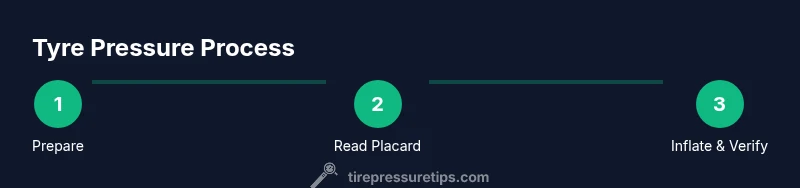
By following these steps, you will correctly inflate each tyre to the manufacturer’s recommended pressure using a gauge and a pump. Gather a tire pressure gauge, an air compressor or hand pump, and the vehicle’s PSI chart from the door jamb placard. Check tyres when cold, adjust to the spec, and recheck after a few minutes of driving.
Why correct tyre pressure matters
Correct tyre pressure is a foundational safety and efficiency factor for every drive. Under-inflated tyres increase rolling resistance, heat buildup, and risk of blowouts, while over-inflated tyres can ride harshly and wear unevenly. According to Tire Pressure Tips, maintaining the right pressure improves cornering stability, fuel economy, and tire longevity. Always start measurements with cold tyres because air expands with heat, skewing readings. In this section, we explain the physics behind PSI and how manufacturers choose target numbers for each axle. Temperature, load, and driving conditions all influence the numbers, so the placard on the door jamb remains your primary baseline, not a single on-road reading.
Reading the pressure target: PSI and the placard
Your car’s recommended pressure is expressed as PSI in many regions, but can also be shown in kilopascals (kPa). The placard lists separate values for the front and rear tyres, and sometimes for the spare. Do not rely on the maximum pressure printed on the sidewall as the target; that value is a safety limit, not a recommended operating pressure. Use a quality gauge to read when tyres are cold and adjust according to the axle assignment. If your vehicle supports different pressures for load, adjust per the placard when carrying heavier loads.
Tools you’ll need before you start inflating
Before you touch the air valve, assemble your tools. A reliable tyre pressure gauge is essential; a digital gauge is easiest to read. An air compressor or hand pump with a built-in pressure release helps you dial the target precisely. You may also want paper to record readings or a notes app to log the values for your vehicle records. Keep spare valve caps clean and finger-tight to seal after checking.
How to locate the correct pressure for each tyre
Check the door jamb placard on the driver’s side for the recommended PSI, noting separate values for front and rear. Some cars use a single value; others differ by axle. If you regularly carry heavy loads or passengers, the placard will indicate higher pressures for the axle bearing more weight. Always follow the placard values rather than generic online numbers, and remember that seasonal temperature shifts can move readings slightly.
Step-by-step inflating considerations
Inflating tyres is a controlled process: start with cold tyres, verify the target on the placard, and adjust in small increments. After reaching the spec, recheck both front and rear tyres to ensure even inflation. If you overshoot, release air in 1–2 psi increments and recheck. Keep your gauge and pump in a stable position to avoid accidental readings while you work.
Common mistakes to avoid
Avoid inflating or deflating based on a single hot reading; heat from driving raises pressure. Don’t rely on the sidewall maximum as a target; it’s a limit. Do not use a worn or inaccurate gauge—calibrate or replace it. Finally, avoid mixing different gauges; consistency matters for accurate results.
Seasonal and driving conditions impact tyre pressure
Temperature changes cause air to expand or contract; tyres lose or gain pressure with ambient temperature swings. In cold weather, pressures can drop, so check more often in winter. In hot environments or after long highway drives, read after the tyres have cooled to avoid over-inflation readings and adjust accordingly.
After-inflation checks and maintenance routine
Recheck each tyre after a short cool-down period and record the results. Ensure valve caps are tightened and the wheels are balanced if you notice vibration after inflation. Keep a small gauge in the glovebox for quick future checks and add tyre pressure checks to your regular maintenance routine.
Tools & Materials
- Tire pressure gauge(Prefer a digital gauge or a gauge with a bleed valve for fine control)
- Air compressor or hand pump(Ensure it can reach the vehicle’s target PSI and is compatible with your valve stems)
- Vehicle door jamb placard (PSI chart)(Take a photo if the placard is hard to read; use the values for front/rear as specified)
- Notebook or digital note-taking app(Record readings for future reference and maintenance logs)
- Valve core tool or small cap removal tool(Useful if valve caps are stuck or you need to release air precisely)
- Wheel chocks (optional but recommended)(Stabilize the vehicle when you’re working on it)
Steps
Estimated time: 25-30 minutes
- 1
Prepare your gear
Collect a calibrated tyre gauge, an air pump, and your vehicle’s placard. Ensure the vehicle is parked on a flat surface with the engine off and the parking brake engaged. If possible, work with the tyres cold to avoid heat-driven pressure changes.
Tip: Double-check gauge calibration before starting to ensure accuracy. - 2
Locate the target PSI
Find the front and rear tyre pressures on the door jamb placard. Note any differences between axles and consider load conditions if you’re carrying passengers or heavy cargo. Do not rely on the sidewall max pressure as your target.
Tip: If the placard is unreadable, consult the owner's manual or manufacturer website for the correct values. - 3
Check current pressure when cold
Attach the gauge to the valve stem of each tyre and read the current pressure when the tyre is cold. Record the numbers for future reference. If a tyre is obviously low, plan to adjust, but do not overinflate in one go.
Tip: Remove the valve cap and inspect the valve stem for leaks before reading. - 4
Inflate to the target PSI
Attach the pump and gradually add air in small increments, checking after each increment. Stop when you reach the exact PSI on the placard for that axle. Repeat for all tyres.
Tip: Use the gauge’s bleed feature to shave off extra air if you overshoot. - 5
Recheck and verify
Recheck all tyres after a short cooldown (usually 3–5 minutes). Hot tyres will give a higher reading, so a post-cooldown check yields the true value. Ensure even inflation across all tyres.
Tip: When done, replace valve caps firmly to prevent contamination. - 6
Document and maintain
Record the final pressures in a notebook or app and update your vehicle maintenance log. Plan to recheck tyre pressures monthly and before long trips, especially in extreme weather.
Tip: Keep a spare gauge in the car for emergency checks.
Frequently Asked Questions
Why is tyre pressure different from car to car?
Different vehicles have unique axle loads and suspension geometry that require specific front and rear pressures. The door placard provides the correct targets for your car. Always follow those values rather than generic numbers.
Cars vary; follow the placard values for your vehicle.
Can I inflate tyres at a gas station?
Yes. Gas stations often have air pumps and gauges. Ensure the gauge is accurate and tyres are cold before inflation for the best results.
Gas stations can help; read the gauge while tyres are cold.
What if I can’t find the recommended PSI?
Check the vehicle manual or manufacturer website for the exact values. If still unsure, contact a qualified technician. Do not guess or rely on outdated sources.
If you can’t find it, consult the manual or a professional.
Should all tyres have the same pressure?
Not usually. Front and rear pressures may differ based on axle load. Some models require equal values; others do not. Always use the placard’s explicit front/rear targets.
Typically not; follow the explicit front/rear targets.
How often should I check tyre pressure?
Check at least monthly and before long trips. Measure tyres when cold and recheck after any significant temperature change.
Check monthly and before trips when tyres are cold.
Watch Video
What to Remember
- Check tyres cold before inflating
- Follow the door placard values, not the sidewall max
- Recheck after cooling to confirm accuracy
- Maintain a simple log of tyre pressures
- Carry a calibrated gauge for reliable readings