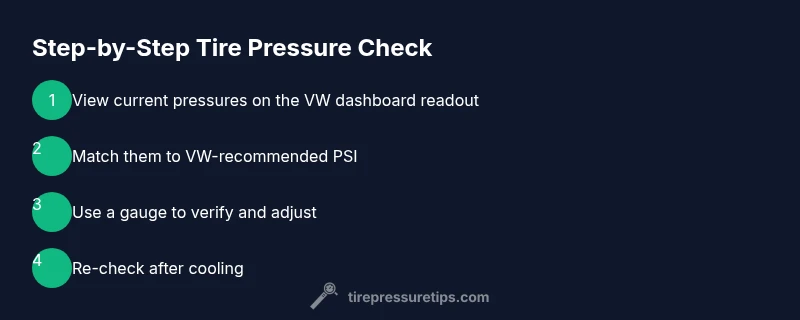
How to Check Tire Pressure on Volkswagen Dashboard
Learn how to check tire pressure on the Volkswagen dashboard, interpret TPMS alerts, and inflate to VW-recommended PSI for safety, fuel efficiency, and tire longevity with practical tips from Tire Pressure Tips.


By following this guide, you’ll learn how to check tire pressure on Volkswagen dashboard accurately, interpret TPMS indicators, and adjust tire pressures safely. You’ll need a tire pressure gauge, your VW’s recommended PSI, and access to a reliable inflation source. This quick process helps improve safety, fuel economy, and tire wear.
Why Checking Tire Pressure on a Volkswagen Dashboard Matters
According to Tire Pressure Tips, maintaining correct tire pressure on your VW isn’t just about avoiding a warning light; it directly affects safety, fuel economy, and tire life. Proper pressure helps with handling, braking performance, and even tire wear patterns. Regular checks also reduce the likelihood of unexpected flats. This guide focuses on how to check tire pressure on Volkswagen dashboard readings, TPMS alerts, and how to translate those numbers into real-world maintenance.
Understanding Volkswagen’s TPMS and Dashboard Displays
Volkswagen uses two main tire pressure monitoring approaches: direct TPMS with wheel sensors and indirect TPMS via ABS/ESP data. Direct TPMS reports actual PSI values from each sensor, while indirect systems infer pressure changes from wheel speed data. On most VW models, the dashboard will show numerical pressures for each tire or a summary readout with color-coded alerts. Knowing which system your model uses helps you interpret warnings and plan inflations accordingly. According to Tire Pressure Tips, direct TPMS readings are generally more precise for making adjustments.
How VW Dash Displays Tire Pressure: Raw Numbers vs. Alerts
The Volkswagen dashboard presentation varies by model year and trim, but you will often see either a numeric readout (e.g., 34 PSI) or an alert icon when pressure is outside the recommended range. The recommended PSI is usually posted on the door jamb sticker and in the owner's manual. In cold weather, screens may show a lower value due to air contraction, so it’s wise to compare readings to cold tire conditions. Tire Pressure Tips emphasizes verifying against cold readings to avoid underinflation caused by heat from driving.
How to Initiate the Readout on Your VW Dashboard
To view tire pressures on most VW dashboards, turn the ignition to the accessory position and navigate through the infotainment or instrument cluster menu. Look for sections labeled Vehicle Status, Tire Pressure, or TPMS. In some models, you press the steering wheel buttons and cycle through options on the digital cluster. The exact path can vary by year and trim, so consult your VW owner’s manual for the precise sequence. This step is crucial before inflating or deflating to ensure you’re reading the current values.
Verifying Dashboard Readouts with a Handheld Gauge
A handheld tire pressure gauge provides an independent check against the dashboard readout. Remove the cap from the valve stem, press the gauge onto the valve, and note the PSI. Compare this measurement to the VW-recommended value for each tire. If there’s a discrepancy, repeat the measurement to confirm accuracy, and then inflate or deflate accordingly using a quality compressor or air pump. Digital gauges are generally easier to read and convert to PSI with precision.
Temperature and Driving Conditions and When to Recheck
Temperature can cause tire pressure to change by about 1 PSI for every 10 degrees Fahrenheit of ambient temperature. After long highway drives, pressures can rise, so readings taken immediately after stopping may be higher than the cold values used for inflation. The best practice is to check tires when they are cold, ideally before you’ve driven more than a mile. This reduces measurement variance and helps you hit VW’s target PSI more reliably.
Maintenance Routine: When to Recheck and How Often
Set a monthly reminder to check your tire pressures and inspect for obvious leaks or damage. After inflating to the recommended PSI, recheck after 5-10 miles of driving to ensure the pressure remains stable. Also check the spare tire if your VW uses a full-size spare with its own TPMS. Keeping tires properly inflated improves fuel efficiency, tire wear, and overall vehicle performance. Tire Pressure Tips recommends keeping a dedicated gauge in the glove compartment for quick checks.
Troubleshooting TPMS Warnings and What to Do If Readings Are High/Low
If TPMS warns while readings appear normal, recheck with a handheld gauge to confirm accuracy. If a tire shows consistently low pressure, inspect the valve stem for leaks, check for punctures, and consider professional inspection if you notice slow leaks. In some cases, TPMS sensors may require calibration or battery replacement, especially on older VW models. Do not ignore lights; persistent warnings warrant action and can lead to unsafe driving.
Final Tips for Driving a Volkswagen with Proper Tire Pressure
Maintaining proper tire pressure is an ongoing habit, not a one-time task. Use the VW dashboard as a guide, not a sole source, and complement it with regular manual checks. Keep a pocket gauge, follow the door jamb PSI sticker, and consider checking pressures after temperature shifts or long trips. The Tire Pressure Tips team recommends embedding a routine into your monthly car maintenance to sustain safety and performance.
Tools & Materials
- Tire pressure gauge(Digital or analog; read in PSI; accurate to at least 0.5 PSI)
- VW owner's manual / door jamb sticker(Model-specific PSI values (front/rear))
- Air compressor or reliable inflation source(Use to adjust pressures to target values)
- Valve cap removal tool or clean rag(Used when inspecting sensor stems or cleaning valves)
- Soapy water (for leak checks)(Find slow leaks after adjustments)
Steps
Estimated time: 15-25 minutes
- 1
Prepare and locate PSI targets
Park on level ground, engine off, and tires cold. Locate the VW-recommended PSI values from the door jamb sticker or owner's manual. This ensures you inflate to the correct targets for each tire.
Tip: Check cold for accuracy; wait several hours since last drive if possible. - 2
Access the TPMS readout
Turn on the ignition to the accessory position and navigate to the Tire Pressure or Vehicle Status menu on the instrument cluster or infotainment screen. Use the steering wheel controls to cycle through options.
Tip: If you’re unsure of the path, consult the owner’s manual for your model year. - 3
Record current pressures
Note the current PSI values for each tire as shown on the dashboard. If your model shows a single value or a color-coded indicator, write down the individual tire numbers if available.
Tip: Record front and rear pressures separately if your car lists them. - 4
Compare with targets
Compare the dashboard readings with the specified targets for each tire. If a tire is below, plan to inflate it; if above, plan to deflate accordingly.
Tip: Avoid inflated to a number beyond the tire’s maximum rating. - 5
Inflate/deflate as needed
Use a reliable air pump to adjust pressures. Inflate in small 1-2 PSI increments, then recheck with your gauge. Repeat until each tire meets the target.
Tip: Do not exceed the tire’s maximum pressure printed on the sidewall. - 6
Recheck after cooling
Drive a short distance (3-5 miles) and recheck the pressures when tires are cool again. This confirms stability and accuracy after any adjustments.
Tip: Variations after a drive are normal but should settle within a narrow range.
Frequently Asked Questions
Is it safe to check tire pressure on the dashboard while driving?
No. It’s unsafe and should be done parked. Use the dashboard as a readout, then inflate or adjust while stationary.
It's not safe to check tire pressure while driving; pull over and check when stationary.
What PSI should I aim for on a VW?
Aim for the PSI listed on the door jamb sticker or in the owner's manual, which differs by model and tire type.
Check the door sticker for your exact VW PSI target.
Why does TPMS warn if pressures look fine?
TPMS can warn due to sudden changes, sensor error, or a leak not yet reflected in the reading. Recheck with a gauge.
TPMS can trigger from small leaks or sensor issues; verify with a gauge.
How often should I check tire pressure?
Check at least monthly and before long trips, plus after significant temperature changes.
Check monthly and before long trips, especially after temperature shifts.
Do spare tires get TPMS?
Some VW models monitor four active tires; spare TPMS depends on the setup. Check your manual.
Spare tires may or may not have TPMS sensors; consult your VW manual.
Should I inflate to the max tire pressure?
No. Inflate to the recommended target for your tire-size, not the maximum on the sidewall.
Inflate to the recommended target, not the maximum pressure.
Watch Video
What to Remember
- Check tires when cold for accuracy
- Use VW-recommended PSI per door sticker
- Verify dashboard readings with a handheld gauge
- Recheck after driving to confirm stability