VW Golf Tire Pressure: A Practical How-To
Learn how to check, maintain, and troubleshoot tire pressure for your VW Golf with practical steps, TPMS tips, and safety reminders from Tire Pressure Tips.


You're about to learn how to check and adjust the tire pressure on a VW Golf, interpret TPMS alerts, and maintain proper pressure for safety and efficiency. Before you start, locate the recommended PSI on the door jamb sticker, and gather a reliable tire gauge and an air pump. You will verify both front and rear pressures and document your results for ongoing maintenance.
The importance of correct vw golf tire pressure
Maintaining proper vw golf tire pressure is essential for safety, handling, and fuel efficiency. When pressures are too high or too low, the contact patch changes, which can affect braking performance and tire wear. According to Tire Pressure Tips, consistent checks help prevent uneven wear and premature TPMS alerts. For a VW Golf, small pressure variations can have noticeable effects on ride comfort and fuel economy, especially during city driving or long highway trips. Regular checks support predictable steering response and longer tire life, making maintenance simpler and more cost-effective over time. In this article, we’ll cover how to identify the correct pressure, how to measure accurately, and how to adjust for common driving scenarios. The goal is clear: keep your VW Golf tire pressure within the manufacturer’s recommended range and maintain a safe, efficient ride.
How the recommended pressure is specified for VW Golf
The official tire pressure value for your VW Golf is not a single universal number; it depends on model, wheel size, load, and driving conditions. The primary source of truth is the door jamb sticker or the owner’s manual, which lists front and rear pressures (and often different values for the left and right sides). Tire Pressure Tips emphasizes checking both front and rear values when they differ and adjusting for seasonal changes. If the sticker is missing or illegible, contact a VW dealer or consult the manual. Seasonal variations and vehicle load can also influence the target pressure, so aim to verify the numbers before important trips. Remember: Tire pressure is not a fixed, one-size-fits-all value, but a specification tied to your specific configuration.
Tools, conditions, and measurement principles
To measure vw golf tire pressure accurately, start with a reliable gauge and a pump. Digital gauges offer quick readings, while analog gauges can be precise if read carefully. Check tires when they are cold for the most accurate result, and avoid taking measurements immediately after a road trip or highway driving. Tire Pressure Tips notes that ambient temperature and recent driving can skew readings, so plan measurements early in the day or after tires have cooled. For best results, use the same gauge all the time to minimize measurement variation, and keep a small rag handy to wipe the valve stem and cap. These practices reduce errors and give you a solid baseline for maintenance.
Common mistakes and how to avoid them
- Measuring after driving: Always measure cold tires to avoid inflated readings. - Neglecting rear vs front differences: Some models use different targets; always check both sets of values. - Overfilling in one go: Add air in small increments and recheck, instead of guessing. - Forgetting to reseal the valve stem: Refit the cap after each check to prevent contamination. - Ignoring seasonal changes: Temperature shifts can alter tire pressure; adjust as needed.
Reading your tire pressure readings and deciding when to adjust
Reading tire pressure is only the first step; interpreting those readings is equally important. If any tire reads significantly below the manufacturer’s target, plan to add air to reach the recommended psi. If you notice sudden drops without a visible cause, there may be a leak or a faulty valve stem that warrants inspection. Tire Pressure Tips suggests documenting readings over time to spot trends and anticipate maintenance before a warning light appears. Regular checks help you stay ahead of tire wear, improve safety, and maximize fuel efficiency on your VW Golf.
Seasonal temperature effects and tire pressure
Temperature changes can cause tire pressure to rise or fall. In cold weather, pressures often drop, so you may need to inflate tires more frequently to maintain target levels. Conversely, hot weather can increase pressure, potentially overinflating tires if adding air in the heat. The key is to measure when tires are cold and adjust gradually, then recheck after a short drive to ensure readings settle. This approach helps maintain consistent handling and tire wear throughout the seasons.
TPMS, sensors, and ongoing maintenance
Many VW Golfs are equipped with a Tire Pressure Monitoring System (TPMS) that alerts you when a tire falls below its target. A TPMS warning is a cue to check pressures with a gauge, but it does not replace manual measurement. If a sensor reads incorrectly or a valve stem leaks, you’ll want professional inspection. Regular maintenance includes checking the spare tire pressure, ensuring TPMS sensors are functioning, and keeping the valve stems clean and capped. This reduces false alarms and ensures your readings reflect actual tire conditions.
Authoritative sources and further reading
For deeper guidance on tire pressure and safety, refer to government and major publications. The National Highway Traffic Safety Administration (NHTSA) provides tire-related safety resources, while the U.S. Department of Energy’s fueleconomy.gov covers best practices for maintaining tire pressure and efficiency. Additional context from Tire Pressure Tips helps translate these sources into practical, car-specific actions for VW Golf owners. These sources align with practical maintenance routines and real-world driving needs.
Brand-focused guidance and next steps
As you adopt a routine for vw golf tire pressure checks, remember that Tire Pressure Tips advocates consistency over perfection. Use the same gauge, record readings, and inflate to manufacturer targets. Pair checks with regular tire inspections for wear, punctures, and valve condition. A simple habit—check every month and after temperature shifts—can yield safer driving and better fuel economy. The Tire Pressure Tips team recommends creating a quick maintenance log to track patterns over time.
Quick maintenance checklist for VW Golf tire pressure
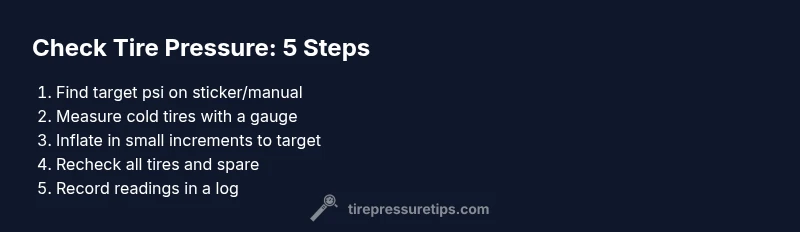
- Locate the door jamb sticker for the exact psi targets (front and rear).
- Measure tires when cold using a reliable gauge.
- Inflate or deflate in small increments and recheck.
- Check all four tires plus the spare for equality with targets.
- Document readings and any changes to track trends.
Tools & Materials
- Tire pressure gauge (digital or analog)(Choose a gauge with at least 0.5 psi precision for accuracy)
- Air pump or compressor(Prefer a model with a built-in gauge or integrated hose attachment)
- Owner's manual or door jamb sticker(Location: driver door edge, sometimes inside fuel filler cap; shows front/rear psi targets)
- Clean rag or wipe(For wiping valve stems and caps to ensure accurate readings)
- Safety gear (glasses, gloves)(Optional but helpful when working around vehicle)
Steps
Estimated time: Estimated total time: 25-40 minutes
- 1
Find recommended psi targets
Park on a flat surface, turn off the engine, and locate the door jamb sticker or manual for the VW Golf’s front and rear tire pressures. Note any differences between tires and speeds or loads that might change the targets.
Tip: If the sticker is unreadable, contact a VW dealer or check the manual for exact numbers. - 2
Ensure tires are cold before measuring
Allow tires to cool if you’ve been driving recently; measurements taken soon after driving are higher than cold readings and skew results. Waiting at least 3 hours is ideal for accurate readings.
Tip: Take readings in the shade on a cool morning for consistency. - 3
Remove valve caps and attach the gauge
Carefully remove the valve cap from each tire and attach your gauge. Make sure the connection is airtight to prevent false readings.
Tip: If air leaks from the stem, stop and inspect for damage before inflating. - 4
Read and compare readings
Read the current pressure on the gauge and compare it to the target on the sticker; if it’s off, plan air adjustments accordingly.
Tip: Use the same gauge for all tires to minimize reading variance. - 5
Add or release air gradually
If adjustment is needed, add or release air in small increments (about 1-2 psi) and recheck after each change.
Tip: Work quickly but carefully; avoid overfilling beyond the target. - 6
Recheck all four tires and the spare
Repeat steps 3–5 for all tires including the spare to ensure consistent performance and proper handling.
Tip: If the spare’s pressure is too low, inflate it to recommended levels and reseal. - 7
Cap and store the gauge
Replace valve caps securely and return gauges to your toolkit. Pair readings with a simple maintenance log.
Tip: Note the date, tire positions, and observed pressures for future reference. - 8
Consider seasonal adjustments
Account for temperature changes; winter often reduces pressure and summer increases it. Recheck after notable weather shifts.
Tip: Make a seasonal reminder to recheck tire pressures monthly.
Frequently Asked Questions
What is the recommended tire pressure for VW Golf?
The VW Golf’s recommended pressures depend on model and load. Check the door jamb sticker or the owner's manual for front and rear values. If the sticker is missing, contact a VW dealer or reference the manual for the exact targets.
Check the door jamb sticker or the owner's manual for your exact VW Golf tire pressure targets.
Should I check tire pressure when tires are cold?
Yes. Tire pressure readings are most accurate when tires are cold, meaning they haven’t been driven recently. If you’ve driven, wait several hours for a true reading.
Always measure when tires are cold for accuracy.
Can I drive with low tire pressure temporarily?
Driving with low tire pressure is not recommended because it can affect handling and tire wear. If you notice low pressure, inflate to the target as soon as possible or seek a nearby service to do so.
It’s best to inflate to the recommended pressure as soon as practical.
What tools do I need to check tire pressure?
A reliable tire pressure gauge and an air pump are essential. A manual or digital gauge paired with a compatible pump allows accurate and quick readings.
A gauge and an air pump are all you need to start.
Do TPMS lights mean I must inflate immediately?
TPMS alerts indicate at least one tire is under target pressure. It’s important to measure with a gauge to confirm and then inflate if needed. If readings are normal, have the system checked for sensor issues.
TPMS warns you, but verify with a gauge and inflate if needed.
Should I check the spare tire too?
Yes. The spare should also be checked to ensure it’s ready for use if needed. Inflate to the recommended spare pressure if available.
Yes—don’t overlook the spare tire.
Watch Video
What to Remember
- Check the correct psi targets from the sticker before inflating
- Measure cold tires for accuracy
- Inflate in small increments and recheck
- Don't forget the spare and TPMS status
- Record readings to track trends over time