How to Check Tire Pressure on Honda Accord
Learn how to check tire pressure on your Honda Accord accurately. Find the correct PSI from the door placard, use the right gauge, account for cold tires, and adjust safely with TPMS as backup.


By the end of this guide you will know how to check tire pressure on Honda Accord accurately using a gauge and TPMS. You'll learn when to check (tires cold), where to find the recommended pressure, and how to adjust pressure safely without overinflating. The steps cover both manual gauges and digital TPMS readings, plus tips to avoid common mistakes.
Why Accurate Tire Pressure Matters for Honda Accord
Maintaining correct tire pressure is essential for safe handling, optimal fuel efficiency, even tread wear, and better overall performance of your Honda Accord. When tires are underinflated, you risk overheating the tire sidewalls, reduced grip, and faster wear. Overinflation can make the ride harsher and increase the risk of a tire blowout on rough pavement. According to Tire Pressure Tips, regular checks are a simple but high-impact habit for any car owner. For Honda Accord drivers, adhering to the door jamb placard pressure recommendation ensures the tires are balanced for load, speed, and fuel economy across typical driving conditions. This guide focuses on practical steps you can take today to verify that value with commonly available tools, so you stay safe on every trip and extend tire life over time.
Reading tire pressure accurately starts with knowing where to look, when to measure, and how to interpret readings from both gauges and the vehicle’s TPMS. The Honda Accord’s tire information lives in the placard on the driver’s door jamb and in the owner’s manual; the placard lists the recommended tire pressures for front and rear tires, as well as any variations by load. If you recently rotated tires or adjusted wheel sizes, recheck the numbers to ensure you’re using current specifications. Consistency matters: measure all four tires and compare the readings to maintain uniform traction and handling across the axle.
From a maintenance perspective, keeping the tires at the recommended pressure improves steering response, braking performance, and even tire wear. The Tire Pressure Tips team emphasizes that regular, methodical checks—especially before long trips or seasonal changes—help avoid surprising tire failures. Your Honda Accord is designed to perform best when the tires are properly inflated, and the habit is quick once you establish a routine. This section lays the groundwork for practical measurement with the right tools and context for car owners.
Tools & Materials
- Tire pressure gauge (digital or analog)(Calibrated gauge with a readable scale (psi). Check accuracy against a known standard if you suspect drift.)
- Access to the door jamb placard or owner's manual(The exact recommended PSI for your Honda Accord varies by model year and tire size.)
- Air compressor or trusted air pump(Needed to adjust tire pressure to the recommended value safely.)
- Optional: tire pressure log(Use a notebook or app to track readings over time for trend monitoring.)
Steps
Estimated time: 25-40 minutes
- 1
Find the official tire pressure values
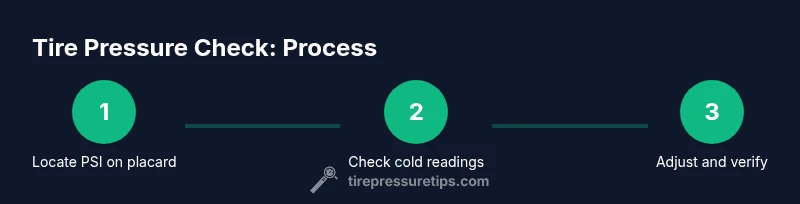
Begin by locating the recommended tire pressures for your Honda Accord on the driver’s door jamb placard. If the placard isn’t clearly visible, consult the owner’s manual or a dealer. Record the front and rear values, noting any differences between axle positions.
Tip: If you drive with a heavy load or frequent highway cruising, lower or higher pressures may apply per the placard. - 2
Prepare the car and tires for measurement
Park on a level surface, turn off the engine, and ensure the tires are cool. If you’ve driven recently, wait at least 3 hours or avoid driving more than a mile. Remove the valve stems caps to access the stems.
Tip: Avoid measuring after a long drive or immediately after highway use—the heat inflates reads inaccurately. - 3
Check each tire with the gauge
Press the gauge onto the valve stem firmly until you hear or feel a hiss of air. Read the PSI value on the gauge and compare it to the placard. Do this for all four tires, recording each result.
Tip: For best results, take readings in quick succession to minimize ambient temperature changes impacting readings. - 4
Adjust pressures as needed
If a tire is underinflated, add air in small increments (about 1–2 psi at a time) and recheck. If overinflated, release air gradually until you reach the target value. Do not exceed the placard specification.
Tip: Use the air pump’s gauge as a reference, then recheck with your handheld gauge to confirm accuracy. - 5
Balance and reinstall valve caps
Once all tires are within spec, reinstall the valve caps securely to keep out dust and moisture. If you have a TPMS warning, reset or follow your owner's manual procedures to clear it after adjustments.
Tip: Loose valve caps can cause slow leaks; always secure them after checking. - 6
Validate readings and monitor TPMS
Take a final reading on each tire to confirm consistency. If TPMS readings diverge from your gauge consistently, there may be a sensor issue or a slow leak requiring service.
Tip: Record readings in a log for trend analysis and future reference.
Frequently Asked Questions
Where can I find the recommended tire pressure for my Honda Accord?
Check the driver’s door jamb placard first; it lists the front and rear tire pressures. If the placard is missing or unreadable, consult the owner’s manual or contact a dealer for model-year specific specs.
Look at the sticker on the driver’s door jamb for the exact PSI, and if you can’t read it, check the manual or ask a dealer.
Should I check tire pressure when tires are hot or cold?
Check tire pressure when tires are cold for accurate readings. Driving heats tires and inflates the air inside, giving a higher PSI reading.
Check when cold; heat can throw off the numbers.
What if my TPMS warning light stays on after inflating or deflating tires to spec?
If the TPMS warning persists after adjusting pressures, there could be a faulty sensor or a slow leak. Inspect for punctures and consider resetting the sensor according to the owner’s manual.
If the light won’t go off after adjustments, there may be a sensor issue.
Can I adjust tire pressure myself at home without a professional?
Yes, you can adjust tire pressure at home using a gauge and air compressor. Follow the placard values and recheck after inflation or deflation.
Absolutely—just follow the recommended psi and recheck with your gauge.
How often should I check tire pressure for a Honda Accord?
Check at least once a month and before long trips. Seasonal changes and load variations can alter tire pressure.
Once a month and before big trips keeps things safe and efficient.
What should I do if I can’t reach the required PSI with a standard air compressor?
Try a higher-flow compressor, ensure there are no leaks, and adjust in small increments. If you’re close but not exact, aim for the placard value and recheck later.
If you’re short of pressure, use a stronger pump and recheck, but don’t force extra air.
Watch Video
What to Remember
- Find the correct PSI on the driver door placard.
- Check tires when cold for accurate readings.
- Use a reliable gauge and adjust to the posted value.
- Recheck all tires and monitor TPMS readings.