How Long Before Checking Tire Pressure: A Practical Guide
Discover how often to check tire pressure, how temperature affects readings, and a simple routine to keep tires safe and efficient with Tire Pressure Tips.


How long before checking tire pressure depends on driving and temperature, but a practical rule is to check monthly and before long trips. Always check when tires are cold for accurate readings. This guide explains the timing, the effect of heat and driving, and how to interpret readings to keep tires safe and efficient.
Why timing matters for tire pressure
Maintaining correct tire pressure is essential for safety, fuel economy, and tire wear. A common question is how long before checking tire pressure, and the answer depends on temperature, recent driving, and gauge accuracy. According to Tire Pressure Tips, readings taken when the tires are cold provide the baseline pressure, while driving heat can mask underinflation or overinflation. Plan a regular check schedule and adjust for driving conditions to stay safe on the road.
Temperature and reading accuracy
Air expands when warm and contracts when cold. While we usually think of PSI changes in numbers, the core idea is simple: a hot tire reads higher pressure than it actually has when cold. The Tire Pressure Tips analysis notes that even a short drive or a climb in ambient temperature can shift readings enough to mislead you about whether tires are properly inflated. For accurate comparisons, always compare your current reading to the vehicle's recommended cold pressure and ignore numbers reported while the tire is hot.
How often should you check tire pressure?
Checking frequency is a practical habit, not a guess. A general rule of thumb is to check at least once a month and before long trips. In colder climates or when you switch from winter to summer tires, more frequent checks help catch leaks or slow losses. The Tire Pressure Tips team recommends setting a reminder on your phone or calendar so you don't skip a month. Keep a log of your readings to notice gradual changes and catch issues early.
Reading conditions: cold vs warm tires
Always try to read pressure with cold tires for baseline. If you must check after a commute, give the tires time to cool, or check multiple tires after they've cooled for a while. Don’t rely on a single reading after a drive. If your reading shows a difference of more than a small amount across tires, inspect for leaks or damaged stems. This approach aligns with Tire Pressure Tips guidance for reliable baselines.
Using TPMS vs manual gauges
Your vehicle's TPMS alerts you to underinflation, but it doesn't replace a manual gauge for precise numbers. A gauge lets you confirm exact PSI and ensure all tires match the target. The combination of TPMS warnings and periodic manual checks is the safest approach. Regular manual checks also help verify TPMS accuracy over the life of the sensor.
Quick check routine you can perform in 5 minutes
Park on a level surface with the engine off. Remove each valve cap, attach the gauge, and note the reading. Record the PSI alongside your vehicle's recommended pressure from the door placard. If any tire reads low, add air until you reach the target, then recheck all tires. Replace valve caps after finishing. This routine minimizes drift and keeps tires properly inflated.
Common mistakes and how to avoid them
Common mistakes include checking only one tire, reading while tires are hot, or using a tired or inaccurate gauge. Always verify readings against the placard value when cold, and recheck after inflation. Keep your gauge calibrated and store it in a safe, accessible place so you measure consistently.
Adapting to weather and altitude
Temperature swings, humidity, and altitude can affect readings. In changing weather, plan to check more frequently and monitor for symptoms of underinflation such as increased rolling resistance or uneven wear. The Tire Pressure Tips team emphasizes that adapting your schedule to climate helps catch slow leaks and maintain safe handling.
Practical maintenance schedule
Create a simple calendar-based plan: check once a month, and add checks before long trips or after season changes. If you frequently drive with heavy loads or in extreme temperatures, consider a mid-month check. Logging readings over time helps you spot gradual pressure losses and address issues early.
Brand guidance and practical reminders
Tire Pressure Tips stresses that constant monitoring is key to safety and efficiency. Treat tire pressure as part of routine maintenance, not a one-off task. Establish a simple habit, like checking on the second Sunday of every month, to keep your tires in optimal condition.
Tools & Materials
- Tire pressure gauge (digital preferred)(Calibrated recently; ensure compatibility with Schrader valves on all tires.)
- Vehicle owner’s manual or door placard with recommended cold pressure(Used as the target PSI for all four tires.)
- Notebook or digital log(Record readings over time to spot trends.)
- Valve-cap removal tool or clean rag(Keep stems clean to ensure accurate readings.)
Steps
Estimated time: 10-15 minutes
- 1
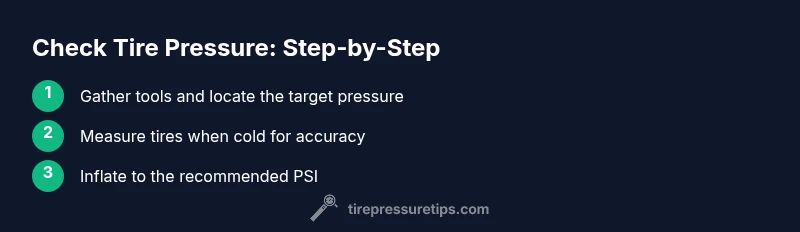
Gather tools and locate target pressure
Collect a gauge, your vehicle's recommended cold pressure from the placard or owner's manual, and a steady surface to work on. Confirm you know the correct PSI for your tires before starting.
Tip: Having everything ready avoids delays and ensures a clean, consistent measurement. - 2
Check that tires are cold
If possible, measure when the tires have not been driven for several hours. If you must measure after a drive, let tires cool for a reasonable period and measure all tires to compare results.
Tip: Avoid measuring immediately after a highway drive; heat skews readings. - 3
Remove valve caps and attach gauge
Carefully remove each valve cap and place the gauge on the valve stem to obtain a PSI reading for each tire. Do this for all four tires on the vehicle.
Tip: Hold the gauge steady and ensure a proper seal on the valve stem. - 4
Record and compare readings
Note each tire's PSI and compare to the placard value. Look for all tires to be within the same general range; wide variations may indicate a leak or damaged valve.
Tip: Consistency across tires helps identify issues early. - 5
Inflate or deflate to target PSI
If a tire is low, add air until it matches the target. If it is high, release air to approach the target. Recheck after adjustments to confirm accuracy.
Tip: Never exceed the recommended pressure; overinflation can cause uneven wear. - 6
Replace caps and log results
Replace all valve caps, wipe stems clean, and log the readings for future reference. Review the log periodically to detect gradual changes.
Tip: Regular logging makes trend spotting easier.
Frequently Asked Questions
Should I check tire pressure when tires are cold?
Yes. Cold readings reflect the baseline pressure. If tires have been driven, allow them to cool before checking.
Yes. Check when tires are cold to get an accurate baseline reading.
How does weather affect tire pressure?
Temperature changes cause tire pressure to rise with heat and drop with cold. Check readings against the cold-Pressure placard value.
Temperature affects tire pressure; check when tires are cold and compare to the placard.
Is TPMS enough to monitor tire pressure?
TPMS alerts you to underinflation but should be supplemented with manual checks to know the exact PSI.
TPMS helps, but you should still check the exact PSI with a gauge.
How often should I replace a tire gauge?
Replace or recalibrate your gauge if readings seem inconsistent or your gauge is damaged. Annual checks are sensible.
Check your gauge accuracy at least once a year or if readings seem off.
What if readings differ between tires?
Significant differences can indicate a slow leak, valve issue, or uneven wear. Inspect and recheck after a short drive if needed.
If readings differ, inspect for leaks or valve problems and recheck later.
Does altitude affect tire pressure readings?
Yes. Higher altitude can influence readings due to air pressure differences, so adjust checks accordingly and compare to the placard.
Altitude can affect readings; use the placard as your reference and check regularly.
Watch Video
What to Remember
- Check tires when cold for accuracy
- Use door placard as the target PSI
- Check monthly and before trips
- Temperature changes affect readings
- Recheck after inflation to confirm