Goodyear Assurance Tire Pressure: How to Check and Maintain
A practical, step-by-step guide to checking, inflating, and maintaining Goodyear Assurance tire pressure for safety, fuel efficiency, and longer tire life. Includes TPMS tips, tool list, and maintenance routines.


You will learn to check, inflate, and verify the proper pressure for Goodyear Assurance tires on your vehicle. This guide covers how to locate the recommended PSI, how to use a reliable gauge, and how to adjust when TPMS readings differ. You’ll improve safety, fuel efficiency, and tire life by following cold-reading procedures and seasonal adjustments.
Why correct goodyear assurance tire pressure matters
Maintaining accurate tire pressure for Goodyear Assurance tires improves handling, safety, fuel economy, and tire longevity. Underinflated tires generate more heat and wear, while overinflated tires reduce traction and ride comfort. Regular verification helps TPMS operate correctly and minimizes uneven tread wear. According to Tire Pressure Tips, habitual checks with a consistent gauge are a simple, effective habit that protects your investment and passengers.
How to determine target pressure for Goodyear Assurance tires
Your vehicle's placard on the door jamb lists the recommended cold PSI for front and rear tires. If you can't locate the placard, consult the owner's manual or the tire sidewall for maximum pressure (not a replacement for your vehicle's target). Use a cold reading—before driving or at least 3 hours after driving—to avoid readings inflated by heat. When TPMS shows a discrepancy, inspect tires for nails or leaks and re-check after adjustments.
Common pressure mistakes and how to avoid them
Common errors include inflating after a short drive (warm readings are higher), relying on visual inspection, and ignoring seasonal temperature changes. Avoid inflating to the max pressure on the sidewall; this can harshen ride and reduce contact patch. Always use a calibrated gauge, check all four tires, and reset your maintenance schedule. If you frequently drive with heavy loads, consult your vehicle manual for updated targets.
Maintaining tire pressure across seasons and driving conditions
Temperature affects tire pressure: cold weather lowers PSI, while heat raises it. Check pressure at least monthly and before long trips, especially when temperature swings are large. If you notice frequent readings outside the target range, have tires inspected for leaks or worn valves. Consistent pressure helps TPMS accuracy and improves gas mileage.
Tools & Materials
- Tire pressure gauge (digital or analog)(Ensure readings are in psi and read with the gauge perpendicular to the valve stem for accuracy)
- Vehicle door placard or owner's manual(Find the vehicle's recommended cold PSI for front and rear tires)
- Valve caps and basic tool(Keep valve caps in place; damaged caps can affect readings)
- Notebook or mobile notes app(Record readings and the date of checks for trend tracking)
Steps
Estimated time: 15-25 minutes
- 1
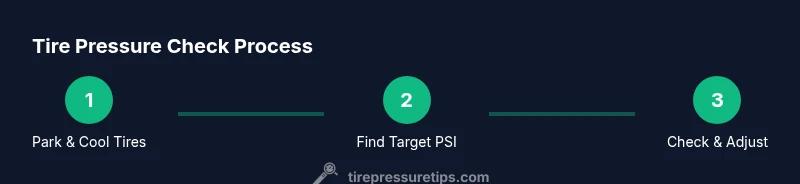
Park and let tires cool
Park on a level surface and turn off the engine. If tires were recently driven, wait 10-15 minutes or until they cool to get a cold reading.
Tip: Cold readings are the baseline; avoid checking after a ride. - 2
Find your target PSI
Look at the door placard or owner's manual for the recommended cold PSI for each axle. Note front and rear values separately if they differ.
Tip: Do not use tire max pressure as your target. - 3
Prepare the gauge
Remove the valve cap and keep it nearby. Prepare your gauge and ensure it reads in psi.
Tip: Inspect the valve stem for dirt; a dirty stem can cause false readings. - 4
Read current pressure
Press the gauge onto the valve stem firmly and read the psi. Take a second reading to confirm accuracy.
Tip: If readings vary, use a new measurement to confirm. - 5
Adjust to target
If below target, add air in small increments and recheck. If above target, release air gradually until you reach the target PSI.
Tip: Avoid over-inflating; recheck after adjustments. - 6
Finish up
Replace the valve caps and recheck all four tires to ensure consistency across axles.
Tip: Document the final readings for future comparisons.
Frequently Asked Questions
Why is tire pressure important for Goodyear Assurance tires?
Correct tire pressure improves handling, safety, and tire life. Goodyear Assurance tires benefit from correct pressure to maintain tread wear and fuel efficiency.
Correct tire pressure improves handling and safety.
How do I find the right PSI for my tires?
Look at the door placard or owner's manual for cold PSI; verify with a gauge.
Check the door placard and verify with a gauge.
Can I rely on visual inspection to gauge pressure?
No, visual estimates are unreliable. Use a gauge to confirm pressure.
Visual checks aren't reliable; always use a gauge.
What should I do if TPMS shows a warning light?
Check readings with a gauge, inspect for leaks or damage, and adjust if needed. If readings are normal, consult a technician.
If TPMS warns, check the tires with a gauge and inspect for leaks.
Is it safe to overinflate to the max PSI listed on the tire?
No; max PSI on the sidewall is not a target. Follow the vehicle manual.
Don't inflate to the max; use the recommended target.
Should I check the spare tire pressure?
Yes, check the spare if you carry one; it often has a different target.
Yes—check your spare tire as well.
Watch Video
What to Remember
- Check target PSI from placard/manual and stay within it.
- Use a reliable gauge and measure when tires are cold.
- Check all four tires and TPMS readings regularly.
- Seasonal temps require more frequent checks.