Good Tire Pressure on Car: Practical Guide
Learn how to maintain good tire pressure on car for safety, fuel efficiency, and tire life. Step-by-step checks, TPMS guidance, and common mistakes.


Goal: You will learn how to check, adjust, and maintain good tire pressure on car for safety, fuel efficiency, and tire longevity. This guide covers tire pressure targets, how to read TPMS, and step-by-step checks using a gauge and your vehicle's placard. By following these steps, you’ll consistently maintain appropriate tire pressure and avoid common driving risks.
Why good tire pressure matters\n\nAccording to Tire Pressure Tips, good tire pressure on car is foundational to safety, handling, and efficiency. When tires are under-inflated, they flex more, generating heat and increasing wear on the tread edges. Over-inflated tires ride on the center of the tread, reducing grip and increasing the risk of a blowout on sharp objects. Both conditions can affect braking distance, steering response, and even fuel economy. The Tire Pressure Tips team found that regular checks help drivers avoid these issues and keep tires lasting longer.\n\nKey factors: load, speed, climate, and driving style all influence how much pressure your tires actually need. Vehicle manufacturers specify a recommended range rather than a single number, because tire pressure is a function of weight distribution and expected use. In practice, most passenger cars use a range around 30-35 psi when cold, but vans, SUVs, and high-performance tires may require different targets. Always start with the placard on the driver's door jamb or inside the fuel hatch and verify with the owner's manual. When you drive with the wrong pressure, you pay the price at the fuel pump, on the highway, and over the life of your tires.\n\nFor safety, this article emphasizes consistent checks, not one-off adjustments. A quick habit—checking tire pressure monthly and before long trips—reduces risk and helps you avoid uneven wear. The Tire Pressure Tips methodology stresses fuel savings, safer handling, and extended tire life, all achievable with a simple gauge and a plan.
lengthCheckFlag": false
Tools & Materials
- Tire pressure gauge (digital or analog)(Choose a gauge with a ready-to-read display and a bleeder function if possible)
- Air compressor or access to an air pump(Prefer a built-in or public air pump that can maintain stable pressure)
- Vehicle placard or owner's manual(Use it as the source of the correct tire pressure values)
- Clean rag or towel(Wipe off valve stem before reading if needed)
- Valve cap removal tool or fingers(Keep caps to prevent moisture entering stems)
Steps
Estimated time: 15-25 minutes
- 1
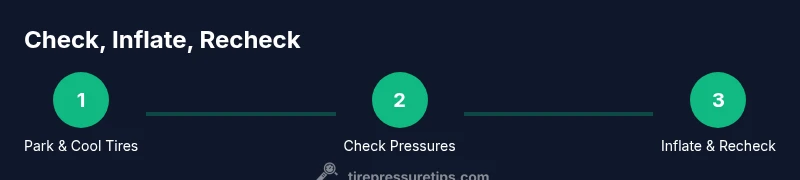
Park on level ground and allow tires to cool
Find a flat, level area and turn off the engine. Allow at least 3 hours after driving for tires to cool, or check in the morning before driving. This ensures an accurate reading since heat inflates readings.
Tip: A cooler tire reading is more accurate; avoid checking after a long trip - 2
Locate the correct target pressure
Read the placard on the driver’s door jamb or consult the owner’s manual to determine cold pressures for front and rear tires. Note that different axles or load conditions may require different numbers.
Tip: Do not use the tire sidewall maximum pressure as your target. - 3
Detach the valve cap and attach the gauge
Remove the valve cap and place the gauge onto the valve stem firmly to prevent air leakage. Keep the measurement steady and read the gauge after a moment of stabilization.
Tip: If you’re using an air hose with a chuck, hold it square to avoid air leakage. - 4
Read, interpret, and inflate as needed
Compare the reading to the target; if low, add air in small increments (about 2-3 psi at a time). Recheck after each increment until you reach the target.
Tip: If the tire is near ambient temperature, re-check after waiting 1–2 minutes for pressure to settle. - 5
Recheck and seal the valve cap
Reattach the valve cap and re-check all four tires to confirm even inflation. If any tire is too high, release air slowly and recheck to reach the target range.
Tip: Ensure caps are screwed on tightly to prevent moisture or dust entry. - 6
Document and monitor
Record the pressures and the date. Check tires again after a few weeks of driving or temperature changes, since ambient conditions affect readings.
Tip: Set a reminder to check monthly and before long trips.
Frequently Asked Questions
What is the correct tire pressure for my car?
Refer to the door placard or owner's manual for cold pressures by axle and tire size. Pressure can vary by load, speed, and season. Do not rely on a number from a tire sidewall.
Check the placard on the driver’s door jamb or the owner's manual for your car’s exact cold pressures.
How often should I check tire pressure?
Aim to check once a month and before long trips. Temperature changes can alter readings, so recheck after weather shifts.
Check your tires monthly and before long trips to maintain safety.
Does TPMS reflect the exact pressure?
TPMS alerts you when a tire is significantly under-inflated; always verify with a pressure gauge because readings can vary with temperature and sensor calibration.
TPMS alerts you, but you should still measure with a gauge for accuracy.
What happens if a tire is over-inflated?
Over-inflation reduces the contact patch, increasing the harsh ride and uneven wear. Target a safe pressure within the recommended range.
Don't over-inflate; stick to the recommended range.
Watch Video
What to Remember
- Check tires when cold for accuracy
- Use the placard values, not the tire sidewall max
- Inflate in small increments and recheck
- Maintain a monthly check routine