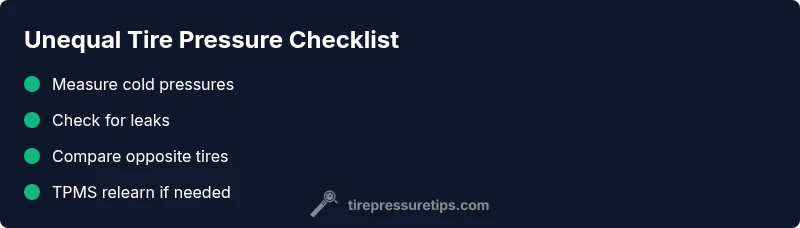
Unequal Tire Pressure Left and Right: Troubleshooting Guide
Learn how to diagnose and fix uneven tire pressure between left and right tires. Step-by-step checks, TPMS guidance, and safety tips for car owners to prevent uneven wear and improve handling.


Unequal tire pressure left and right is usually caused by a slow puncture, TPMS sensor drift, or temperature differences. Start with a cold pressure check, compare opposite tires, and adjust to the vehicle spec. If the gap persists beyond a conservative threshold, arrange a professional inspection.
Understanding unequal tire pressures
Tires support your vehicle’s weight, transmit steering input, and absorb road shocks. When you notice that tire pressure left and right differs, it signals that one tire is carrying a different load or that the tire assembly isn’t sealing properly. Always compare like-for-like tires (same size, type, tread) and ensure you measure when the tires are cold. In practice, many drivers see this symptom after a long drive, hot days, or when the vehicle has carried an uneven load. The phrase 'different tire pressure left and right' describes a measurable discrepancy that should be investigated promptly. The Tire Pressure Tips team emphasizes consistency in measurement conditions and instrument accuracy for reliable comparisons.
Key takeaway: Treat any sustained left-right discrepancy as a safety concern that can affect handling, braking, and tire wear.
Diagnosing the symptom: what to check first
The first step is to confirm the discrepancy using a reliable gauge and cold tires. Then compare the pressures across opposite tires on the same axle. If you notice a persistent gap, inspect each tire for obvious signs of damage, punctures, or bead leaks. Remember that temperature changes can cause tires to lose or gain pressure, but a consistent left-right difference across multiple checks suggests a mechanical issue rather than weather alone. The Tire Pressure Tips guidance stresses standardized checks and noting the exact psi values for future reference.
Measuring accurately and safely
Always measure tire pressure when the tires have cooled for at least 3 hours and the vehicle hasn’t been driven, to avoid heat-induced readings. Use a calibrated gauge (digital or analog) and take readings on each tire twice to confirm consistency. Ensure valve stems are clean and free of debris; bottom line: record the tire position (front-left, front-right, etc.) and compare against the manufacturer-recommended pressure for that exact tire. The right measurement method prevents chasing false positives and helps you identify real pressure differences that require action.
Temperature, load, and driving conditions that influence differences
Tire pressure is not static. It rises with heat and falls with cold. If left and right tires experience different loads (one side carrying more weight due to heavy passengers or cargo distribution), or if one tire sits in the sun while the other sits in shade, you may see a reported difference. That said, persistent differences after stabilizing temperature and load often point to a leak, stem issue, or TPMS misread. The Tire Pressure Tips approach is to correlate readings with recent driving conditions and load to separate transient changes from persistent problems.
When to seek professional help and how to communicate the issue clearly
If you cannot locate a leak, the pressure difference persists after multiple cold checks, or TPMS readings don’t align with manual measurements, seek professional tire service. Explain the exact locations (front-left vs front-right), the pressures you observed, and when you last drove the vehicle. A technician can perform leak tests, TPMS relearning, valve inspection, and potential tire repair or replacement. The cost and risk of driving on an unresolved imbalance make professional help a prudent choice.
Steps
Estimated time: 20-40 minutes
- 1
Park and inspect for obvious damage
Find a flat, safe area and turn off the engine. Visually inspect all four tires for cuts, bulges, nails, or objects lodged in the tread. Note any tire that looks damaged, and avoid driving on compromised tires.
Tip: Take a quick photo of each tire’s sidewall and tread after inspection. - 2
Measure pressures with cold tires
Use a calibrated tire gauge and record the pressure on each tire when the tires are cold. Be sure to note the position (FL, FR, RL, RR). Compare opposite tires on the same axle for any gap.
Tip: Always measure after the car has been parked for a few hours and hasn’t been driven. - 3
Check for leaks and valve condition
Spray soapy water on valve stems and bead areas to identify slow leaks. Look for moisture bubbles; a persistent bubble indicates a leak that needs repair.
Tip: Wipe away residue and re-test specific suspect areas to confirm. - 4
Inspect TPMS and relearn if needed
If readings don’t align with manual gauges, consult the owner’s manual for TPMS relearn procedures or visit a shop to perform a proper relearn.
Tip: A failed relearn can trigger false alerts; don’t ignore TPMS warnings. - 5
Adjust pressures to spec and recheck
Inflate or deflate to the vehicle’s recommended tire pressure, usually printed on a placard near the door jamb. Recheck all tires to confirm equalization by axle.
Tip: Use the same gauge brand for consistent results. - 6
Decide on follow-up steps
If the difference persists after these steps, schedule a professional inspection to verify tire integrity, wheel condition, and TPMS calibration.
Tip: Avoid driving long distances if a tire remains suspect.
Diagnosis: Tire pressure reads significantly higher on one side than the other (left vs right).
Possible Causes
- highSlow leak from puncture, nail, or bead seal
- mediumTPMS sensor fault or misread
- lowTemperature-related differences between tires
- lowUneven load distribution or wheel misalignment
Fixes
- easyInspect tires for punctures or embedded objects; use soapy water to find slow leaks
- easyCheck TPMS readings and perform relearn if applicable per the owner's manual
- easyAllow tires to cool, recheck pressures, and adjust to spec
- mediumInspect wheels for rim damage, check valve stems, and verify tire sizes are correct
- mediumIf the discrepancy continues after checks, schedule professional inspection for repair or replacement
Frequently Asked Questions
What causes tire pressure to differ between left and right tires?
Causes include slow leaks, punctures, valve stem leaks, TPMS sensor issues, and temperature or loading differences. Start by inspecting for leaks and checking TPMS readings against manual measurements.
Common causes include leaks, punctures, valve issues, TPMS problems, and temperature or load differences.
Should I trust TPMS readings or manual gauges?
Both are useful. Use a calibrated manual gauge for accuracy and treat TPMS as an early warning that should be verified with direct measurement.
Use a calibrated gauge to verify TPMS readings when in doubt.
What should I do if I find a slow leak?
Limit driving, locate the leak, patch or replace the tire as needed, and ensure TPMS is updated if you service the tire.
If you find a leak, limit driving and get it repaired promptly.
Can temperature alone cause left-right differences?
Temperature affects all tires, but a persistent left-right difference beyond a single measurement should be investigated for leaks, stems, or TPMS issues.
Temperature affects pressures, but persistent differences need inspection.
When is professional help required?
If you cannot locate the leak, if the gap persists after checks, or if TPMS readings remain inconsistent, consult a tire technician promptly.
If problems persist after checks, seek professional help.
Watch Video
What to Remember
- Measure both sides when cold to detect true pressure differences
- Inspect for leaks or damaged stems before driving further
- Consider TPMS relearn if readings seem inconsistent
- Persistent left-right differences require professional evaluation