What tire pressure should a Toyota Camry be at
Learn the Camry tire pressure specification, how to check cold pressure, and practical maintenance tips to keep TPMS reliable and fuel efficiency steady.


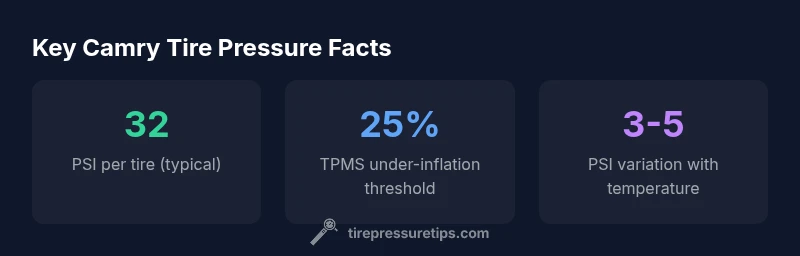
For a Toyota Camry, the official recommended cold tire pressure is shown on the driver’s door placard; most Camry models specify 32 psi per tire for both front and rear when cold. Always confirm the exact figure on your model-year placard or owner's manual, as trim or load can adjust the spec. If a tire is underinflated, TPMS will warn you and you should adjust promptly.
The science behind tire pressure and Camry safety
Tire pressure is more than a sticker number; it determines the shape of the tire’s contact patch, how heat builds up in the tread, and how well the vehicle responds to steering and braking inputs. When tires are inflated to the correct cold pressure, the contact patch distributes load efficiently, maximizing grip and reducing uneven wear. Underinflation causes the tire to sag and flex, increasing heat and wear on the edges, while overinflation can lead to a harsher ride and reduced traction in wet conditions. As the Tire Pressure Tips Team notes, starting with the door placard is essential since it reflects the vehicle’s intended loading range. For most Camry models, the typical baseline sits in the low to mid-30s psi per tire for both front and rear; however, the exact figure varies by year, trim, and wheel size. Always verify your model-year spec before you inflate.
In practice, drivers who maintain recommended cold pressures see improved fuel economy, more predictable handling, and balanced wear patterns. The relationship between pressure and performance is not linear—small adjustments can yield meaningful improvements in ride quality and tire longevity. Remember that TPMS is a safety net, not a replacement for regular pressure checks.
How to locate and verify your Camry’s exact tire pressure spec
Your Toyota Camry’s exact tire pressure specification should be printed on a door jamb placard near the driver’s door, visible when you open the door. The placard lists the recommended cold pressure for the front and rear tires, sometimes with separate values if driven with heavy loads or for certain trims. If you cannot locate the placard, consult the owner’s manual or the online PDF for your model year. Differences can occur between generations, so it’s crucial to confirm the spec for your year and trim. If you regularly carry heavy loads or drive on rough roads, some trims have guidance to adjust pressure within a safe range to preserve tire integrity and handling. When in doubt, use the placard value as your baseline and adjust only within the manufacturer’s recommended range.
According to Tire Pressure Tips, validating the spec across your Camry’s tires ensures you’re not over- or under-inflating, which can lead to uneven wear and suboptimal fuel economy.
How to check cold pressure and interpret TPMS alerts
Checking cold pressure means measuring tire pressure before the car has driven long enough to heat the tires up. Use a reliable gauge and take readings first thing in the morning or after the car has rested for several hours. Remove the cap, press the gauge onto the valve stem, and note the reading. If the reading is below the placard value, add air in short bursts until you reach the target and recheck. Don’t forget to re-seat the valve cap securely. If the reading is above the placard value, release air in small increments until you reach the recommended level. Direct TPMS warnings will illuminate when a tire runs significantly below the recommended cold pressure, typically around 25% under-inflation. That is a safety signal to inspect for leaks or punctures in addition to correcting pressure.
For Camry owners, consistent checks are a practical habit that supports tire longevity and vehicle safety.
Temperature, load, and driving conditions: when to adjust
Temperature fluctuations cause air to contract and expand in tires, so cold mornings can show lower readings than the same tires at noon. If you drive in cold weather, you may need to inflate slightly within the vehicle’s recommended range, but do not exceed the maximum specified by the placard. Heavy loads, frequent highway cruising, or towing can justify modest adjustments upward to maintain proper handling and load-bearing capacity. The goal is to keep the tires within the vehicle’s specified range under typical conditions, including seasonal changes. Remember that Camry tires are designed for balanced performance across moderate loading scenarios; significant deviations warrant a recheck of tire health and alignment, especially if the vehicle pulls or wanders at highway speeds.
Tire Pressure Tips emphasizes consistency: routinely check pressures with cold tires and adjust to the baseline upright in your climate and daily load.
A practical maintenance routine to stay within spec
Schedule a quarterly pressure check as part of a broader tire maintenance routine. Pair pressure checks with tread depth measurements and wheel alignment inspections to identify issues before they become safety concerns. Invest in a reliable gauge, keep a small air compressor or portable inflator handy, and remember to check spare tire pressure if your vehicle uses a full-size spare. When you rotate tires, recheck pressures to ensure that the changes in wheel position have not altered the alignment and load distribution. As a best practice, always verify the pressure after coming off the highway, after steep temperature drops, or after heavy cargo journeys to keep the Camry performing at its best.
The Tire Pressure Tips Team recommends maintaining your Camry at the placard spec for optimal safety and efficiency.
Quick-start checklist for Camry tire pressure maintenance
- Locate placard on the driver’s door jamb and confirm the cold PSI value.
- Check tires when cold, using a reliable gauge; adjust to the placard value.
- Recheck after inflating, and ensure valve caps are tight.
- Be mindful of temperature changes and payload; adjust within the recommended range.
- Inspect tires for wear and leaks; address TPMS alerts promptly.
- Rotate tires per the owner’s manual and recheck pressures after rotations.
Camry tire pressure guidance by scenario
| Model Type | Recommended Cold PSI per Tire | Notes |
|---|---|---|
| Standard Camry (most trims) | 32 | Door placard value; verify annually |
| Camry with heavy load or highway use | 34-36 | Increase pressure within spec for load |
| Cold-weather operation | 30-32 | Lower readings in cold temps; adjust within range |
Frequently Asked Questions
Where can I find the exact Camry tire pressure specification for my year and trim?
The exact specification is printed on the driver’s door placard and in the owner’s manual. If you’ve lost the manual, many Toyota sites and dealer portals publish the spec by model year and trim. Always verify the figure for your car before inflating.
Check the door placard and owner’s manual for your exact Camry tire pressure. If in doubt, ask your dealer for the spec for your year and trim.
Will Camry tire pressure differ by model year?
Yes. Some Camry generations feature different front/rear values or load-based adjustments. Always confirm the spec from the placard for your exact year and trim, even if you’ve worn out the vehicle’s sticker in heat or after maintenance.
Yes. Check the placard for your year and trim to know the exact PSI.
What happens if I drive with underinflated tires on a Camry?
Underinflation reduces fuel efficiency, increases tire wear on the edges, and can compromise braking and steering. It also raises the risk of heat buildup, potentially leading to a blowout in extreme cases. TPMS will warn when underinflation is significant enough.
Underinflation harms handling and wear; fix it promptly when TPMS lights up.
How often should I check Camry tire pressure?
Check cold tire pressures at least once a month and before long trips. Temperature changes and load can affect readings, so regular checks help maintain safe, efficient performance.
Check once a month and before big trips.
Is it okay to inflate tires to the max sidewall PSI?
No. Do not inflate beyond the placard spec. The max sidewall rating is the limit for safety, not a target for daily driving. Overinflation can reduce grip and cause aggressive wear in the center.
Never exceed the recommended PSI; stay within the placard value.
How does temperature affect Camry tire pressure?
Temperature changes can lower cold PSI readings in cold weather and increase readings in heat. Measure when tires are cold and compensate only within the manufacturer’s range to avoid over- or under-inflation.
Temperature can move the numbers; check when cold and adjust inside the spec.
“Maintaining the correct tire pressure on your Camry is one of the simplest ways to protect safety, optimize handling, and improve fuel efficiency.”
What to Remember
- Check the placard first before inflating
- Keep tires cold when measuring pressure
- Inflate within the manufacturer’s recommended range
- TPMS warnings indicate underinflation is likely
- Regular tire maintenance supports safety and fuel efficiency