Toyota Camry Tire Pressure Display: A Practical Guide
Learn how the Toyota Camry tire pressure display (TPMS) works, how to read alerts, and how to bring all tires to the recommended psi. Includes troubleshooting, relearn steps, and best practices for safety and efficiency.


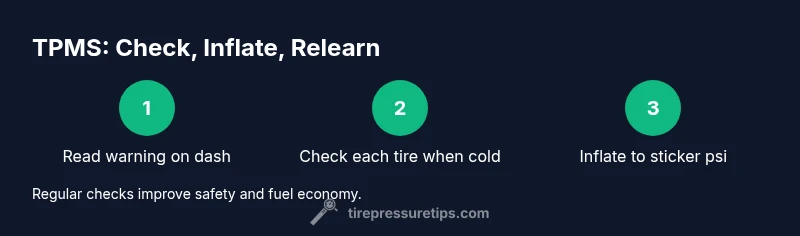
You will learn how the Toyota Camry tire pressure display (TPMS) works, how to read alerts, and how to bring all tires to the recommended psi. Start by confirming the warning on the dash, then check each tire when cold against the door jamb sticker. Inflate as needed and relearn the system if required. This guide also covers direct vs indirect TPMS and common failure modes.
Why the Toyota Camry tire pressure display matters
The Toyota Camry tire pressure display is more than a warning light—it's a practical safety feature that integrates with the car’s TPMS. According to Tire Pressure Tips, understanding this display can save you fuel, extend tire life, and prevent unexpected flats. The Camry's TPMS alerts you when a tire falls below the recommended psi, or when a sensor anomaly occurs. By acting promptly, you keep all four tires at an optimal balance of performance and safety.
How the display communicates warnings: common alerts and what they mean
When the TPMS detects underinflation, the dash warning light illuminates and sometimes a message shows the tire position. In some Camry models, a numeric readout or bar indicator appears on the instrument cluster. Understanding whether this is a single tire or multiple tires helps you triage quickly. If there are multiple flags or an ongoing sensor fault, you’ll want to inspect all tires and consider a TPMS reset.
Finding your Camry’s recommended tire pressure: where to look and how to read it
The recommended cold tire pressure is usually listed on the driver’s door jamb sticker and sometimes in the owner’s manual. It varies by tire size and load. Use a high-quality gauge to verify cold pressures and note that temperatures and recent driving can temporarily change readings. Always use cold readings for accuracy, ideally after the car has been stationary for several hours.
What affects tire pressure (and how temperature shifts readings)
Tire pressure changes with ambient temperature: about 1 psi for every 10°F change is a common rule of thumb. Driving heat can raise pressure by a few psi. Heavy loads and aftermarket tires can also shift the ideal range. Keeping a simple log helps spot trends and ensures you stay close to the manufacturer’s specification.
Step-by-step approach to check and inflate your Camry tires
This section provides a practical approach to physically check and inflate tires, while the dedicated Step-by-Step block below gives discrete actions with timing. Begin with all tires cold, use a reliable gauge, inflate to the exact recommended psi from the door sticker, and recheck after inflation. If any tire reads above the limit, adjust accordingly and confirm they are within the specified range.
Troubleshooting a false or intermittent TPMS warning
Intermittent warnings can stem from sensor battery depletion, damaged valve caps, or incorrect relearn. Start by inspecting valve stems and caps for corrosion or gaps, then verify that the sensors are seated properly. If readings remain inconsistent, you may need a diagnostic tool or dealer service to check sensor health and recalibrate.
Relearn or reset the TPMS after pressure changes
Many Camry models require a TPMS relearn procedure after inflating or rotating tires. This typically involves a sequence in the vehicle’s menu or a specific ignition/state method described in the owner’s manual. Completing the relearn ensures the system correctly associates each sensor with its tire position.
Seasonal tire pressure maintenance tips for Toyota Camry owners
Winter and summer shifts can affect tire pressures, so check pressures more frequently during seasonal transitions. Use a durable gauge, and keep a small log of readings for reference. If you regularly drive with heavy loads or sport tires, verify the target psi is compatible with your tire type and driving style.
Safety considerations when adjusting tire pressure
Always ensure you are parked on a flat surface, with the engine off and wheels chocked if needed. Wear safety glasses, use a stable ladder or platform when checking pressure, and never overinflate beyond the maximum shown on the tire sidewall. If you suspect a leak or sensor fault, seek professional help promptly.
When to consult a dealer or tire professional
If the TPMS warning persists after inflating to the correct PSI and relearning, or if you notice slow leaks, a professional inspection can diagnose sensor faults, valve issues, or wheel damage. Regular maintenance helps prevent unexpected tire failures and preserves return-on-investment in your Camry’s tires.
Tools & Materials
- Tire pressure gauge(Digital or analog; read to 1 psi precision)
- Portable air compressor or reliable air source(Prefer a unit with an accurate built-in gauge)
- Door jamb tire pressure sticker or Camry manual(Use as the official reference for PSI)
- Owner’s manual or service manual (optional)(Helpful for model-specific TPMS relearn steps)
- Notebook and pen (optional)(Record readings for future reference)
Steps
Estimated time: 45-60 minutes
- 1
Observe the TPMS warning on the dash
Turn on the ignition and note which tire the system flags, or if there is a general warning. This helps you focus checks on the correct wheel(s) and plan your inflation strategy.
Tip: If you’re unsure which tire is flagged, start with the front left and move clockwise around the vehicle. - 2
Check all tires when cold with a gauge
Park on level ground and ensure the car hasn’t been driven for several hours. Remove the valve caps and measure each tire’s cold pressure using a reliable gauge. Record the readings for comparison.
Tip: Cold readings are the most accurate; driving heats tires and skews the numbers. - 3
Inflate tires to the door-sticker specification
Compare each tire’s reading to the sticker on the driver’s door jamb and inflate underinflated tires to the recommended psi. Do not exceed the maximum psi shown on the tire sidewall.
Tip: Inflate in small increments and recheck after each adjustment for precision. - 4
Reset or relearn the TPMS after inflation
If your Camry requires a relearn after adjusting pressures, follow the process documented in the manual or vehicle settings. This re-links sensors to each tire position.
Tip: Some models require ignition cycles or a specific button sequence; a quick manual check prevents misalignment. - 5
Drive to complete the relearn
Take a short test drive (10-15 minutes) at moderate speeds to allow the system to relearn sensor positions. Avoid aggressive driving during this phase.
Tip: Monitor the dash; a solid update typically occurs after a highway or steady-speed segment. - 6
Recheck pressures after driving
Park again and measure all four tires to confirm they remain at or near the recommended psi after a drive. If readings drift, re-evaluate and adjust as needed.
Tip: Fluctuations may indicate slow leaks or temperature-induced changes.
Frequently Asked Questions
What does the tire pressure display warning mean on a Toyota Camry?
The warning indicates at least one tire is underinflated or there is a sensor fault. Check all tires when cold and inflate to the recommended psi; perform a TPMS relearn if required.
A TPMS warning means a tire is underinflated or there’s a sensor issue. Check the tires when cold and inflate to spec, then relearn if needed.
Can I drive with a TPMS warning?
Short trips at moderate speeds may be possible if pressures are near spec, but avoid long drives until all tires are properly inflated and the system is relearned.
You should not drive long distances with a TPMS warning. Inflate to spec and relearn before extended trips.
How often should I check tire pressure?
Check monthly and before long trips, or after any tire rotation. Use cold readings for accuracy and adjust as needed.
Check tires monthly and before long trips, using cold readings for the most accurate measurement.
Direct vs indirect TPMS—what’s the difference?
Direct TPMS uses sensors inside each tire, while indirect TPMS estimates pressure via wheel speed sensors. The Camry can use either depending on the year and trim.
Direct TPMS uses inside-tire sensors; indirect uses wheel speed data to estimate pressure.
How do I relearn TPMS after tire changes?
Follow the Camry’s TPMS relearn procedure in the manual or the vehicle’s settings menu. This aligns sensor IDs with tire positions.
Use the car’s TPMS relearn sequence as shown in the manual or settings.
What should I do if the warning persists after inflation?
If the warning stays after inflating to spec and relearning, there might be a faulty sensor or leak. Have the system inspected by a professional.
If the warning persists after inflating and relearning, seek professional diagnostics.
Watch Video
What to Remember
- Know what your Camry TPMS warning means and act promptly
- Always measure cold tire pressures for accuracy
- Inflate to the door-sticker psi and relearn TPMS if required
- Temperature and load affect tire pressures, monitor regularly