Tire Pressure on Honda Accord: A Practical Guide
Learn how to check and adjust tire pressure on Honda Accord, interpret TPMS alerts, and maintain optimal tire health with practical, step-by-step guidance for safe driving.


Mastering tire pressure on Honda Accord begins with reading the correct cold-inflation values from the door placard and using a reliable gauge to verify pressure when tires are cold. This quick guide shows you how to check, adjust, and maintain pressures, plus how to interpret TPMS alerts. Following Tire Pressure Tips recommendations helps prevent uneven wear, improves fuel efficiency, and enhances overall safety.
Why Tire Pressure on the Honda Accord Matters
The tire pressure on the Honda Accord affects safety, handling, comfort, and tire life. Underinflated tires flex more at the tread, generate unnecessary heat, and wear unevenly, increasing the risk of blowouts on busy highways. Overinflated tires can reduce the contact patch, making braking less predictable in wet or snowy conditions and accelerating wear in the center of the tread. The balance of inflation also influences ride quality, steering response, and fuel economy, especially on long commutes or cargo-heavy trips. For drivers, this means that checking tire pressure regularly is not a one-time task but a maintenance habit. The Honda Accord's factory placard specifies cold pressures that balance comfort and performance for typical loads, but those numbers assume tires are cold and the vehicle is not recently driven. Tire Pressure Tips emphasizes that readings should be taken after the tire has been at rest for several hours, or after the car has been parked for at least three hours. If a heat-soaked tire is measured, you may overestimate the true cold pressure.
Honda Accord tire pressure specifications and where to find them
To ensure accuracy, always start with the door placard on the driver's side, which lists the recommended cold tire pressures for the front and rear axles. The Honda Accord’s specification can vary by trim, wheel size, and load, so refer to the exact label on your car rather than guessing from a generic chart. The values on the placard reflect “cold pressure”—that is, the tire pressure when the tires are cold and the vehicle has been stationary. If you’ve recently driven, park the car and wait 3 hours before checking. In many cases, the front tires may have a different recommended pressure than the rear tires to optimize handling under normal driving conditions. If you carry heavy cargo or passengers, you may need a modest adjustment; consult your owner’s manual or the placard for any load-inflation guidance. When you replace tires or switch to different sizes, re-check the recommended pressures and adjust accordingly. Remember, proper inflation supports even wear, better fuel economy, and reliable TPMS readings.
Reading and Interpreting TPMS on a Honda Accord
TPMS lights are not just a warning—they guide your maintenance behavior. A TPMS alert can indicate a tire that has lost pressure, a failing sensor, or a temporary fault in the system. If the light comes on, you should verify each tire’s pressure with an independent gauge and compare it to the door placard values. If one tire reads significantly below spec, inflate to the recommended cold pressure and recheck after driving for a short distance to allow the system to stabilize; if the light remains on after inflation, the sensor or module may require service. For older Accord models, the TPMS relies on wheel-mounted sensors that use battery power and may drift over time. In all cases, do not ignore a persistent TPMS warning. Tire Pressure Tips notes that a consistent approach to monitoring and maintaining tire pressures reduces uneven wear and helps maintain predictable handling and braking performance.
How to check tire pressure on a Honda Accord: a practical method
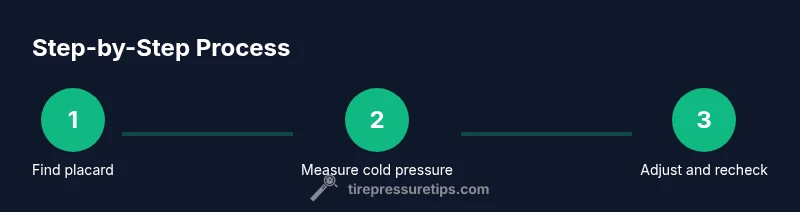
First, park away from heat sources, turn off engine, and let tires cool. Locate the door placard and identify front/rear pressures. Use a gauge to measure your tire per tire; remove valve caps, place gauge on valve stem, press firmly to get a measurement, and record the value. If the reading is low, use a compressor to add air until you reach the target, then re-check. If reading is high, release air gradually until correct. Reinstall valve caps. Finally, re-check all tires to ensure even pressures.
Common pitfall reminders and seasonal considerations
Seasonal changes and daily temperature swings can subtly affect tire pressures. In cooler mornings, pressures tend to be lower, while afternoon heat can raise readings. Rely on the door placard for the target values rather than memory, and always read tires when they are cold. Remember to check the spare tire if you have one, as it may be neglected and lose air over time. Avoid repeatedly over-inflating to compensate for perceived soft ride; it can lead to uneven wear and a harsher ride. And never ignore a TPMS warning; address it promptly to maintain safe handling.
Tools & Materials
- Tire pressure gauge (digital or mechanical)(Choose a gauge with a clear scale and a range that covers the vehicle’s expected psi values.)
- Door placard (vehicle information label)(Shows the recommended cold pressures for front and rear tires; read when tires are cold.)
- Air compressor or CO2 inflator(Optional for inflating tires on the spot; ensure you do not overinflate beyond the recommended psi.)
- Owner’s manual(Helpful for model-specific guidance and for understanding TPMS maintenance.)
- Valve-cap replacement caps(Reinstall after measuring; helps keep debris out of valve stems.)
Steps
Estimated time: 15-25 minutes
- 1
Find the official tire pressure values
Identify the door placard on the driver's side to locate the recommended cold pressures for front and rear tires. Note any model-specific differences and keep a simple record of the targets for each axle.
Tip: Always verify both front and rear values; neglecting a difference can affect handling. - 2
Check tires when cold
Ensure the vehicle has been stationary for at least three hours or has driven less than a mile since the last drive. Read each tire with a gauge and write down the numbers for reference.
Tip: Measuring after driving yields higher readings due to heat and can mislead you into underinflation. - 3
Attach gauge and read
Remove the valve cap, place the gauge on the valve stem, and press straight down to get a measurement. Do this for all four tires and the spare if applicable.
Tip: Keep the gauge perpendicular to the valve stem for an accurate reading; wipe off any dust first to prevent interference. - 4
Inflate or deflate to target
If a tire reads below the placard value, add air in small increments and recheck. If it reads too high, release air gradually until it matches the target.
Tip: Inflate in 1–2 psi increments to avoid overshooting the target pressure. - 5
Recheck and seal
Replace valve caps, recheck all tires to confirm uniform pressures, and address any TPMS warnings if they persist after inflation.
Tip: A final check ensures long-term stability and TPMS reliability.
Frequently Asked Questions
What is the correct tire pressure for Honda Accord?
Refer to the door placard for the specific values of your Honda Accord. The placard shows recommended cold pressures for both front and rear tires, which can vary by trim and wheel size.
Check the door placard on your Honda Accord for the exact cold tire pressures for your model.
How often should I check tire pressure on Honda Accord?
Check tire pressure at least monthly and before long trips. Always read when tires are cold to avoid inflated readings from heat.
Check your tires monthly and before trips, making sure to read them when cold.
What does TPMS mean on a Honda Accord?
TPMS indicates low tire pressure or a sensor fault. If it lights up, verify each tire’s pressure with a gauge and compare to the placard values.
TPMS warns about low pressure or a sensor fault; verify pressures with a gauge.
Can I inflate tires while they are hot?
No. Inflate or measure only when tires are cold for an accurate reading. Hot tires read higher due to heat expansion.
No—read and adjust tires when cold for accuracy.
What tools do I need to check tire pressure?
A reliable tire pressure gauge, access to the placard, and an air source if you need to adjust pressures on the spot.
A gauge, the placard, and an air source if you need to adjust pressure.
What should I do if TPMS stays on after inflation?
If the light remains on after adjusting, inspect sensors or schedule service; persistent TPMS can indicate a faulty sensor.
If TPMS stays on after inflation, have the system checked for sensor or module faults.
Watch Video
What to Remember
- Check tires when cold using the placard values.
- Read all four tires (and spare) with a reliable gauge.
- Inflate or deflate in small steps and recheck.
- Address persistent TPMS warnings promptly to maintain safety.