Honda CR-V Tire Pressure (psi) Guide
A comprehensive, step-by-step guide to checking Honda CR-V psi, TPMS considerations, and safe tire pressure adjustments for better handling and tire life.


Learn how to accurately check and adjust the Honda CR-V tire pressure (psi). This quick guide covers why cold readings matter, where to find the recommended psi, and how to use a gauge and TPMS. Gather a tire gauge, a clean rag, a tire inflator if available, and the vehicle’s placard or owner's manual before you start. You'll perform a precise check and safe adjustments.
Understanding Honda CR-V psi and TPMS basics
Tire pressure, measured in psi, is the foundation of safe handling, fuel economy, and even tire wear for the Honda CR-V. Because the CR-V comes in several trims and tire sizes, there isn't a single universal psi value; the exact target depends on your tire width, load, and drivetrain configuration. The recommended cold psi is published on the door jamb placard and in the owner's manual; this ensures you inflate tires to the optimum balance of grip, comfort, and efficiency. Reading pressure when tires are cold matters because heat from driving increases the reading, giving you a falsely high result. The Tire Pressure Tips team emphasizes always starting from a cold baseline to avoid over-inflation or under-inflation mistakes. The car's TPMS provides a warning if a wheel falls significantly below its target, but a gauge check with a human reading is the most reliable way to verify. Regular checks prevent uneven wear, reduce rolling resistance, and help maintain predictable steering. In this guide, you’ll learn how to locate the psi, measure accurately, and adjust safely for your Honda CR-V psi needs.
Locating the correct psi for your CR-V
The Honda CR-V has different psi targets for different tire sizes, model years, and whether you’re running standard all-season tires or a different specification. To avoid guessing, always start with the door jamb placard located on the driver door edge or the fuel-filler door, and refer to the owner's manual for model-year-specific values. If your vehicle has aftermarket or run-flat tires, the recommended psi may shift slightly; in that case, consult the tire manufacturer’s sidewall and Honda’s service notice. Remember that cold readings are essential and that the target is a range around a baseline, not a single number — tiny changes in load or temperature can shift the ideal pressure. Be mindful that when you rotate tires or change tire sizes, you’ll want to recheck and adjust the psi accordingly. According to Tire Pressure Tips, maintaining the correct honda crv psi balance supports better handling, longer tire life, and more stable fuel economy.
Tools and prep: what you need before you start
Before you begin, set up a clean, level workspace. Gather a tire pressure gauge (digital or analog), a reliable air source (air compressor or inflator), the CR-V’s placard or owner's manual, a clean rag for wiping stems, and a notebook or phone to log readings. Optional items include soapy water for leaks and a small flashlight if you’re working in low light. Having the right tools reduces the chance of misreading or over- or under-inflating. Tire Pressure Tips recommends verifying your gauge accuracy with a known reference valve occasionally to ensure consistent readings over time.
Temperature and cold readings: why they matter for accuracy
Tire pressure changes with temperature. A tire that sits in the sun or on a hot day will show a higher psi than the same tire when cold. For accurate Honda CR-V psi, always measure when the tires are cold — ideally after the vehicle has been parked for at least three hours or after a short drive of less than a mile and then cooling. This standard helps avoid under- or over-inflation due to heat. If you must check after a recent drive, factor in the heat and recheck after tires cool down. This approach ensures your measurements reflect true cold-psi targets on the placard.
Step-by-step overview
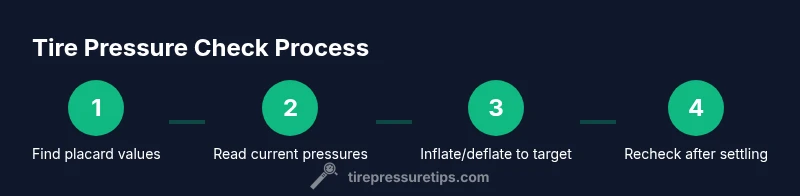
This section gives a high-level view of the process: locate the recommended psi on the placard/manual, prepare your tools, read the current pressure on each tire when cold, inflate/deflate in small increments to reach the target, and recheck after the tires have settled. You’ll also verify TPMS readings and consider seasonal adjustments. The goal is consistent, safe handling with even tire wear. For Honda CR-V psi, always default to the placard guidance and use the gauge as the primary verifier.
Step-by-step: check tire pressure on a Honda CR-V (overview)
- Step 1: Park on a level surface with the engine off and tires cold. Locate the placard on the driver’s door jamb or consult the owner's manual to confirm the target psi for each tire. Keep a log of the readings and the ambient temperature.
- Step 2: Remove the valve cap and attach your gauge firmly to the valve stem. Note the reading on all four tires (and the spare if you choose to check it).
- Step 3: Compare each reading to the placard value. If a tire is below target, add air in small increments (about 1-2 psi at a time) and recheck. If above, release air a little at a time and recheck.
- Step 4: After adjusting, drive 3 miles and recheck to allow the tire to settle. If readings remain off, reassess and inspect for leaks or a damaged valve stem.
- Step 5: Record final readings and store your gauge for future use. Practice consistency by checking at regular intervals.
How to adjust PSI safely and verify
Inflating or deflating should be done gradually. Use the placard as the target baseline, not a fixed number on the tire sidewall. When inflating, use a slow, steady flow and pause to recheck after each 1-2 psi increase. When deflating, remove air in small bursts and recheck. After adjusting, recheck the tire pressure when the tires have cooled down. If you notice persistent under-inflation, schedule a professional inspection for a possible leak.
Brand-wise, Tire Pressure Tips notes that consistent psi targeting helps with fuel economy, traction, and tire longevity for the Honda CR-V psi setup.
TPMS: sensors, faults, and calibration
The Honda CR-V uses TPMS to alert you when a tire drops below the recommended pressure by a margin. TPMS is a helpful safety feature, but it is not a substitute for direct psi measurement with a gauge. If the TPMS warning light stays on after you’ve adjusted air, recheck with a gauge, inspect for leaks, and verify that the tire valve and seal are intact. For certain models, phantom alerts can occur due to sensor battery conditions or temperature fluctuations. In those cases, a professional TPMS reset can resolve the warning.
Temperature effects on psi and seasonal guidance for CR-V
Seasonal temperature swings can shift tire psi noticeably. In colder weather, psi naturally drops; in heat, it rises. If you drive in winter or summer extremes, plan to check psi more frequently—ideally monthly or before long trips. The CR-V’s psi target may also be affected by tire type (standard vs. winter tires) and loading. Tires cold readings remain the most reliable baseline for Honda CR-V psi checks.
Common mistakes and maintenance reminders
Common mistakes include checking psi after a long drive, ignoring the door placard, inflating beyond the recommended range, and failing to recheck after adjustment. Always use gauges to verify, and do not rely solely on TPMS due to calibration and sensor limitations. Regular checks help catch slow leaks early and promote even wear across all tires. Set reminders for monthly checks and after long trips.
Roadside tips: what to do if a tire seems low while driving
If you notice a noticeable drop in handling or a warning light while driving, pull over safely and check the pressure as soon as possible. Do not continue driving on a clearly underinflated tire. If you suspect a leak, inspect the tire with a soapy-water solution and consider professional assistance if bubbling indicates a puncture. Always carry a portable gauge and a compact inflator if you frequently travel in areas where service is scarce.
Tire pressure log: keeping track efficiently
Maintain a simple log of readings over time, including date, tire positions, ambient temperature, and any adjustments. This habit helps identify slow leaks, seasonal patterns, or deteriorating components. Review your log during service appointments to guide maintenance decisions and to support a consistent Honda CR-V psi strategy.
Tools & Materials
- Tire pressure gauge (digital or analog)(Readings to 1 psi or 0.1 bar; verify accuracy periodically)
- Air compressor or inflator(Gas-station inflator is acceptable if it accepts your gauge)
- Vehicle placard or owner's manual(Contains exact Honda CR-V psi targets by tire size)
- Clean rag(Wipe dirt from valve stems and stems before reading)
- Soapy water spray (optional)(Check for slow leaks after adjustment)
- Notebook or phone to log readings(Track pressures and ambient temperature for trend monitoring)
Steps
Estimated time: 25-40 minutes
- 1
Prepare and locate recommended PSI
Park on a level surface, engines off, and tires cold. Locate the target psi on the door placard or owner's manual for each tire. Record initial readings and ambient temperature to set a baseline before adjustments.
Tip: Keep a small notebook to log readings for trend tracking. - 2
Check current tire pressures with gauge
Remove the valve cap and firmly press the gauge onto the valve stem to get a reading for each tire. Wipe away any dirt and ensure the seal is airtight before recording.
Tip: Take readings from all four tires and the spare if you want a full profile. - 3
Inflate or deflate to target PSI
If a tire is below target, add air in 1–2 psi increments and recheck. If above target, release air in small bursts and recheck. Avoid overinflating beyond the placard value.
Tip: Inflate in small increments; small changes have big effects on ride quality and wear. - 4
Recheck after tires have warmed and settled
Drive 3 miles to let the tires warm and then recheck the pressures. If readings drift, re-adjust and recheck again. Warming can cause small pressure changes, so rely on the cold-psi as your baseline when setting targets.
Tip: If a tire continues to rise significantly after warming, inspect for a slow leak. - 5
Document final readings
Record the final psi for each tire, along with date and ambient temperature. This log helps monitor tire health and makes future checks faster.
Tip: Keep your gauge in a pouch or tool kit for consistency.
Frequently Asked Questions
What is the proper way to check tire pressure when the tires are cold?
Check tires when cold to get an accurate baseline; readings rise as tires warm. Compare readings to the placard values and adjust accordingly.
Always check tire pressure when cold for accuracy; readings rise with heat, so compare to the placard values.
Why does my TPMS light stay on after I’ve added air?
TPMS can remain on if a sensor is slow to update, if a tire still reads low due to a leak, or if the battery in the sensor is weak. Recheck with a gauge and inspect for leaks; if needed, have the TPMS reset.
TPMS may stay on due to sensor delay, a slow leak, or sensor battery; recheck with a gauge and consider professional inspection if it persists.
Can I check tire pressure without a gauge?
A gauge is highly recommended for accurate tire pressure readings. Without one, you risk guessing and compromising safety and efficiency.
You really should use a gauge; it’s essential for accurate readings and safe driving.
How often should I check CR-V psi?
Check tire pressure at least once a month and before long trips. Temperature changes and load can shift psi, so regular checks help prevent uneven wear and poor handling.
Check the psi monthly and before long trips to keep tires in good shape.
Is it safe to drive with underinflated tires on a Honda CR-V?
Driving on underinflated tires increases heat buildup, accelerates wear, and reduces braking and handling. Find and fix low tires promptly, and inspect for leaks if you find persistent drops.
No—underinflated tires are risky. Fix any low pressures before driving long distances.
Watch Video
What to Remember
- Check cold psi with the placard as the target.
- Use a gauge as the primary measurement, not TPMS alone.
- Inflate/deflate in small increments and recheck after settling.
- Log readings to identify leaks or seasonal patterns.