Tire Pressure Guide for Jeep Gladiator
A practical, step-by-step guide to checking and maintaining proper tire pressure on the Jeep Gladiator. Learn how to use gauges, interpret TPMS, and adjust for load, weather, and off-road use—boosting safety, fuel efficiency, and performance.


Goal: You will accurately check and adjust tire pressure on your Jeep Gladiator to improve safety, fuel efficiency, and traction. You'll need a reliable tire pressure gauge, access to an air source (at-home compressor or gas station), and the vehicle's recommended cold PSI from the door placard or owner’s manual. This quick guide outlines the required steps, safety notes, and how temperature and load affect readings.
Why Tire Pressure Matters on the Jeep Gladiator
Maintaining correct tire pressure is one of the simplest, most effective ways to improve grip, braking, and fuel economy for a Jeep Gladiator. Underinflated tires flex more at the sidewalls, generating heat and reducing contact patch efficiency, which can compromise on- and off-road performance. Overinflated tires wear unevenly and lose traction on loose surfaces. According to Tire Pressure Tips, the Gladiator benefits from precise, load-aware pressures that match road or trail conditions. For many drivers, the door placard offers the baseline, but real-world use—in town, highway, or rock-crawling—often requires small adjustments. In this section we’ll unpack why pressure matters, how to interpret the placard, and how to approach PSI changes responsibly while preserving tire longevity and safety.
Tools & Materials
- Tire pressure gauge(Digital preferable; measure range 0-60 psi; accuracy within ±1 psi.)
- Portable air compressor or access to air pump(Ensure it can reach target PSI and has compatible nozzle.)
- Door placard or owner's manual(Shows recommended cold PSI for front and rear tires.)
- Wheel chocks(Place behind wheels on level ground when inflating.)
- Notebook or app for logging pressures (optional)(Record readings to track trends and leaks.)
Steps
Estimated time: 15-25 minutes
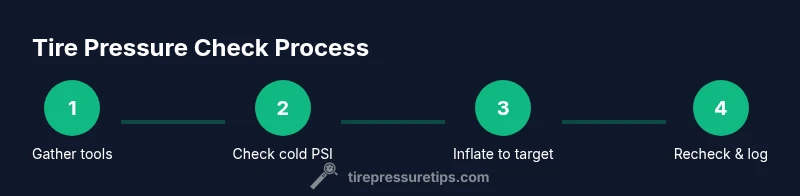
- 1
Gather tools and locate target pressures
Collect your gauge, air source, and the vehicle’s placard. Locate the recommended cold PSI for both front and rear tires, typically found on the door jamb placard or in the owner's manual. Having everything within arm’s reach makes the process faster and reduces the chance of missing a tire.
Tip: Have the gauge ready and note the baseline readings before making any changes. - 2
Check tires when cold
Park on level ground and wait for the tires to cool, ideally for several hours. Cold readings are the most accurate baseline because driving heats tires and raises pressure. If you must check after a drive, treat the reading as a temporary value and adjust after a proper cooldown.
Tip: If you’ve just driven, wait and recheck later rather than inflating immediately. - 3
Inflate to target on each axle
Using your gauge, measure current psi on the front tires and adjust to the door placard values. Do the same for the rear tires. Inflate or release air in small increments and recheck each tire after adjustments.
Tip: Work from the most under-inflated tire first to avoid overcorrecting others. - 4
Recheck for accuracy
After reaching the target, recheck all four tires to confirm accuracy. Replace valve caps, and ensure the stems aren’t damaged or bent. If you’re using a station compressor, allow the gauge to steady before recording the number.
Tip: A second check confirms accuracy and prevents rebound adjustments. - 5
Check the spare tire (if mounted)
If your Gladiator carries a mounted or readily accessible spare, check its pressure as well. Spares carry different duty cycles and may require a different PSI depending on the wheel type and load.
Tip: Don’t forget the spare when you’re logging tire pressure. - 6
Log readings and close out
Record date, time, ambient temperature, and psi for each tire. Regular logging helps you spot slow leaks or gradual changes over time. Pack a quick reference card in the glove box for future checks.
Tip: Set a reminder to recheck periodically or after temperature swings.
Frequently Asked Questions
What is the best way to determine the Jeep Gladiator's recommended tire pressure?
Refer to the door placard or the owner's manual for the official cold PSI values. Measure tires when cold and tailor inflation to load and driving conditions. These sources reflect Jeep’s recommendations for front and rear tires and any variations by tire size.
Check the placard, measure cold tires, and adjust based on load and conditions.
Can I rely on TPMS instead of manual pressure checks?
TPMS provides a warning when pressure drops, but it isn’t a replacement for manual checks. Temperature changes, slow leaks, or sensor issues can delay or mislead readings, so always verify with a gauge.
TPMS helps, but you should still measure with a gauge to be sure.
Should I adjust tire pressure for off-road driving in the Gladiator?
Yes, off-road use often requires adjustments based on terrain, weight, and desired traction. Start with the placard as a baseline, then fine-tune by small PSI changes and recheck after returning to level ground.
Off-road use needs careful tweaks; use small steps and recheck.
What happens if tires are underinflated?
Underinflated tires can overheat, wear unevenly, reduce fuel efficiency, and shorten tire life. They also decrease traction and increase stopping distances.
Underinflation causes heat and wear; it hurts safety and fuel economy.
Why does the TPMS light stay on after inflating?
A TPMS light can indicate a slow leak, sensor fault, or recent inflation that the system hasn’t fully registered yet. Recheck with a manual gauge to confirm before driving long distances.
TPMS warnings can linger; verify with a manual check.
How often should I check tire pressure?
Check at least once a month and before long trips. Also recheck when temperatures shift dramatically or after loading the bed with gear.
Check monthly and before big trips, especially with temperature changes.
Watch Video
What to Remember
- Check cold PSI before driving for accuracy
- Use a reliable gauge and target placard values
- Document changes to detect slow leaks
- TPMS alerts supplement, not replace, manual checks