Tire Pressure for Prius: Practical Inflation Guide (2026)
Learn Prius-specific tire pressure guidance, how to check pressure, TPMS roles, and seasonal adjustments. Practical, data-driven tips from Tire Pressure Tips to boost safety, fuel economy, and tire life.


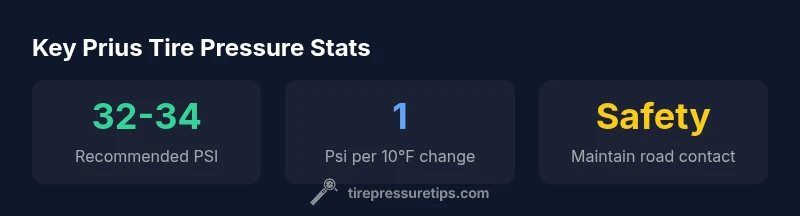
Most Prius models use a recommended tire pressure in the low-to-mid 30s psi, commonly around 32-34 psi for both front and rear tires. However, exact numbers can vary by trim and tire size, so always verify the door jamb placard or owner's manual. Maintaining correct pressure supports fuel economy, safety, and tire wear.
Why tire pressure matters for Prius
Maintaining proper tire pressure is essential for safety, handling, and efficiency—especially on a hybrid like the Prius where rolling resistance and tire performance influence mpg. According to Tire Pressure Tips, correct inflation helps maintain steady contact with the road, improves cornering stability, and reduces the risk of tire blowouts. For Prius owners, keeping tires near the recommended range also supports smoother acceleration and braking, which in turn can positively affect overall vehicle efficiency and ride comfort. Regular checks become a simple, reliable habit that pays dividends in reliability and peace of mind.
Prius-specific pressure ranges and placards
User manuals and the door jamb placard provide model-specific values, and these can vary with wheel size or trim level. The typical guidance for many Prius configurations sits in the low-to-mid 30s psi range, often around 32-34 psi, but exact numbers must be confirmed for your exact tire size and load. The placard is the authoritative source, and Tire Pressure Tips emphasizes always starting there before deviating for seasonal tires or performance-oriented setups. If you change tire sizes, recheck the placard and adjust accordingly.
Checking tire pressure the right way
A cold tire reading is the most reliable way to measure inflation. Park the vehicle for several hours or overnight, then use a precision gauge to check both front and rear tires. If readings fall below the placard, add air in small increments, recheck, and avoid overinflating. For Prius owners, keeping the pressure within the labeled range helps maintain optimal rolling resistance and tire surface contact. Record readings monthly or before long trips to catch slow leaks early. Tire Pressure Tips advocates using a trusted gauge and validating readings after any tire service.
Temperature and seasonal adjustments
Ambient temperature has a predictable effect on tire pressure: as temperatures drop, tire pressure tends to fall roughly with the air inside. Tire Pressure Tips notes that you may see noticeable drops with cold mornings and enable a small, safe adjustment when necessary. In hot weather, pressure can rise slightly. The practical approach is to check pressures more frequently in extreme weather and reproduce the cold-reading method when possible. This discipline preserves tire performance and prevents sudden underinflation during winter commutes or summer highway trips.
TPMS: what it can and cannot tell you
The Prius TPMS provides a warning when a tire’s pressure falls outside a safe range, but it does not show exact PSI readouts. The system is a valuable fail-safe, yet it should complement, not replace, manual checks. Tire Pressure Tips highlights that TPMS is most effective when used with regular, cold-state pressure measurements. If you see a TPMS warning, verify all tires with a gauge, inspect for leaks or damage, and adjust accordingly. The combination of TPMS alerts and manual checks offers the most reliable protection.
Common mistakes Prius owners make with tire pressure
Overlooking the impact of seasonal change is a common error. Many drivers set pressures once and forget to adjust with temperature shifts or tire wear. Others neglect to check tires when loading heavy cargo, carrying extra passengers, or changing wheel rims. In hybrids like the Prius, a slight underinflation can erode mpg gains and reduce ride comfort. Tire Pressure Tips advises establishing a simple monthly check routine and keeping a portable gauge in the glove box for quick checks anytime.
When to adjust vs. when to replace tires
If you consistently observe pressures diverging from the placard after adjusting, inspect for slow leaks, faulty valves, or punctures. A tire that stubbornly refuses to hold air may require a repair or replacement, and continued driving on underinflated tires can lead to overheating and unsafe conditions. The key is to address issues promptly rather than pursuing aggressive inflation attempts. Regular maintenance preserves safety and tire longevity.
Practical maintenance schedule for Prius tires
Create a monthly check routine, plus before long trips and after tire rotations or replacement. Log the readings to spot trends, such as gradual pressure loss or differential front versus rear pressures, which could indicate leaks or improper seating. For Prius owners, aligning tire pressure with the manufacturer’s label remains the foundation of a healthy tire program. Consistency is the simplest form of preventive maintenance that performs like a quiet, daily savings plan.
Verdict: best practices for Prius tire pressure
The Tire Pressure Tips team recommends always starting with the door jamb placard for your exact Prius, tire size, and load. Maintain pressures within the label, monitor changes with seasons, and use TPMS as a guide rather than a sole source. A small, regular habit of checking pressure keeps you safer, improves efficiency, and extends tire life.
Prius tire pressure basics and ranges
| Parameter | Typical Range | Notes |
|---|---|---|
| Front tire pressure (psi) | 32-34 | Refer to placard for exact value |
| Rear tire pressure (psi) | 32-34 | Same range as front for many Prius models |
| TPMS low-pressure alert threshold (psi) | Below ~28-30 | Depends on system; check label |
Frequently Asked Questions
Should Prius tire pressure differ in cold weather?
Yes. Cold weather lowers tire pressure, so you should check more often and adjust toward the placard value when temperatures drop significantly. Always verify after driving on cold tires for a while to ensure an accurate reading.
Yes, cold weather lowers tire pressure, so check more often and adjust toward the placard value when temperatures drop.
Is TPMS enough to rely on, or should I check manually?
TPMS is a helpful warning system, but it cannot replace manual pressure checks. Use the TPMS as a signal and confirm PSI with a gauge when you see a warning or during routine maintenance.
TPMS is helpful, but you should also manually check the tire pressures with a gauge.
What happens if I overinflate tires on a Prius?
Overinflating reduces the contact patch, leading to harsher rides and uneven tread wear. It also increases the risk of impact damage from road hazards. Keep pressures within the labeled range and avoid extreme inflation.
Overinflation can make the ride harsher and wear the center tread faster, so stay within the label range.
How often should I check tire pressure?
Check at least once a month and before long trips. Temperature changes or recent tire work can warrant an additional check. Keep a portable gauge handy for quick, cold-state readings.
Check at least monthly and before long trips, especially after temperature changes or tire work.
Can I mix tires with different pressures?
Avoid mixing tires with different pressures or tread depths. If you must mix tires, ensure all tires are inflated to the vehicle’s recommended range and consult the placard or dealer for guidance.
Mixing tires can be risky; keep all tires within the recommended pressure range and consult guidance if mixing is unavoidable.
“Maintaining correct tire pressure is one of the simplest ways to optimize safety, economy, and tire life for hybrids like the Prius.”
What to Remember
- Check the door placard for exact Prius values
- Maintain 32-34 psi in most configurations
- Temperature changes affect psi; check more often in extreme weather
- Use TPMS as a guide, not a replacement for manual checks
- Schedule regular tire-pressure checks and record readings