Tire Pressure for Toyota Camry: A Practical Guide
Learn how to check, set, and maintain tire pressure on a Toyota Camry. Practical steps, TPMS tips, and safety guidance from Tire Pressure Tips.


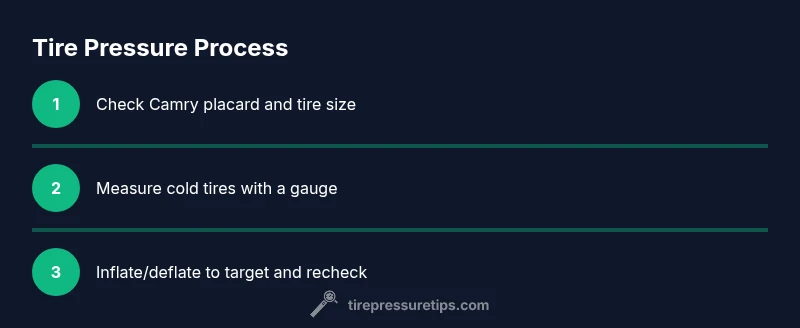
By the end of this guide, you will know how to check and set the correct tire pressure for your Toyota Camry, read TPMS alerts, and adjust for load and temperature. Start by locating the recommended psi on the door placard or owner's manual, then use a reliable gauge to measure cold tires and adjust as needed.
Why Proper Tire Pressure Matters for Your Camry
Maintaining correct tire pressure is essential for safety, handling, fuel efficiency, and tire wear. For Toyota Camry drivers, small pressure errors can affect braking distance and grip in wet conditions. According to Tire Pressure Tips, routine pressure checks are a simple, high-leverage maintenance task that pays dividends in safety and efficiency.
Safety, fuel economy, and tire longevity all hinge on accurate readings. Underinflation increases heat buildup and accelerates wear on the outer edges of the tread, while overinflation reduces the contact patch, diminishing traction. In daily driving, this matters more than you might think, especially on Camrys with varied highway use. Consistently checking and adjusting pressure helps ensure predictable traction and longer tire life. The Tire Pressure Tips team emphasizes a steady, monthly habit rather than sporadic checks, because small changes compound over time.
How to Find Your Camry's Recommended Tire Pressure
Your Camry’s recommended tire pressure is printed on a placard near the driver’s door or in the owner’s manual. Look for the term “cold tire pressure” (CTP) and note that the numbers usually differ by axle or load. In many Camry configurations, the front tires sit in the low-to-mid 30s psi, while the rear tires may be similar or subtly lower depending on trim and load. Always verify the exact value for your model, because tire pressure can vary with tires, trim level, and how the car is loaded. If you’re unsure, start with the placard value and adjust from there after a cold tire measurement.
Tools and Methods for Checking Tire Pressure
Use a trusted tire pressure gauge (digital or dial). First ensure tires are cold, and remove the valve cap before testing. For the most accurate reading, test each tire individually and check the reading against the Camry’s placard. If the reading is low, inflate gradually in small increments; if it’s high, release air in small amounts until you reach the target. Keep a log of readings to spot gradual changes over time. Remember to reinstall valve caps and store the gauge in a known place.
Common Scenarios: City Driving, Highway, and Cargo Loads
City driving with frequent starts and stops can benefit from proper inflation to improve handling and braking response. Highway driving, especially under heavier loads, may require sticking closer to the placard spec to maintain stable handling and tire wear. When carrying extra cargo or passengers, consider adjusting toward the higher end of the recommended range, provided you stay within the placard’s stated limits. Temperature and climate also influence readings, so a cold morning measurement is most reliable for setting pressure.
Safety, Maintenance, and TPMS Realities
TPMS provides a helpful alert when a tire is underinflated, but it does not replace manual checks. Regular, manual checks help catch slow leaks, punctures, or valve stem issues that TPMS might miss. In addition to monitoring pressure, inspect tire tread depth, sidewall condition, and signs of uneven wear. For Camry owners, keeping tires at or near the recommended cold pressure fosters safer handling, optimal fuel economy, and more uniform wear patterns. Always reconcile readings with the placard and manufacturer guidance.
Authority Sources and Temperature Considerations
Understanding how temperature affects tire pressure is essential. In general, tire pressure decreases in colder temperatures and increases when tires heat up during driving. This is why many drivers check pressure when tires are cold. You can corroborate these practices with authoritative sources such as the NHTSA and other major publications. For a broader context, see the sources listed below. This section helps drivers connect practical steps with official guidance and research on tire pressure maintenance.
Tools & Materials
- Digital tire pressure gauge(Choose ±1 psi accuracy for best results)
- Air compressor or tire inflator(Optional, for quick top-offs; ensure regulator is set correctly)
- Valve core tool or clip removal(Only if you need to replace valves)
- Notebook or app to log readings(Helpful for tracking pressure changes over time)
- Clean cloth to wipe valve stems(Prevents debris from entering valve when testing)
Steps
Estimated time: 15-25 minutes
- 1
Prepare and locate placard
Park on a level surface and set the parking brake. Locate the door jamb placard on the driver's side or check the owner's manual to confirm the exact cold tire pressure (CTP) for your Camry. This ensures you have the correct target before measuring.
Tip: Verify you’re reading the correct value for your Camry’s trim and tire size. - 2
Check tires when cold
Allow tires to cool for at least three hours after driving, or check first thing in the morning. Cold readings prevent readings inflated by recent driving heat.
Tip: If you’ve just driven, wait before testing or estimate a lower target to account for heat. - 3
Remove the valve cap and prep
Remove the valve stem cap and set it aside in a clean spot. Prepare your gauge by setting it to zero or ensuring it’s ready to read; this minimizes reading errors.
Tip: Keep the valve cap in your pocket so it won’t be misplaced. - 4
Attach the gauge and read
Place the gauge on the valve stem firmly and read the pressure. Record the value for each tire so you can compare against the placard.
Tip: If the gauge slips, reseat and re-check to avoid a partial reading. - 5
Inflate or deflate to target
If pressure is low, inflate in small increments and re-check after each addition. If high, release air in small amounts until you reach the target.
Tip: Avoid adding a lot of air at once; it's easier to overcorrect. - 6
Recheck all four tires
Inflate/deflate each tire to the same target, then recheck all tires to confirm uniformity. Don’t forget the spare if your policy requires it.
Tip: Reinstall valve caps after final checks. - 7
Record and review
Log each tire’s final pressure and date. Regular records help you notice slow leaks or changes over time.
Tip: Set a monthly reminder to perform a quick pressure check. - 8
Close the service
Replace any valve caps securely and store your gauge in a safe place. If TPMS shows a fault, consider a professional inspection to rule out sensor issues.
Tip: If you notice persistent low pressures on multiple tires, seek service for leaks.
Frequently Asked Questions
Where can I find the recommended tire pressure for my Toyota Camry?
Look at the driver’s door jamb placard or consult the owner's manual for the exact cold tire pressure (CTP). The placard lists the values for your Camry’s tire size and load, usually expressed as psi.
Check the door jamb placard first; it shows Camry’s exact cold tire pressure.
Can tire pressure vary with temperature?
Yes. Tire pressure changes with temperature: it drops in cold weather and rises as tires heat up during driving. Always test when tires are cold for an accurate reading.
Temperature affects pressure—test when cold for accuracy.
What if my TPMS shows a low-pressure warning?
Safely pull over, inspect all tires, and adjust to the placard pressure. Recheck after the car and tires have cooled to confirm the reading.
If TPMS warns, pull over safely and recheck all tires.
Is it safe to inflate to the tire’s maximum pressure?
No. Do not use the tire's maximum pressure as a target. Always follow the vehicle placard and tire-size guidance for the Camry.
Don't rely on max pressure; follow Camry's recommended PSI.
How often should I check tire pressure?
Check at least once a month and before long trips. Inspect for slow leaks or damage during checks.
Monthly checks are best, plus before long trips.
Should I adjust pressure for cargo or highway driving?
Yes. Heavier loads or sustained high-speed driving can benefit from adjusting toward the placard’s higher end, within the specified limits.
Yes—adjust for load and driving conditions, within the placard range.
Watch Video
What to Remember
- Check Camry placard first for target PSI.
- Measure cold tires for accuracy.
- Adjust with small increments and recheck.
- Regular checks prevent uneven wear and improve safety.