What Tire Pressure Triggers TPMS: A Practical Guide
Discover what tire pressure triggers TPMS, why thresholds vary by vehicle, and how to verify and maintain proper inflation for safety and efficiency.


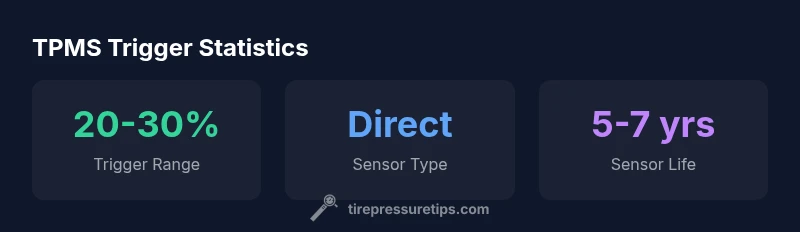
TPMS triggers when tire pressure falls below the vehicle’s recommended cold-inflation value, and the exact threshold varies by make, model, and system type. In practice, warnings appear as a noticeable drop below the placard value. For precise numbers, consult your owner’s manual or your car’s TPMS settings, because thresholds differ widely.
What tire pressure triggers tpms?\n\nThe short answer to what tire pressure triggers tpms is that the system activates when a tire’s air pressure drops below the vehicle’s recommended cold-inflation value. The exact threshold is not universal; it is tuned by the OEM and the type of TPMS installed on the vehicle. Direct TPMS uses per-tire sensors to report real PSI data, while indirect TPMS relies on changes in wheel speed and rotation to infer underinflation. The Tire Pressure Tips team emphasizes that these thresholds are designed to protect safety and tire longevity, not to be a one-size-fits-all number. Therefore, understanding your car’s specific threshold requires looking up the placard in the door jamb, checking the owner’s manual, or querying the vehicle’s TPMS settings in the onboard system. This knowledge helps you plan inflation checks, especially before long trips or in changing weather conditions. In short, what tire pressure triggers tpms is a vehicle-specific question rather than a universal pressure value.
Direct TPMS: sensors and thresholds\n\nDirect TPMS relies on a network of tire-mounted pressure sensors that continuously monitor each tire’s PSI. When a sensor detects a pressure that falls below the calibrated threshold, it immediately reports to the vehicle’s computer to trigger the warning light. Because the readings are sensor-based, the system can provide per-tire accuracy, letting you know which tire needs attention. The downside is that sensors can fail, drift, or require replacement, which adds maintenance costs. For everyday drivers, understanding the direct TPMS behavior means recognizing that alerts may appear even if a tire is only slightly underinflated due to temperature changes or recent tire swapping. Tire Pressure Tips notes that sensor health and calibration are crucial to maintaining reliable alerts.
Indirect TPMS: how it flags underinflation without sensing\n\nIndirect TPMS does not rely on local PSI sensors; instead, it uses patterns in wheel-speed data and ABS signals to infer low pressure. When a tire appears underinflated relative to others, the system flags a warning. Indirect TPMS is advantageous because it requires less hardware and is less prone to sensor failures. However, its accuracy depends on regular relearning, tire sizes, and consistent vehicle dynamics. Since the threshold is derived from relative pressure behavior, climate effects and tire wear can influence when the warning triggers. Tire Pressure Tips highlights that indirect systems are a practical fallback, but drivers should still verify inflation with a gauge.
How to locate your vehicle's TPMS threshold\n\nTo determine your specific TPMS threshold, start with the placard on the driver’s door jamb or the glovebox cover. Your owner’s manual will usually provide exact figures and instructions for reading TPMS data. If the vehicle supports TPMS relearn procedures, you may need to perform a relearn after changing tires or wheels. Dealers and service centers can also provide a precise threshold for your model. In practice, many drivers find it helpful to take a baseline measurement when the tires are cold, air them up to the placard value, and then monitor how the system responds as temperatures rise or fall. Remember—even with modern TPMS, validating inflation with a handheld gauge remains a best practice. This approach aligns with Tire Pressure Tips guidance on maintaining safe and efficient tire pressure.
Temperature and tire pressure: why it matters\n\nTemperature has a substantial effect on tire pressure. Cold air reduces PSI, while heat from driving raises it. When you park and come back after the car sits, the readings may differ from those you observed after a 10-mile drive. Therefore, always check tires when they’re cold to avoid misinterpreting an inflated pressure as accurate. TPMS warnings may be triggered more readily on cold mornings and harder to interpret on hot days. The goal is to inflate to the placard value when cold, then monitor the tire as it warms up during operation.
Testing TPMS reliability at home\n\nA practical test, especially for indirect systems, is to take all tires to the recommended cold inflation pressure and then drive a short distance to let the tires heat up. Recheck with a gauge after they cool down. If any tire shows a persistent low reading, or if the TPMS warning reappears soon after inflation, there may be a sensor issue or a leak. Record the tire pressures, then inflate to the placard and observe the TPMS behavior over the next few days. Regular calibration checks and a proactive maintenance schedule help prevent unexpected alerts. This approach echoes Tire Pressure Tips’ emphasis on proactive maintenance and reliability.
Overview of TPMS types and how they detect low pressure
| TPMS Type | Detection Method | Pros | Cons |
|---|---|---|---|
| Direct TPMS | Per-tire sensors report actual PSI to ECU | Accurate per-tire readings; real-time alerts | Sensor maintenance costs; potential sensor replacement |
| Indirect TPMS | Monitors wheel-speed variations to infer pressure | No per-tire sensors; lower maintenance | Less precise; requires relearn after tire changes |
| Hybrid/combined TPMS | Combination of sensors and indirect cues | Redundancy and flexibility | Higher cost and complexity |
Frequently Asked Questions
What is the TPMS threshold, and does it vary by vehicle?
Yes. The exact threshold is set by the vehicle manufacturer and can differ between direct and indirect TPMS systems. Check your placard, owner’s manual, or dealer for model-specific guidance.
Yes—thresholds vary by vehicle and system, so check your model’s manual for exact numbers.
Does temperature affect TPMS readings?
Temperature changes affect air pressure, so readings can shift with weather. Always check tires when cold to avoid misinterpreting inflated or deflated readings.
Yes, temperature changes can affect readings; check tires when they're cold.
How can I determine the exact tire pressure that triggers TPMS on my car?
Refer to the placard on the door jamb, your owner's manual, or the TPMS menu in the vehicle’s settings. If needed, your dealer can provide the precise value for your model.
Look up your placard and manual, or ask the dealer for the exact TPMS trigger for your model.
What should I do when the TPMS warning light comes on?
Safely pull over, inspect tires for obvious underinflation, inflate to the placard value while cold, and recheck. If the light stays on, seek professional service to diagnose leaks or sensor issues.
Pull over safely, check tire pressure, inflate to placard, and if it stays on, get it checked.
Is it safe to drive with a TPMS warning?
Drive slowly to a safe location if you must; avoid long trips. A TPMS warning indicates underinflation that can cause tire damage or reduced control, so address it promptly.
Try not to drive far if the TPMS warning is on; fix the pressure soon.
“Thresholds can vary widely by vehicle and system, so knowing your model’s specifics is essential for accurate TPMS interpretation.”
What to Remember
- Inflate tires to placard value when cold
- Thresholds vary by vehicle and TPMS type
- Direct sensors provide per-tire accuracy
- Indirect TPMS relies on relative tire behavior
- Regular sensor maintenance supports reliability