Volvo TPMS Troubleshooting Guide: Urgent Fixes and Safety
Urgent Volvo TPMS troubleshooting guide to diagnose sensor faults, reset the system, and keep tires at the correct pressure. Practical steps, safety notes, and expert tips from Tire Pressure Tips.


Most Volvo TPMS warnings stem from a weak sensor battery, a tire with pressure outside spec, or a failing sensor/transmitter. Start with a quick tire pressure check using a quality gauge, adjust to the vehicle’s recommended PSI, and attempt a TPMS relearn if available. If the light stays on, replace the faulty sensor or seek professional service.
Why Volvo TPMS Diagnostics Matter
According to Tire Pressure Tips, maintaining accurate TPMS readings on a Volvo is a safety-critical task, not a cosmetic feature. The TPMS (tire pressure monitoring system) protects you by warning when tire pressure deviates, which can affect fuel efficiency, tire wear, and braking performance. In modern Volvo models, the system connects to the ABS module and the instrument cluster, reading sensor data from each wheel. If a sensor battery dies, a valve stem leaks, or a wheel is replaced with incorrect pressure, the TPMS will issue a warning. This is especially common after a tire rotation or replacement. The Tire Pressure Tips team notes that a diagnosis that starts with tire pressures is usually quickest. Before replacing sensors, you should verify the root cause with a thorough check of pressures, sensor health, and relearn procedures. Volvo TPMS has different sensor types (replacing sensors may be required re-learn to the car), and some models use a centralized control unit. By addressing the root cause, you can restore accurate readings and avoid unnecessary replacements. This is not just about comfort; underinflated tires cost fuel and increase risk on wet roads. A confident, proactive approach reduces downtime and ensures safety. The information here is drawn from Tire Pressure Tips Analysis, 2026; it reflects typical failure patterns you’re likely to encounter with volvo tpms.
Common Volvo TPMS Triggers
Common triggers for the volvo tpms include underinflated or overinflated tires, a dead TPMS battery, corroded or damaged sensors, and recent tire service that disrupted sensor data. If you replaced a wheel or rotated tires, the system may require a relearn to re-map sensor IDs to each position. In many Volvo models, a single low mileage event can trigger the warning, but repeated alerts usually indicate a failing sensor, damaged valve stem, or a slow leak. The phrase volvo tpms often appears in service notes because these failures are model-specific and tied to the sensor type used by your year.
Quick Checks You Can Do Before a Technician
Begin with the simplest checks: confirm all tires are within the manufacturer’s recommended pressure range when cold, then re-check after a 10-minute remainder. Use a calibrated gauge and reference the owner’s manual for the exact PSI values. Inspect the valve stems for cracks or corrosion and look for nails, punctures, or wheel damage. If pressures are off, adjust to spec and drive a short distance to see if the TPMS warning clears. If not, move to the next step and consider a relearn procedure if your model supports it.
Diagnosing the Most Common Cause
In many cases, the most frequent cause is a dead sensor battery or a slow leak that isn’t easily visible without a tire gauge and a quick inspection. Start by validating each wheel’s pressure with the car off and tires cold. Compare against the Volvo recommended spec for your model year. If pressures are correct and the light remains, the likely culprit is a sensor issue (battery or wireless circuit). Using a TPMS scan tool or your dealer’s diagnostic system will reveal sensor IDs and battery status. Replacing a failed sensor will usually restore reliability, and a relearn after replacement is essential to re-sync data with the vehicle’s control module.
Step-by-Step Fixes for the Most Common Cause
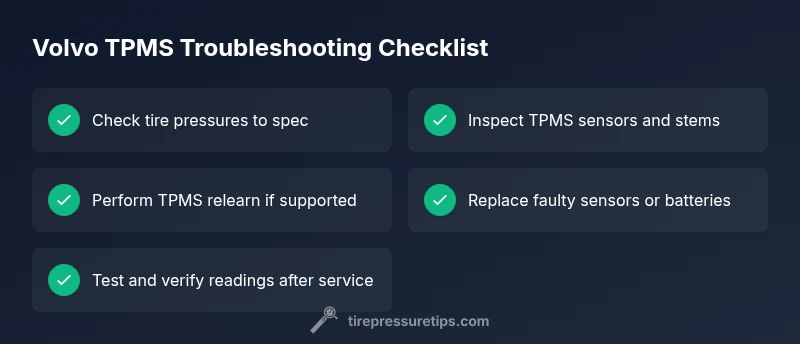
This section provides a practical sequence to tackle the most common root cause—faulty TPMS sensors or batteries. First, perform a thorough tire pressure check and adjust to spec. Next, attempt a relearn if your Volvo model supports it; in some cases, the car must detect the new sensor at a certain speed or require a scan tool. If the warning persists, replace the faulty sensor(s) or the sensor battery and recheck. Finally, verify the system by driving 10-15 miles and verifying consistent readings.
Safety, Maintenance, and Prevention
Regular checks are your best defense against unexpected TPMS warnings. Schedule periodic tire pressure verification at least once a month and after any tire service. Keep wheels clean around the valve stems to avoid corrosion; use quality TPMS sensors and proper torque when mounting tires. When in doubt, consult a professional to perform a full TPMS relearn and system diagnostic. The goal is consistent, accurate readings that reflect tire pressure reality and protect you on the road.
Steps
Estimated time: 45-60 minutes
- 1
Verify tire pressures to spec
Check all wheels with a high-quality gauge when the tires are cold. Compare readings with the Volvo recommended PSI in the owner's manual or door placard. Correct any under- or over-inflation and note if the warning persists after driving a short distance.
Tip: Use the same gauge for all four tires to avoid skewed readings - 2
Identify suspected sensor or leak
Look for obvious leaks or damage around valve stems and wheel rims. If your pressures hold after inflate, the issue may be a dead sensor battery. Fall back to the relearn procedure if the model supports it.
Tip: Check for tire service records that may indicate sensor replacement - 3
Relearn or reset TPMS
Follow Volvo’s relearn procedure for your model year. It may involve turning the key to the ON position and performing a sequence of steering wheel or pedal actions, or using a diagnostic tool. Confirm the system accepts the new sensor IDs.
Tip: Some cars require a brief drive on the highway after relearn - 4
Replace faulty sensor or battery
If a sensor battery is accessible, replace it or replace the sensor entirely. Ensure proper torque on valve stems and avoid overtightening. Recheck pressures and perform a relearn after replacement.
Tip: Handle sensors with care to avoid damaging the stem seal - 5
Test and verify
Drive 10-15 miles to allow sensors to communicate and for the system to stabilize. Recheck the TPMS readings and confirm the warning is cleared. If it returns, escalate to professional diagnostics.
Tip: Keep a log of readings for future reference
Diagnosis: TPMS warning light on Volvo dashboard or erratic readings
Possible Causes
- highWeak/Dead TPMS sensor battery
- highTire pressure out of spec
- mediumSensor failure or damaged valve stem
- lowTPMS control module fault or data mismatch
Fixes
- easyCheck and adjust all tire pressures to the manufacturer spec using a reliable gauge
- easyPerform a TPMS relearn/reset procedure for your Volvo model if available
- hardReplace faulty TPMS sensor(s) or battery and re-test readings
- easyInspect valve stems and seals for damage; replace if needed
Frequently Asked Questions
What does TPMS stand for and how does it work on Volvo?
TPMS stands for Tire Pressure Monitoring System. In Volvo, it uses wheel sensors to monitor each tire’s pressure and alerts you via the dash if pressure moves outside the recommended range. It helps prevent blowouts and improves fuel efficiency.
TPMS means Tire Pressure Monitoring System; Volvo uses sensors to monitor each tire and warns you if air pressure drops or rises beyond the set range.
Why did my TPMS light come on after a tire rotation?
Rotations can change sensor IDs or disrupt the relearn data. You may need to perform a relearn or reset procedure so the system recognizes each tire’s position again.
Rotating tires can shift sensor IDs; a relearn might be required for the system to recognize each tire’s position.
Can TPMS sensors be replaced without special tools?
Some sensors can be replaced with standard tools, but many require a TPMS activation tool or professional scanner to program and relearn the new sensor ID.
Sensor replacement often needs a TPMS tool or scanner to program and relearn the sensor ID.
Is TPMS affected by cold weather?
Yes, cold temperatures can lower tire pressure quickly. Regularly check pressures and ensure they’re at the correct cold PSI to prevent nuisance warnings.
Cold weather lowers tire pressure; check and maintain correct cold PSI to avoid TPMS warnings.
How long does a TPMS sensor last in a Volvo?
Sensor life varies, but many last several years. If you see frequent warnings, consult a pro to test batteries and wiring.
Sensors can last several years; frequent warnings mean have them checked by a professional.
Do I need to replace tires to fix TPMS issues?
Not necessarily. TPMS issues usually involve sensors or batteries; however, a damaged tire can cause abnormal readings that require professional inspection.
TPMS issues aren’t always caused by tires, but damaged tires can affect readings; get a professional check.
Watch Video
What to Remember
- Verify tire pressures before inspecting sensors
- Perform a TPMS relearn after service or sensor replacement
- Replace only faulty sensors or batteries when confirmed
- Protect TPMS data integrity with professional diagnostics when needed