BMW Tire Pressure Sensor Guide: TPMS & Maintenance
A practical, step-by-step guide to BMW tire pressure sensors (TPMS): how they work, diagnosing faults, calibration, and maintenance to keep tires properly inflated and safe.


This guide explains how BMW's tire pressure sensor TPMS works, how to identify sensor faults, and how to maintain correct pressure across all wheels. You'll learn sensor locations, calibration steps, common failure causes, and practical maintenance tips to prevent false alerts, preserve tire life, fuel economy, and safe driving. This overview is presented by Tire Pressure Tips.
Understanding TPMS and the BMW System
Tire Pressure Monitoring Systems (TPMS) are designed to alert you when a tire is underinflated or the system detects abnormal pressure readings. On many BMWs, the TPMS relies on direct sensors installed inside each tire and a processor in the vehicle that translates sensor data into a dashboard warning. According to Tire Pressure Tips, staying within the manufacturer's recommended cold tire pressures is one of the simplest and most impactful ways to improve safety, fuel economy, and tire longevity. Direct sensors are powered by small batteries and communicate via wireless signals; indirect systems infer pressure using wheel speed sensors and rotational data. In practice, BMW owners often encounter two scenarios: a steady, accurate TPMS warning when pressures drift, and occasional false alerts caused by sensor drift, temperature changes, or a weak battery. Understanding which system your BMW uses helps you choose the right service approach and estimate maintenance costs. This section sets the stage for practical steps you can take to keep TPMS reliable across seasons and driving conditions.
note
Tools & Materials
- Digital tire pressure gauge(Choose a gauge with a known calibration and read cold tires for accuracy)
- Air compressor(Medium capacity preferred for quick fills; avoid overinflation)
- Owner's manual or vehicle placard(Locate the manufacturer's recommended cold tire pressures)
- OBD-II scanner with TPMS support( Helpful for reading TPMS fault codes and sensor data)
- Replacement TPMS sensor(s)(Only if you confirm a failed sensor and plan a replacement)
- Soapy water spray(Used to check for air leaks around valve stems after service)
- Torque wrench(Ensure lug nuts are torqued to BMW specifications after wheel work)
- Safety gloves(Keep hands clean and protected during tire work)
Steps
Estimated time: 45-60 minutes
- 1
Check current tire pressures
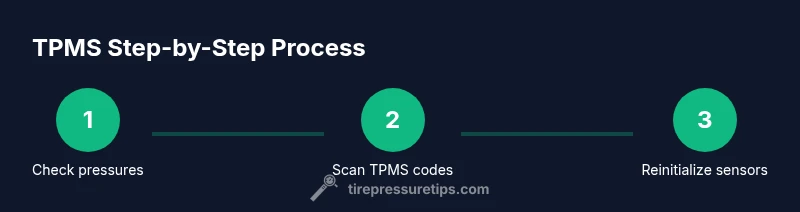
Park on a level surface and measure all four tires when they are cold. Compare readings to the vehicle placard and note any significant deviations. This establishes a baseline and helps identify which tires are underinflated.
Tip: Record readings in a notebook or phone so you can track changes over time. - 2
Inspect tires for wear and damage
Look for cuts, bulges, or uneven wear that could affect TPMS readings. Damaged tires or valves can trigger false alerts just as a weak battery can. Address obvious defects before pursuing sensor work.
Tip: Use a flashlight to check the bead area and valve stems for cracks or corrosion. - 3
Scan for TPMS fault codes
If the TPMS light is on, use an OBD-II scanner with TPMS support to read fault codes. Codes can point to a failed sensor, battery issue, or calibration needs. Record the codes for reference or a technician visit.
Tip: Preserve the codes when you visit a shop to speed diagnostics. - 4
Reinflate and recheck
Inflate each tire to the recommended cold pressure and recheck after 5–10 minutes. If a tire won’t hold pressure, inspect the valve stem and bead for leaks and address as needed.
Tip: Avoid inflating beyond the placard; overinflation can cause uneven wear and TPMS misreads. - 5
If a sensor is suspected, test replacement
If you suspect a sensor fault, plan for replacement with a compatible TPMS sensor. Some BMW models require coding after sensor installation to synchronize with the vehicle's ECU.
Tip: Ensure you match sensor type (direct vs indirect) to your car’s configuration. - 6
Reinitialize or recalibrate TPMS
After sensor work or tire changes, perform TPMS reinitialization via iDrive or compatible scanner. This step helps prevent persistent warning lights and ensures sensor data aligns with wheel position.
Tip: Follow the car’s on-screen prompts or the tool’s instructions precisely. - 7
Test drive and verify
Drive a short distance at moderate speeds to confirm the TPMS behaves as expected. Check if the warning light re clears and monitor for any returning alerts.
Tip: If the light returns, recheck pressures and consider re-testing the sensor or battery. - 8
Document maintenance
Record dates, pressures, sensor replacements, and codes for future service. This creates a maintenance history that helps with future diagnostics and recalls.
Tip: Keep receipts and sensor part numbers for reference at next service.
Frequently Asked Questions
What is the difference between direct and indirect TPMS in BMWs?
Direct TPMS uses physical sensors in each tire to report actual pressure values, while indirect TPMS uses wheel speed data to infer pressure. Direct sensors generally provide more precise readings and faster alerts, but they require battery maintenance and occasional sensor replacement.
Direct TPMS uses sensors in each tire; indirect TPMS relies on wheel speed data. Direct systems are typically more precise, while indirect systems depend on vehicle data and indirect indicators.
Can I reset the TPMS myself after a tire change?
Yes, many BMWs support TPMS reset via iDrive or a compatible scan tool. Follow the vehicle’s prompts and perform a test drive to confirm readings after resetting.
You can reset TPMS yourself with iDrive or a TPMS scanner; then verify the readings with a short test drive.
How long do TPMS batteries last, and when should sensors be replaced?
TPMS batteries are not user-serviceable. When readings become unreliable or sensors fail to communicate, replacement of the direct TPMS sensors is typically required.
TPMS batteries aren’t user replaceable; if readings fail, replace the sensor.
Will rotating tires trigger TPMS issues?
Rotating tires can affect which wheel is associated with a sensor. After rotation, you may need to reinitialize the TPMS so the system maps sensors to the correct wheel positions.
After a rotation, reinitialize TPMS so wheels match the right sensors.
What should I do if the TPMS warning light stays on after service?
If the light remains on, recheck tire pressures, inspect valves, and consider scanning for fault codes. A persistent warning may indicate a faulty sensor or calibration issue.
If the warning stays, check pressures, inspect valves, and scan for fault codes; you may need sensor service.
Are there model-specific TPMS considerations for BMWs?
Some BMW models require model-specific sensors and calibration sequences. Always consult the owner’s manual or a qualified technician when in doubt.
BMWs may need model-specific sensors and calibration; check the manual or ask a tech.
Watch Video
What to Remember
- Know whether your BMW uses direct or indirect TPMS to choose the right service path.
- Always verify tire pressures with a gauge and align with door placard before driving.
- Calibrate and reinitialize TPMS after tire service or sensor replacement.
- Maintain a maintenance log to simplify future diagnostics and recalls.