Audi Tire Pressure Sensor (TPMS) Guide: How to Diagnose, Service, and Relearn
Learn how Audi TPMS works, how to diagnose faults, and practical steps to service tire pressure sensors safely. A comprehensive, brand-authoritative guide from Tire Pressure Tips.


This guide explains how to understand and service a tire pressure sensor on an Audi, including TPMS basics, diagnosing faults, and practical fixes you can perform at home or with a shop. You'll need basic tools, a safe wheel-access method, and careful handling to avoid sensor damage while preserving tire life and safety.
Audi TPMS Essentials: Why TPMS matters
According to Tire Pressure Tips, maintaining correct tire pressure is essential for safety, fuel efficiency, and tire longevity. In Audi vehicles, the Tire Pressure Monitoring System (TPMS) automatically tracks air pressure in each tire and alerts you if a pressure drop could compromise grip or heat buildup. Proper TPMS awareness helps prevent underinflation, which increases rolling resistance, reduces braking performance, and accelerates tread wear. In addition, a healthy TPMS can help you spot slow leaks caused by punctures, wheel valve failures, or temperature-related changes. This section explains why TPMS is more than a warning light and how Audi's implementation affects daily driving. You’ll learn the difference between direct sensors and indirect pressure estimation, how the car’s ECU communicates with the wheel sensors, and what to expect when the light comes on on the highway or after a tire service. The Tire Pressure Tips team emphasizes proactive checks and proper calibration after any tire service.
TPMS in Audi: direct vs indirect explained
Audi uses two main approaches to tire pressure monitoring. Direct TPMS installs a small pressure sensor inside each wheel, communicating real numbers to the vehicle’s onboard computer. Indirect TPMS relies on wheel-speed sensors and calibration logic to infer low pressure from changes in tire circumference. Direct systems are highly precise and require battery-powered sensors that may need replacement over time. Indirect systems have no dedicated sensor in the tire and rely on calibration accuracy, which can vary with tire size and wear. Understanding which approach your Audi uses helps you diagnose issues, decide between DIY fixes or professional service, and plan for sensor replacement when the light persists.
The Tire Pressure Tips team notes that most modern Audis lean toward direct TPMS, but some model lines or trims can integrate indirect methods for certain markets. Regardless of the method, a consistent maintenance routine—checking pressures, replacing damaged valve stems, and conducting re-learn procedures when tires are changed—will keep the system reliable and accurate over the car’s lifespan.
Sensor location and types used by Audi
In many Audi models, the direct TPMS uses valve-stem sensors mounted on each wheel. These sensors monitor pressure and temperature, sending data to the ECU via wireless transmission. The sensors are compact, sealed devices with a small battery that typically lasts several years, depending on driving conditions and climate. Some Audi variants may implement indirect TPMS, where the system interprets tire pressure changes through ABS wheel-speed data rather than sending direct pressure numbers. Knowing your wheel sizes and tire types helps ensure you buy compatible sensors if a replacement is necessary. Regular checks of the valve core and grommets are essential since leaks often originate there and can falsify readings.
For drivers, the practical takeaway is to understand that the presence of TPMS does not eliminate the need to visually inspect tires. The system is a safety net, not a substitute for routine maintenance. The Tire Pressure Tips team stresses the importance of keeping rare sensor failures in check by avoiding stalling the battery and protecting sensors during tire changes.
How to read TPMS warnings and interpret lights
When the TPMS detects a significant pressure drop, Audi’s dashboard light typically illuminates to alert you. A persistent light indicates that at least one tire is underinflated beyond the vehicle’s threshold or that a sensor might be failing. In some cases, the warning comes with a specific fault code shown via the onboard diagnostics when connected to a scanner. If the light blinks or behaves erratically, it could signal communication issues, sensor battery wear, or a faulty valve core. The best practice is to verify pressures using a calibrated gauge first, then use a TPMS-enabled scan tool to pull fault codes from the ECU and identify which wheel sensor or circuit is affected. If the readings are inconsistent with your gauge, consider sensor replacement, valve service, or a relearn from a qualified technician.
Diagnosing faults: common causes and checks
TPMS faults in Audi can stem from a leaking valve stem, a dead or weak sensor battery, corrosion on the wheel electronics, or miscommunication with the ECU after a tire change. Environmental factors such as extreme heat or cold can also impact readings temporarily. Start with a visual inspection of valve stems, caps, and wheel rims for damage or corrosion. Then check for obvious leaks with soapy water at valve stems and bead seating areas. If no leaks are found, connect a TPMS-capable scan tool to retrieve fault codes and sensor IDs. This step helps you determine whether a single wheel or multiple sensors are defective and guides you toward either replacing one sensor or performing a full relearn after service. The key is to isolate the issue before committing to sensor replacement.
Tools you need for TPMS inspection and service
To work on Audi TPMS, you’ll need a calibrated digital tire pressure gauge, a TPMS diagnostic/scanner tool that supports Audi relearn, lugs and a torque wrench, a valve-core tool, and spare valve stems or direct TPMS sensors if you plan to replace a failed unit. A stable, well-lit workspace and safety gear are essential. The scanner should be able to read live data from the TPMS ECU, identify sensor IDs, and initiate relearn procedures. If you’re performing a wheel swap, ensure you transfer the sensor hardware or purchase compatible units that fit your Audi model and wheel diameter. Always follow Audi’s service manual for torque specs and wheel installation steps.
Relearn and calibration procedures for Audi models
After any tire service that involves TPMS sensors or wheel changes, a relearn or calibration procedure is required so the ECU recognizes the new sensor IDs. The exact steps vary by model year and infotainment system, but the general method involves using an OBD-II or Volkswagen/Audi-compatible scanner to trigger the relearn sequence while the ignition is in the proper position. In some cases, you can perform a relearn through a sequence of steering, pedals, or dashboard button combinations, while in others a hand-held scanner is mandatory. The goal is to sync the ECU with the current sensor IDs and confirm all four wheels report valid data. The process may take several minutes and should be followed by a road test to ensure the warning light stays off.
Replacing sensors: DIY pathways and professional routes
If a tire sensor battery dies or the unit suffers physical damage, replacement is often the most reliable solution. Direct TPMS sensors come in a wheel-specific form factor, so you’ll need to select the right part for your Audi’s wheel size and model year. DIY replacement is possible for experienced DIYers with proper tools, including a torque wrench and a relearn tool, but incorrect sensor installation or failed relearn can lead to persistent warnings. If you are unsure, a professional tire shop or Audi dealership can perform the replacement, re-learn, and verify the system with a road test. For indirect TPMS setups, maintenance generally focuses on wheel alignment, sensor calibration accuracy, and ensuring the ABS system reads correctly. The key is to verify compatibility and follow the model’s relearn steps precisely to avoid future warning lights.
Maintenance and best practices to prevent TPMS issues
Regular tire maintenance reduces TPMS problems. Check pressures at least monthly and before long trips, use a calibrated gauge, and inspect valve stems for leaks. When replacing tires, ensure the TPMS sensors are transferred properly or replaced with compatible units. Clean sensor components and protect them from impact during wheel handling. OEM-recommended procedures and torque specs should be followed at all times. The Tire Pressure Tips team recommends logging sensor IDs, replacement history, and relearn events to simplify future service and maintain reliability across your Audi’s lifespan.
Tools & Materials
- Digital tire pressure gauge(Calibrated; read pressures in psi or bar for all four tires.)
- TPMS diagnostic tool with Audi relearn capability(Must support VW/Audi protocols and relearn procedures.)
- Lug wrench and torque wrench(Needed to remove wheels and re-torque lug nuts to spec.)
- Valve-core tool and spare valve stems(For replacing faulty stems or sensor seals.)
- Replacement TPMS sensor kit (direct sensors)(Ensure compatibility with your Audi model and wheel size.)
- Safety gear (gloves, eye protection)(Protect hands and eyes during tire service.)
- Wheel chocks and a clean workspace(Always secure the vehicle and work in a clear area.)
Steps
Estimated time: 45-90 minutes
- 1
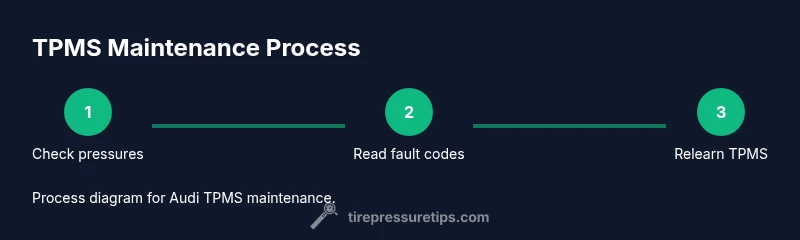
Check tire pressures
Use a calibrated digital gauge to measure the four tires when cold. Compare each reading to the Audi manufacturer specification shown in the owner’s manual or door placard. Record any discrepancies and plan the next steps based on how far each tire is from spec.
Tip: Use the same gauge for all four tires to minimize measurement variation. - 2
Inspect wheels and valves
Visually inspect each wheel for damage, dents, and corrosion. Check valve stems for cracks or missing caps, and ensure the valve core isn’t leaking. Address obvious issues before moving on to sensor diagnostics.
Tip: A loose or corroded valve core is a common, inexpensive failure point. - 3
Read fault codes with a TPMS scanner
Connect your scanner and retrieve fault codes and sensor IDs. Note which wheel IDs are present and whether the ECU reports data anomalies, sensor failures, or communication issues. This step guides whether you’ll replace one sensor or perform a full relearn.
Tip: Note the exact wheel position (FL, FR, RL, RR) for accuracy. - 4
Decide on replacement or repair
If a sensor shows a low battery or damage, plan a direct sensor replacement. For minor valve leaks, valve stem service might fix the issue without full sensor replacement. If data is inconsistent, prepare for a relearn after repair.
Tip: Sometimes a simple valve stem replacement resolves the issue without sensor changes. - 5
Replace or service the TPMS sensor
Install the new sensor or service kit according to the manufacturer’s instructions. Re-seat the tire bead if needed and ensure a proper seal. Reinstall the wheel with correct lug torque.
Tip: After installation, recheck wheel torque to the recommended spec. - 6
Relearn/calibrate the TPMS
Perform the relearn procedure using a compatible tool or Audi’s built-in relearn sequence. The ECU must recognize the new sensor IDs. If the light remains after relearn, recheck sensor IDs and retry.
Tip: Follow the exact sequence for your model year; even small deviations can fail relearn. - 7
Test and verify
Drive a short loop to clear the warning and verify the light stays off. Recheck tire pressures after the road test to confirm stability and accuracy of readings.
Tip: If the light returns, re-scan for fault codes and confirm sensor integrity.
Frequently Asked Questions
What is TPMS and why does my Audi have it?
TPMS stands for Tire Pressure Monitoring System. It monitors the air pressure in each tire and alerts you to underinflation, helping improve safety, fuel efficiency, and tire life. In Audi, TPMS integrates with the vehicle’s ECU and sensor hardware.
TPMS monitors tire pressure and warns you if it’s too low, helping keep you safe on the road.
Can I drive with a TPMS warning light on?
If the TPMS warning is on, check your tire pressures with a reliable gauge and refill to the recommended level. If readings are correct but the light stays on, have the system inspected for sensor faults or a relearn.
Don’t ignore the TPMS warning—check pressure and get the system checked if the light remains."
How long do TPMS sensors last in Audi vehicles?
TPMS sensors typically last several years, depending on driving conditions and climate. Battery life and sensor integrity can affect longevity, so plan for replacement if readings become unreliable.
Sensors can last several years, but effectiveness depends on usage and conditions.
Do I need a dealership to relearn TPMS after tire service?
Not always. Many Audi models allow relearn with an OBD-II scanner that supports VW/Audi protocols, or via an in-car relearn sequence. If you’re unsure, a professional can perform a quick relearn check.
A professional can usually do the relearn quickly if you’re not comfortable.
What’s the difference between direct and indirect TPMS in Audi?
Direct TPMS uses battery-powered sensors in each tire to report exact pressures. Indirect TPMS estimates pressure using ABS sensors. Audi models may implement either method depending on the year and trim.
Direct TPMS uses sensors in tires; indirect relies on wheel-speed data.
Should I replace all TPMS sensors at once?
Replace sensors individually if only one is faulty. Replacing all sensors is usually unnecessary unless multiple sensors fail or the vehicle requires a system-wide relearn.
Usually you don’t replace all sensors at once unless several are failing.
Watch Video
What to Remember
- Know how Audi TPMS works with direct vs indirect sensors.
- Verify tire pressures before attempting repairs.
- Relearn properly after any tire service or sensor replacement.
- Use the right tools and protect sensors during service.
- Seek professional help if you’re unsure about the relearn procedure.