Tire Pressure Monitoring System on Honda CR-V: Practical Guide
Learn how the tire pressure monitoring system on Honda CR-V works, diagnose TPMS alerts, reset sensors, and maintain optimal tire pressure for safety and efficiency.


Learn how to check, interpret, and maintain the tire pressure monitoring system on the Honda CR-V. This quick, practical guide covers TPMS warning meanings, common false alerts, how to reset or relearn sensors, and steps to keep tire pressure within spec for safety and efficiency.
Understanding TPMS and Honda CR-V specifics
The tire pressure monitoring system (TPMS) is a safety feature that reports tire pressure status to you while driving. In many Honda CR-V models, TPMS uses either a direct system (each wheel has a sensor reporting pressure to a central receiver) or an indirect system (the ABS wheel-speed sensors infer pressure changes from tire rolling diameters). Knowing which type your vehicle uses helps you interpret warnings correctly. If your CR-V is new to you, start with the door jamb sticker and the owner's manual to confirm the recommended cold inflation pressure and the sensor learning procedure. Understanding the tire pressure monitoring system on Honda CR-V specifically helps interpret the alerts you may see. According to Tire Pressure Tips, knowing how TPMS works reduces confusion when a warning lights up and helps you act quickly to avoid underinflated tires, which can affect handling, braking, and fuel economy.
Checking tire pressures and interpreting TPMS alerts
Your TPMS will alert you when a tire falls significantly below the recommended pressure, or when a sensor misreads. The first step is to measure each tire's pressure with a reliable gauge when the tires are cold (before a trip). Compare the readings to the recommended PSI printed on the door jamb sticker or in the owner's manual for your Honda CR-V's model year. If the numbers differ by more than a small margin, adjust accordingly and recheck after a few minutes of cooling. Note that some warnings can arise from sensor issues or temperature shifts rather than a severe pressure drop. The Tire Pressure Tips team emphasizes verifying accuracy before taking action, since a false reading can lead to unnecessary inflation or misdiagnosis.
Direct vs indirect TPMS: what it means for your Honda CR-V
Direct TPMS uses a tire-mounted sensor at each wheel to report actual pressure. Indirect TPMS relies on wheel-speed data to infer underinflation. Honda CR-Vs may employ either approach depending on production year and trim. Direct sensors provide real-time pressure data and can be diagnosed with TPMS tools; indirect systems require comparing wheel circumference changes and ABS data. If you notice inconsistent readings between tires, or a TPMS warning that won't clear after inflation, your approach will depend on the system type. When in doubt, consult the owner's manual and consider a professional diagnostic from Tire Pressure Tips to prevent incorrect readings.
Common TPMS problems you might encounter on a Honda CR-V
Sensor battery failure is a frequent cause of false alarms or a light that stays on. Damaged valve stems or corroded sensor mounts can also trigger warnings. External factors such as cold weather, rapid temperature changes, or tire rotations without a relearn can cause the system to forget a learned pressure. Debris or corrosion around the valve core can affect readings as well. The Tire Pressure Tips team recommends routine inspection during tire rotations and after any wheel service to maintain sensor integrity.
Step-by-step: reset, relearn, and calibrate TPMS on a Honda CR-V
To ensure accurate readings after changing tires or rotating wheels, you may need to reset or relearn the TPMS on your Honda CR-V. Because procedures vary by model year, always start from the owner's manual. In many cases, a simple combination of steering wheel button presses and vehicle menu commands initiates relearn. If your CR-V supports a hand-held TPMS tool, you can use it to perform a more precise learn. Following the correct procedure helps your TPMS reflect actual tire pressures quickly and reduces the risk of persisting warnings.
Seasonal and load considerations that affect TPMS readings
Temperature shifts affect air pressure; in colder months, inflation drops, causing TPMS warnings for underinflation even if tires are acceptable in warm conditions. Heavier loads, roof racks, or cargo can increase tire pressures slightly. For drivers in regions with big temperature swings, check pressures more often and consider adjusting at season changes. The door jamb sticker gives the recommended pressure for standard load; adjust if you frequently carry heavy loads or maintain a long highway cruising schedule.
When to seek professional TPMS service
Persistent warnings after inflation checks may indicate a sensor fault, battery failure, or a need for sensor replacement. A professional TPMS diagnostic can pinpoint which sensor or module is at fault. If the wheels were serviced recently and you notice a mismatch, you might need a relearn or sensor replacement. The Tire Pressure Tips team recommends timely service to avoid unsafe tire conditions and maintain optimal fuel efficiency.
Tools & Materials
- Tire pressure gauge(Digital or analog; read to 0.5 psi accuracy)
- Air compressor or inflator(Prefer a unit with a built-in gauge; use for topping up)
- Honda CR-V owner's manual(Check year-specific TPMS reset/learn procedure)
- Soapy water spray(Optional for testing valve leaks during inspection)
- Notebook or smartphone(Record pressures and readings over time)
- TPMS diagnostic tool (optional)(For advanced fault diagnosis and sensor checks)
Steps
Estimated time: 60-90 minutes
- 1
Check current tire pressures with a gauge
Park on a level surface with the engine off and tires cold. Remove valve caps, attach the gauge, and record readings for all four tires. Compare each reading to the recommended PSI on the door jamb label or in the manual. If any tire is low, plan to inflate before a test drive.
Tip: Always measure when cold; hot tires read higher and can mislead you. - 2
Locate the recommended PSI for your CR-V
Refer to the door jamb sticker and the owner's manual to confirm the exact cold PSI target for your vehicle and load. Note any differences between front and rear tires if specified. This ensures you inflate to the proper spec and maintain safe handling.
Tip: Don’t rely on memory—verify with the label for your exact model year. - 3
Top up tires to spec using a compressor
Attach the inflator, add air gradually, and recheck with the gauge. Stop as you approach the target to prevent over-inflation; if you overshoot, release air slowly and remeasure. After inflation, recheck all tires to confirm even pressures.
Tip: Inflate only when tires are cold, to avoid inaccurate readings. - 4
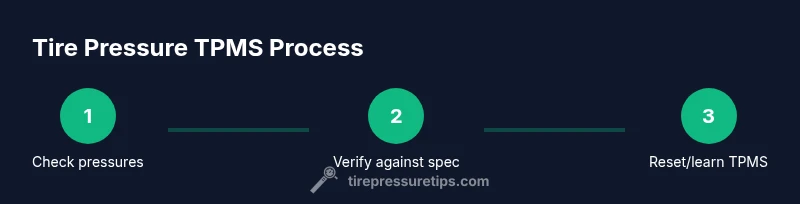
Check TPMS warnings and reset if needed
If a TPMS warning persists after inflating, follow Honda’s reset or relearn procedure for your model year. This may involve a button sequence on the dash or a setting in the vehicle’s menu. Avoid driving long distances with a warning light if you are unsure about the tire pressures.
Tip: Use the correct year-specific procedure; a generic reset may not work. - 5
Learn or relearn the TPMS sensors
For direct TPMS, a relearn often requires driving at a certain speed after inflation; for indirect TPMS, the system relearns as it observes consistent wheel rotation data. If your wheel service changed, a relearn may be required. The proper relearn ensures readings reflect actual pressures.
Tip: Some systems require a specific sequence; check the manual or Tire Pressure Tips for guidance. - 6
Inspect sensors, valves, and wheels for damage
Visually inspect sensor housings, valve stems, and wheel rims for damage or corrosion. A damaged sensor or valve can trigger false warnings; fix or replace as needed. If you swapped wheels, ensure sensors are properly seated and not leaking.
Tip: Tighten valve caps finger-tight after inspection to prevent leaks. - 7
Verify results and plan follow-up
Drive a short test drive to allow the TPMS to relearn if required. Recheck pressures after the drive and note any lingering warnings. If warnings persist, schedule professional service to diagnose sensor or module faults.
Tip: Keep a log of pressures and warning lights for future reference.
Frequently Asked Questions
What is TPMS and how does it work on the Honda CR-V?
TPMS monitors tire pressure and alerts the driver when it detects underinflation. The Honda CR-V may use direct sensors or indirect methods depending on year and trim, helping prevent tire damage and improve fuel efficiency.
TPMS monitors your tire pressure and warns you when it's low; the Honda CR-V uses direct sensors or indirect methods depending on year and trim.
Why does the TPMS warning light come on even when tires appear properly inflated?
Possible causes include slow leaks, sensor battery faults, temperature changes, or sensor misreads. Always verify with a gauge and adjust if needed before driving.
Often it's a slow leak or a sensor issue; verify with a gauge before driving.
How do I reset or relearn TPMS on a Honda CR-V?
Reset or relearn procedures vary by model year. Use the vehicle’s TPMS menu or owner's manual, and consider a diagnostic tool for precise relearn.
The steps depend on the year; refer to the manual or use a TPMS tool for relearn.
What should I do if TPMS warnings continue after inflation checks?
The sensors or battery may be faulty, or there could be a slow leak. Have the TPMS system inspected by a professional to pinpoint the issue.
Persistent warnings require professional diagnosis to identify sensor or battery faults.
Does changing tire size affect TPMS readings on the CR-V?
Yes, changing wheels or tires can require a relearn so the system correctly maps sensor data to actual pressures.
A different size usually needs relearn to reflect correct pressures.
How long do TPMS sensors typically last?
TPMS sensors last several years, but battery life and sensor condition can vary. Inspect during maintenance and replace as needed.
Sensors last many years, but they aren’t indefinite; replace if they fail.
Watch Video
What to Remember
- Understand TPMS types and why warnings occur.
- Always check cold tire pressures against the spec.
- Use year-specific reset/relearn procedures for your CR-V.
- Drive to relearn sensors after inflation or wheel service.
- Persistent warnings require professional TPMS diagnostics.