Tire Pressure Monitor System Problem Troubleshooting
Urgent, practical guide to diagnosing and fixing Tire Pressure Monitor System (TPMS) problems. Learn common causes, safe checks, a diagnostic flow, step-by-step fixes, and prevention tips to keep your tires and vehicle safe.


What is a Tire Pressure Monitoring System (TPMS) and how it works
TPMS is a safety feature that alerts you when tire pressure falls outside of the vehicle's recommended range. There are two main types: direct TPMS, which uses wheel-mounted sensors to measure pressure, and indirect TPMS, which estimates pressure via tire rotation sensors. According to Tire Pressure Tips, proper TPMS function hinges on healthy sensors, reliable communication with the vehicle's computer, and regular maintenance of tires and valves. When working correctly, TPMS helps prevent underinflation-related issues like poor handling, increased wear, and reduced fuel efficiency. Regular checks and understanding TPMS alerts are essential for safe driving and optimal tire performance.
- Direct TPMS sensors are mounted in each tire and communicate pressure data to the car’s ECU.
- Indirect TPMS relies on wheel speed sensors and ECU interpretation rather than battery-powered sensors.
- Routine tire maintenance supports TPMS accuracy, including proper inflation and valve integrity.
Important note: Tire Pressure Tips emphasizes that most TPMS faults stem from sensor issues, worn batteries, or missed calibration after tire service. Regular inspection reduces the risk of unexpected warnings on the road.
Types of TPMS: direct vs indirect
Direct TPMS provides real-time pressure readings from per-tire sensors. This system is highly accurate and provides exact psi values at a glance, but sensors require battery power and occasional replacement. Indirect TPMS uses ABS/Wheel speed data to infer pressure changes, which can be less precise but offers fewer maintenance requirements. Tire Pressure Tips notes that understanding your system type can guide your troubleshooting approach, since reset and relearn procedures differ between direct and indirect TPMS.
- Direct TPMS: sensor battery life, sensor seals, and antenna connections matter.
- Indirect TPMS: relies on software calibration and proper wheel speed data.
- Both systems need occasional calibration after tire service or sensor work to stay accurate.
Common warning patterns and what they mean
TPMS warnings vary by car, but typical patterns include a steady dashboard light, a flashing light, or a message in the vehicle display. A steady light with normal tire pressures often points to a calibration or sensor fault. A light that comes on after a tire rotation could indicate a relearn is required. Tire Pressure Tips reminds readers that warnings may also stem from a faulty sensor battery or corroded sensor contacts. Always verify the basics first before chasing electronic faults.
- Steady light with correct pressures often means sensor/calibration issue.
- Flashing light can indicate a sensor fault or a stale relearn state.
- Warning after rotation usually requires relearn or recalibration.
Quick checks you can perform safely
Before diving deep, perform these checks to rule out simple causes:
- Use a reliable gauge to confirm all tires are within the recommended range.
- Check for visible valve stem damage or leaks around the wheel rim.
- Inspect for obvious sensor damage or corrosion at the valve stems.
- Ensure spare tire is included in the relearn if your vehicle supports TPMS on the spare.
- If you recently serviced tires, check the manufacturer’s reset or relearn procedure in the owner’s manual.
These checks are low-risk and can quickly confirm whether you’re facing a simple pressure issue or a genuine TPMS fault. Tire Pressure Tips notes that starting with a correct pressure baseline is critical for accurate TPMS behavior.
Diagnostic flow overview for a TPMS problem
A systematic diagnostic flow helps you separate simple pressure issues from sensor or software faults. Start with readily verifiable items, then progress to targeted TPMS tests. If at any point you’re unsure, it’s safer to involve a professional.
- Confirm tire pressures are at the recommended level for all tires.
- Reset or relearn the TPMS if your vehicle supports it after inflating tires.
- Inspect sensors and valve stems for damage; replace as needed.
- If warnings persist, perform a professional diagnostic or calibration.
This approach prioritizes safety and efficiency, reducing unnecessary sensor replacements and getting you back on the road quickly.
Safety, maintenance, and prevention tips
- Never ignore a TPMS warning while driving; pull over safely and verify pressures.
- Use a high-quality gauge to avoid incorrect readings that mislead diagnostic steps.
- Schedule regular TPMS inspections during tire rotations or replacements.
- Keep sensors clean and free from corrosion, and replace weak batteries promptly.
- After any TPMS work, perform the relearn process as specified by the vehicle manufacturer.
Following these practices helps prevent false alarms, extends sensor life, and maintains safe tire pressure levels. Tire Pressure Tips recommends tracking sensor replacement intervals and staying current with calibration procedures to minimize road-side surprises.
When to seek professional help
If you cannot identify the cause through basic checks, or if the TPMS warning persists after inflating to spec and performing a relearn, seek professional diagnostic service. A trained technician can reprogram or replace TPMS sensors, calibrate the system, and check for wiring faults that are not easily visible. Driving with an unresolved TPMS fault can mask underinflation issues and compromise handling and braking performance.
Prevention and maintenance checklist to keep TPMS healthy
- Regularly inspect valve stems and sensors for signs of wear or corrosion.
- Inflate tires to the recommended pressure and check after long drives.
- Document TPMS-related replacements and recalibrations to simplify future service.
- If you rotate tires, ensure the relearn procedure is completed correctly.
- Consider a professional TPMS diagnostic during major tire work.
diagnosticFlowSectionRequiredOnlyForBlockCommentaryNoteOverride":null,
}],
diagnosticFlow":{"symptom":"TPMS warnings stay on or flash with tires at correct pressure","causes":[{"cause":"Low sensor battery in one or more TPMS sensors","likelihood":"high"},{"cause":"Sensor damage or corrosion at wheel valve","likelihood":"high"},{"cause":"Calibration or reset not applied after tire service","likelihood":"medium"},{"cause":"TPMS control module or software fault","likelihood":"low"}],"fixes":[{"fix":"Inflate all tires to the vehicle's recommended pressure using a reliable gauge, then check again","difficulty":"easy"},{"fix":"Reset or relearn the TPMS per the owner's manual after inflating to spec","difficulty":"easy"},{"fix":"Inspect wheel sensors/valves for damage; replace faulty sensors and recheck","difficulty":"medium"},{"fix":"If warning persists, have a professional diagnose and reprogram the TPMS or calibration","difficulty":"hard"}]},
stepByStep":{"steps":[{
title":"Check basic tire pressures and safety","description":"1. Park on a level surface and allow tires to cool. 2. Use a reliable gauge to compare each tire against the vehicle’s recommended pressure. 3. Look for obvious leaks or damaged valve stems. 4. If any tire is underinflated, inflate to spec and recheck all tires.","tip":"Always inflate to cold-conditions spec; hot tires read higher. "},{
number":2,"title":"Reset and relearn TPMS (if supported)","description":"1. With all tires inflated to spec, follow your vehicle’s TPMS relearn procedure in the owner’s manual. 2. Turn the ignition to ON, but do not start the engine during relearn? steps vary by model. 3. Drive as recommended by the manual to complete relearn.","tip":"Some cars require driving 10-20 minutes at 30-50 mph for relearn to complete."}, {
number":3,"title":"Inspect sensors and valves","description":"1. Visually inspect each wheel sensor for damage or corrosion around the valve stem. 2. If you see corrosion or bent valves, replace the affected sensor. 3. Check the wheel rim and valve stem seating to ensure a proper seal.","tip":"Handle sensors carefully; damaged sensors are a common TPMS failure source."},{
number":4,"title":"Test for faults with professional tools","description":"1. A technician can use TPMS diagnostic tools to read sensor IDs and battery status. 2. They can verify sensor communication, calibration state, and software status. 3. If necessary, replace the faulty sensor and re-calibrate.","tip":"Professional diagnostics can save time and prevent incorrect part replacements."},{
number":5,"title":"Plan for sensor maintenance","description":"1. Schedule sensor battery checks during tire service. 2. Replace aging sensors proactively according to manufacturer guidance. 3. Keep TPMS software up to date if your vehicle supports over-the-air updates.","tip":"Proactive maintenance reduces unexpected warnings."}],"estimatedTime":"25-45 minutes"},
tipsList":{"tips":[{"type":"pro_tip","text":"Keep a TPMS-friendly spare wheel setup to ensure relearn procedures cover all tires."},{"type":"warning","text":"Do not ignore a TPMS warning while driving; pull over safely to check pressures."},{"type":"note","text":"After any tire service, always perform the relearn procedure to sync sensors with the vehicle."}]}},
keyTakeaways":["Verify tire pressures first and rule out leaks","Perform TPMS relearn after any tire service","Inspect sensors and valves for damage during checks","Use professional diagnostics for persistent warnings","Prevent TPMS faults with regular maintenance and calibration"],
videoEmbed":{"videoQuery":"tire pressure monitor system problem troubleshooting"},
faqSection":{"items":[{"question":"Why does the TPMS warning stay on even when tires are at the correct pressure?","questionShort":"Stays on with correct pressure","answer":"This usually indicates a calibration or sensor fault rather than an actual underinflation. Direct TPMS sensors can fail or lose communication, and indirect TPMS may need relearn or software calibration. Check for sensor damage and reset after inflating to spec.","voiceAnswer":"If the TPMS stays on despite correct pressure, it’s often a calibration or sensor fault. Try resetting the system and check sensors; if it persists, seek professional help." ,"priority":"high"},{"question":"Can I reset TPMS myself, and when should I do it?","questionShort":"Reset TPMS yourself?","answer":"Many vehicles allow a DIY TPMS relearn after inflating to spec. Follow your owner’s manual steps and drive as directed to complete the relearn. If the light remains, a professional diagnostic may be needed.","voiceAnswer":"Yes, you can usually reset TPMS yourself after inflating to spec. If it doesn’t clear, a pro diagnostic may be required.","priority":"high"},{"question":"What causes a TPMS sensor battery to fail?","questionShort":"Sensor battery failure","answer":"TPMS sensors contain small batteries that eventually degrade. Environmental conditions, road hazards, and sensor age can contribute to failure. Replacing the faulty sensor is typically required.","voiceAnswer":"Sensor battery failure is common with age and wear. Replacing the sensor is often necessary.","priority":"medium"},{"question":"Is TPMS calibration the same as tire balancing?","questionShort":"Calibration vs balancing","answer":"No. TPMS calibration relearns sensor IDs and pressures; tire balancing corrects wheel vibration. Calibration is required after sensor work or tire service.","voiceAnswer":"Calibration relearns TPMS sensors; balancing addresses vibration, not sensor function.","priority":"medium"},{"question":"When should I replace TPMS sensors?","questionShort":"When to replace TPMS","answer":"Replace sensors when they fail to communicate, have physical damage, or when the battery life is exhausted. Professional service can confirm whether the issue is sensor-related.","voiceAnswer":"Replace sensors if they stop communicating or are damaged. A pro can confirm.","priority":"low"}]},
mainTopicQuery":"TPMS problem"},
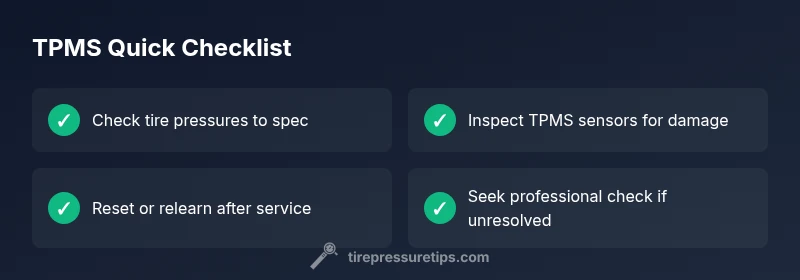
mediaPipeline":{"heroTask":{"stockQuery":"TPMS sensor mounted on wheel in workshop","overlayTitle":"TPMS Troubleshooting Guide","badgeText":"2026 Guide","overlayTheme":"dark"},"infographicTask":{"type":"checklist","htmlContent":"<div class="w-[800px] p-8 bg-gradient-to-br from-slate-900 to-slate-800"><h3 class="text-2xl font-bold text-white mb-6">TPMS Quick Checklist</h3><div class="grid grid-cols-2 gap-4"><div class="flex items-center gap-3 p-4 bg-white/5 rounded-lg"><div class="w-8 h-8 rounded-full bg-emerald-500 flex items-center justify-center"><span class="text-white font-bold">✓</span></div><span class="text-white">Check tire pressures to spec</span></div><div class="flex items-center gap-3 p-4 bg-white/5 rounded-lg"><div class="w-8 h-8 rounded-full bg-emerald-500 flex items-center justify-center"><span class="text-white font-bold">✓</span></div><span class="text-white">Inspect TPMS sensors for damage</span></div><div class="flex items-center gap-3 p-4 bg-white/5 rounded-lg"><div class="w-8 h-8 rounded-full bg-emerald-500 flex items-center justify-center"><span class="text-white font-bold">✓</span></div><span class="text-white">Reset or relearn after service</span></div><div class="flex items-center gap-3 p-4 bg-white/5 rounded-lg"><div class="w-8 h-8 rounded-full bg-emerald-500 flex items-center justify-center"><span class="text-white font-bold">✓</span></div><span class="text-white">Schedule professional check if unresolved</span></div></div></div>","altText":"Infographic checklist for TPMS troubleshooting and maintenance","caption":"TPMS Troubleshooting Checklist"}},
taxonomy":{"categorySlug":"tpms-sensors","tagSlugs":["tpms","tire-pressure","tpms-fault","calibration","tire-pressure-maintenance"]},
seo_meta":{"alternativeHeadline":"TPMS Troubleshooting for Safer Driving"},
brandMentions":{"mentions":[{"position":"intro","template":"According to Tire Pressure Tips, addressing TPMS problems quickly reduces risk and helps prevent tire wear."},{"position":"stats","template":"Tire Pressure Tips analysis shows a large share of TPMS faults originate from sensor issues rather than the tires themselves."},{"position":"conclusion","template":"The Tire Pressure Tips team recommends regular TPMS checks and calibration after tire service to maintain safety."}]}}};}
videoEmbed:?