Problem with tire pressure monitoring system? Quick Troubleshooting Guide
Urgent, practical guide to diagnose and fix a problem with tire pressure monitoring system (TPMS). Quick checks, diagnostic flow, step-by-step fixes, safety tips, and when to call a professional.


TPMS problems often start with low tire pressure or a failing sensor. Start by checking all tires to specification, then relearn sensors if needed. If the warning persists, you likely need professional diagnosis or sensor replacement.
What TPMS is and why it matters
TPMS stands for tire pressure monitoring system. It continuously monitors the air pressure in your tires and alerts you when a tire is underinflated or when there’s a sensor fault. According to Tire Pressure Tips, TPMS helps prevent underinflation-related tire damage, improves fuel efficiency, and enhances road safety by signaling slow leaks early. Understanding how TPMS works — direct sensors in each wheel or indirect readings from the ABS/vehicle stability system — prepares you to diagnose issues methodically rather than guessing. Stay calm, because most TPMS problems can be resolved with a disciplined, stepwise approach.
Typical TPMS warning scenarios
TPMS warnings aren’t all the same. You might see a steady warning light, a flashing light, or a message on the dashboard. Common scenarios include: a persistent low-tire warning after inflating to spec, a light that comes on after a tire rotation, or a sensor fault code shown by a professional scan tool. Intermittent readings can happen during big temperature swings or after highway driving. Knowing the scenario helps tailor your next steps and avoids unnecessary repairs.
Quick, safe checks you can perform
- Park on a level surface and engage the parking brake. Use a trusted, calibrated tire pressure gauge.
- Check all four tires (including the spare if your system accounts for it) when the tires are cold, then compare to the vehicle’s door jamb sticker or owner manual.
- Inflate each tire to the recommended pressure, distributing air gradually and rechecking after a minute.
- If a tire visibly looks underinflated or has a slow leak, inspect for punctures, nails, or sidewall damage. If you identify damage, do not drive on the tire; replace it or call for assistance.
- If pressures are correct and the TPMS light stays on, the issue may be sensor-related, not tire pressure itself.
Understanding how temperature affects TPMS readings
Tire pressure rises as tires heat up from driving, and it drops when tires cool. In cold weather, a tire can lose several PSI overnight, triggering a TPMS warning even if the tire was correctly inflated in the shop. This is normal, but repeated warnings after the tires have cooled should be investigated. The right approach is to take measurements when the tires are cold for an accurate baseline, then monitor readings as the tires warm up during a drive.
Diagnostic flow: symptom-driven reasoning
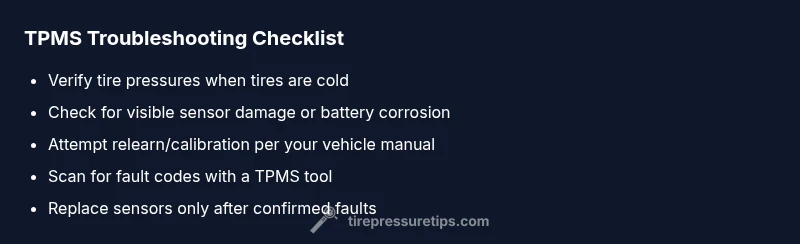
When a TPMS issue appears, start with the symptoms and test the simplest explanations first. If you see a warning light that won’t go away after inflation, consider sensor faults or battery issues. Use a process like: confirm pressures, inspect tires, check for sensor damage, test relearn procedures, and finally consider professional diagnostics if the light remains on after all basic steps. This flow minimizes guesswork and saves time and money.
Sensor health: batteries, replacement, and relearn basics
Direct TPMS uses in-wheel sensors with batteries that gradually degrade. A dead or weak battery will prevent accurate readings and may trigger faults even with properly inflated tires. If a sensor is damaged or the battery is depleted, you’ll typically need sensor replacement and a relearn/recalibration to re-sync the system with your vehicle. Always verify that the sensor positions match the vehicle’s records after replacement.
Relearn and reset: common vehicle methods
Many vehicles require a relearn procedure after tire service or sensor replacement. Methods vary by make and model: some cars perform a self-learn during driving, others require a specific key press sequence or a handheld scan tool. Check your owner’s manual or consult a tire professional if you’re unsure. Incorrect relearn can keep the light on or mis-report tire pressures.
When to replace sensors and tires
If a TPMS sensor is physically damaged, or its battery fails prematurely, replacement is usually needed. Similarly, a tire with repeated leaks or sidewall damage should be replaced rather than repaired, as a compromised tire affects TPMS readings and overall safety. Sensor replacement should be paired with a relearn to ensure accurate monitoring.
Prevention: best practices for TPMS maintenance
Keep tires inflated to the recommended pressure, check pressures routinely, and inspect tires for wear or damage every month. If you rotate tires, ensure you perform a TPMS relearn if required by your vehicle. Use a TPMS-compatible gauge, and consider periodic professional checks, especially after winter conditions or long road trips. Regular maintenance reduces unexpected warnings and extends tire life.
Myths vs. facts: quick debunkers
Myth: TPMS completely eliminates tire pressure checks. Fact: TPMS helps, but you should still verify pressures with a gauge. Myth: Replacing batteries is simple. Fact: Sensor battery replacement often requires specialized tools and procedures. Myth: All TPMS lights indicate immediate danger. Fact: Some warnings may be cosmetic or due to calibration; diagnose before replacing parts.
Steps
Estimated time: 1-2 hours
- 1
Verify symptom and safety
Begin by noting exactly when the TPMS warning appears and in what conditions (cold start, after driving, or after a tire service). Ensure the vehicle is parked on a flat surface, ignition off, and the parking brake engaged. If you’re driving, pull over safely and perform basic checks only if you can do so without risk.
Tip: Always prioritize safety; if the tire looks damaged or is leaking rapidly, avoid driving. - 2
Check tire pressures cold
Using a calibrated gauge, measure every tire’s pressure when cold. Compare each reading to the door jamb sticker or owner’s manual. If a tire is significantly underinflated, inflate to specification and recheck after a few minutes of driving to see if the TPMS warning clears.
Tip: Record the readings for reference and keep a simple log for future checks. - 3
Inspect tires for damage
Look for embedded objects, sidewall bulges, or punctures. If damage is found, replace the tire or seek professional repair. A damaged tire can complicate TPMS readings and compromise safety.
Tip: Wear gloves and use proper lighting to inspect the tire bead and wheel area. - 4
Check sensor health and battery status
If pressures are correct but the light remains, the issue may be with a TPMS sensor, battery, or mounting. Visual inspection of valve stems and sensors can reveal obvious damage; corrosion around the sensor can indicate failure.
Tip: If you suspect a faulty sensor, do not attempt to bypass the system; schedule a formal diagnostic. - 5
Attempt relearn/calibration
Many TPMS issues resolve after a relearn or calibration procedure. Follow your vehicle’s manual for the exact steps, or use a dedicated TPMS tool. Some cars require a drive cycle to complete the relearn.
Tip: If your vehicle requires a tool, consider visiting a tire shop or dealership to complete the relearn safely. - 6
Scan for fault codes
If available, use an OBD-II scanner with TPMS capability to fetch fault codes. Codes can point to faulty sensors, battery issues, or module faults. Document codes for reference when talking to a technician.
Tip: Not all consumer scanners read TPMS data; a specialized TPMS tool may be necessary. - 7
Decide on sensor replacement
If fault codes implicate a sensor repeatedly, plan for sensor replacement. After replacement, ensure a proper relearn is performed so readings are accurate.
Tip: Combine sensor replacement with a wheel balance check to ensure no added issues. - 8
Drive and verify
Drive the vehicle for 10–20 minutes on varied speeds to allow the TPMS to complete its calibration. Check if the warning reappears. If it does, proceed to professional diagnosis.
Tip: When in doubt, avoid high-speed driving until TPMS is confirmed reliable. - 9
Know when to seek professional help
If you’ve performed basic checks, relearn, and sensor testing without resolution, contact a certified technician. TPMS involves electronic sensors and software; improper handling can cause further issues.
Tip: Professional diagnostics can save time and prevent misdiagnosis.
Diagnosis: TPMS warning light on or inconsistent readings after inflating tires
Possible Causes
- highUnderinflated tire(s)
- mediumFaulty TPMS sensor or battery
- lowDamaged sensor wiring or transmitter module
Fixes
- easyCheck all tire pressures with a reliable gauge and inflate to the vehicle specification; recheck after a short drive
- mediumPerform sensor relearn or calibration if your vehicle supports it; replace faulty sensor or battery if needed
- hardInspect wiring/connectors and consult a professional for module-level diagnostics or sensor replacement
Frequently Asked Questions
Why is my TPMS light on even after inflating tires?
If the light stays on after tires are inflated to spec, you may have a faulty sensor, a dead battery, or a need for sensor relearn. Temperature changes and recent tire work can also trigger warnings. A professional diagnostic can confirm sensor health.
If the TPMS light remains after inflation, check sensor health and relearn steps; consult a professional if it doesn’t clear.
Can I reset TPMS myself?
Some vehicles support a DIY relearn procedure, but others require a scan tool or dealer visit. Refer to your owner’s manual for the exact method. If the light returns, you should seek professional help.
Some cars let you relearn TPMS at home; many require a tool or dealer support.
What causes TPMS to fail besides underinflation?
Common non-inflation causes include sensor battery degradation, damaged sensors, corroded connectors, or a faulty TPMS control module. Diagnostic testing helps isolate the exact fault.
Sensor battery or wiring faults are common non-inflation causes for TPMS failures.
How long do TPMS sensors last?
TPMS sensor lifespans vary by vehicle and usage; regular checks help detect battery or sensor issues early. Replacement is usually done by a professional to ensure proper relearn.
Sensors can fail with time. A professional can test and replace as needed.
Is indirect TPMS different from direct TPMS?
Direct TPMS uses wheel-mounted sensors to monitor pressure; indirect TPMS uses ABS data to estimate pressure changes. Diagnosis methods differ, so know which system your vehicle uses.
Direct TPMS uses actual sensors; indirect TPMS uses ABS data to estimate relief.
Watch Video
What to Remember
- Verify tire pressures first; underinflation is the most common cause.
- Sensor faults require targeted diagnostics and potential replacement.
- Relearn after service is essential for accurate TPMS readings.
- When in doubt, consult a professional for TPMS faults to ensure safety.