Pressure Monitoring System: A Practical How-To Guide
Learn how a pressure monitoring system (TPMS) works, how to diagnose issues, replace sensors, and maintain proper tire pressure for safety, fuel efficiency, and tire longevity.


A pressure monitoring system (TPMS) continuously tracks tire pressure and alerts you to under- or over-inflation, helping prevent blowouts and improve fuel economy. It relies on wheel sensors, a control module, and a warning indicator on the dash. This guide explains how TPMS works, how to diagnose common problems, and how to maintain the system for reliable performance.
What is a pressure monitoring system and why it matters
A pressure monitoring system, commonly known as TPMS, continuously monitors tire pressure and alerts you when it falls outside the recommended range. This reduces the risk of underinflation, improves handling, and protects tires from premature wear. According to Tire Pressure Tips, a well-functioning pressure monitoring system saves fuel by reducing rolling resistance and helps you avoid blowouts on the road. The Tire Pressure Tips team found that most drivers overlook slow leaks until the warning light comes on, making proactive checks essential. In modern vehicles, you’ll typically see one of two TPMS designs: direct TPMS with wheel-mounted sensors and indirect TPMS that estimates pressure via wheel speed sensors. Understanding which system you have is the first step in proper maintenance.
Direct TPMS vs indirect TPMS: How they differ
Direct TPMS uses wheel-mounted sensors that report tire pressure to the vehicle’s computer in real time. Indirect TPMS relies on wheel-speed sensors to infer pressure changes, which can be less precise than dedicated sensors. The Tire Pressure Tips analysis shows that direct systems generally provide faster, more reliable warnings, especially as tires wear. Indirect systems, however, can be cheaper to repair and work on older cars without TPMS sensors installed. The choice often depends on vehicle design, wheel setup, and driving conditions. Regardless of type, regular inflation to the manufacturer’s specification remains essential for accurate TPMS performance.
Core components of a TPMS
A typical TPMS comprises wheel-mounted sensors (one per wheel), a receiver in the vehicle, a central control unit, and a dash warning indicator. The sensor monitors air pressure and temperature, then transmits data via RF to the receiver. A dying battery or a damaged sensor is a common TPMS failure point. Modern sensors use long-life batteries, but they still require periodic inspection. The integrity of the valve stem, wheel rim, and seal also affects accuracy. Understanding these components helps you diagnose issues quickly and avoid unnecessary tire service visits.
How to read and interpret TPMS warnings
TPMS warnings indicate that one or more tires are outside the safe pressure range. A single warning means a tire is underinflated or overinflated; a corresponding numeric readout, if available, helps you identify which tire needs attention. In some vehicles, a TPMS fault indicator signifies a sensor or receiver problem rather than a tire issue. When you see a warning, first verify all tires are cold and inflated to the vehicle manufacturer’s recommended pressure. If warnings persist after inflation, you may need a sensor check or relearn procedure to re-establish the system’s baseline.
Diagnosing common problems with TPMS
Common TPMS problems include dead or weak sensor batteries, a corroded sensor stem, leaks around the valve, signal interference, or a blown fuse in the control module. If the warning appears intermittently, it could indicate a sensor that is not communicating reliably. Indirect TPMS can also produce inaccuracies if the vehicle’s wheel speed sensors are dirty or misaligned. A practical approach is to confirm tire pressures with a separate gauge, check for sensor corrosion, and use an onboard diagnostic tool to pull TPMS fault codes. When in doubt, start with the simplest cause—inflation—and progress to sensor checks.
Replacing sensors and relearning the system
If a sensor is confirmed faulty, replace it with a compatible unit and perform a relearn procedure so the system recognizes the new sensor. Relearn steps vary by vehicle, but generally involve inflating tires to spec, turning the ignition to accessories, and following on-screen prompts or a sequence in the owner’s manual. After replacement, drive on a level road at moderate speed to allow the system to register the new sensor. Always verify the warning resets after a successful relearn. For TPMS-equipped vehicles, it’s important to pair new sensors with the vehicle’s system to avoid false warnings.
Maintenance best practices and routine checks
Schedule regular checks of TPMS components alongside tire inspections. Look for corrosion on sensor batteries, damaged valve stems, and proper wheel seating. Keep tires inflated to the recommended pressure when cold, and avoid abrupt temperature swings when performing inflations. If you notice frequent false warnings, consider a professional diagnostic to check the sensor battery health and the relearn configuration. Keeping a log of sensor replacement and valve maintenance helps you plan ahead and reduce downtime.
Safety, tips, and troubleshooting quick-reference
Always work on cool tires to avoid injury and ensure accurate readings. When handling tires, use jack stands and never place your body under a raised wheel. Keep a dedicated gauge for TPMS checks and avoid relying on an analog gauge alone; cross-check with a digital gauge for accuracy. If you suspect a sensor or wiring fault, consult a qualified technician rather than attempting extensive repairs yourself. Remember: a well-maintained pressure monitoring system enhances safety, fuel efficiency, and tire longevity.
Choosing maintenance routines and service intervals
Create a simple maintenance cadence: check pressures monthly, inspect TPMS sensors during tire changes, and perform a relearn whenever tires are rotated or replaced. Vehicle and tire manufacturers provide recommended pressures; always prioritize those numbers over generic “feel” of the tire. A proactive approach minimizes the risk of underinflation-induced wear and reduces the likelihood of sudden warnings on the road.
Tools & Materials
- Digital tire pressure gauge(Calibrated to read within ±1 psi for accuracy)
- Air compressor or reliable air pump(Access to a compressor or shop pump to adjust pressures)
- Owner's manual(Relearn steps vary by model; reference for steps)
- TPMS relearn tool (if needed)(Some vehicles require a dedicated tool or procedure)
- Soapy water spray(Check for leaks around valve stems during inspection)
Steps
Estimated time: 45-60 minutes
- 1
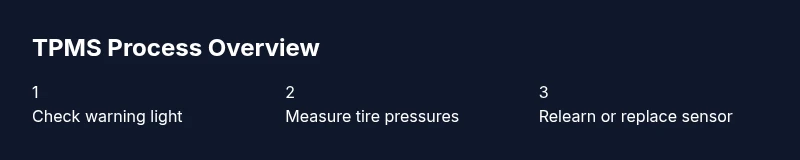
Check the TPMS warning light
Park on a level surface with the engine off, note which warning light is on, and whether it illuminates others. This establishes whether the issue is tire-specific or system-wide. If the light is blinking, it could indicate a transient fault unrelated to tire pressure.
Tip: If the light is blinking, document the sequence and prepare to scan for fault codes. - 2
Measure all tire pressures with a gauge
Use a calibrated gauge to measure cold tire pressures for all tires. Compare each reading to the vehicle's recommended pressure from the door jamb placard or owner's manual. Record any tire reading that deviates more than 2 psi from spec.
Tip: Take measurements from the same position on the tire each time for consistency. - 3
Inflate tires to the recommended pressure
Inflate each tire to the manufacturer’s specified cold pressure. Do not rely on “feel” or last inflated values. Make sure you’re inflating to the correct front and rear values if your vehicle lists different numbers.
Tip: Use the placard values and recheck after inflation to confirm accuracy. - 4
Relearn or reset the TPMS after inflation
If your vehicle requires a relearn, follow the sequence in the owner’s manual or use the on-board settings to initiate the procedure. Some cars relearn automatically after driving, others need a manual sequence.
Tip: If you are unsure, consult the manual before attempting a relearn; incorrect steps can make matters worse. - 5
Drive to complete the relearn window
Drive on a smooth road at moderate speed (usually 30–50 mph) for 10–15 minutes to allow the TPMS to register new sensor data. Avoid aggressive driving during this period as it can confuse the system.
Tip: Avoid short trips during relearn; longer steady driving helps the process. - 6
Verify TPMS status and take notes
After the relearn, check that the TPMS warning light stays off. If it remains on, inspect valve stems and sensors for damage or misalignment and consider a diagnostic scan for fault codes.
Tip: Document the outcome; note any persistent warnings for service instructions. - 7
Schedule maintenance and record findings
Log the tire pressures, sensor status, and any replacements. Schedule sensor inspections during tire service intervals to prevent unexpected warnings.
Tip: A simple maintenance log saves time during future tire changes and repairs.
Frequently Asked Questions
What is a pressure monitoring system and why is it important?
A pressure monitoring system (TPMS) monitors tire pressure in real time and alerts you to under- or overinflation. It helps prevent tire damage, improves safety, and enhances fuel efficiency by maintaining correct inflation.
TPMS watches your tire air pressure and warns you if it’s too low or too high, helping you drive safer and save fuel.
What’s the difference between direct and indirect TPMS?
Direct TPMS uses wheel-mounted sensors to measure pressure, while indirect TPMS estimates pressure from wheel speed data. Direct systems are typically more accurate, whereas indirect systems are common on older or simpler vehicles.
Direct systems measure each tire; indirect systems infer from rotation data. Direct is usually more precise.
Why won’t TPMS go away after inflating tires?
If inflating tires doesn’t clear the warning, your system may need a relearn procedure or sensor replacement. Check the manual for the exact steps, and verify all sensors are communicating.
If the light stays after inflating, you may need to relearn the TPMS or check sensors.
How long do TPMS sensors last?
Sensor life varies by vehicle and environment, but many sensors are designed to last several years. If sensors fail, replace with compatible units and perform a proper relearn.
Sensors last for several years, but if they fail, replace and relearn.
Is TPMS required by law?
In many regions, TPMS is mandated for new vehicles and some used-vehicle inspections. Check local regulations to confirm requirements for your area.
Many places require TPMS for new cars; check local rules for your area.
What should I do if a TPMS sensor leaks or is damaged?
If you suspect a leak or damage, stop driving and consult a professional. Do not attempt to reseal or reuse a damaged sensor, as it can cause rapid air loss or a false warning.
If a sensor leaks, stop driving and seek professional help.
Watch Video
What to Remember
- Know your TPMS type and warnings.
- Maintain manufacturer pressures consistently.
- Relearn after sensor replacement or tire service.
- Cross-check readings with a trusted gauge.
- Document maintenance for future tune-ups.