GMC Tire Pressure Monitoring System: A Practical TPMS Guide
A complete, practical guide to GMC TPMS (tire pressure monitoring system) covering direct vs indirect TPMS, diagnosis, relearn procedures, and maintenance tips for safe, efficient driving.


Learn how to diagnose GMC tire pressure monitoring system (TPMS) issues, check and adjust tire pressures, and perform a system relearn. This guide covers direct and indirect TPMS types, common faults, and safety tips. You’ll need a digital tire gauge, a tire pressure reference, and a basic scan tool if your GMC supports TPMS relearn.
Why GMC Tire Pressure Monitoring System matters
According to Tire Pressure Tips, the GMC Tire Pressure Monitoring System is designed to help drivers maintain proper inflation for safety, fuel efficiency, and tire longevity. A correctly inflated tire reduces heat buildup, improves steering response, and minimizes wear on the tread. GMC models commonly use direct TPMS sensors attached to each wheel, while some configurations rely on indirect TPMS that monitors wheel speeds via the ABS system. Either way, TPMS acts as an early warning signal if a tire is significantly underinflated or if a sensor battery is degrading. Regular attention to TPMS can prevent costly tire damage and potential handling issues in adverse weather. For GMC owners, understanding the difference between direct sensors and indirect indications helps tailor maintenance: you’ll know when to replace a sensor, when to schedule a tire rotation, and how ambient temperature changes can affect readings. This section sets the stage for practical checks you can perform without specialized equipment, which is where Tire Pressure Tips’ guidance shines.
- The safety and performance impact of proper inflation
- How direct vs indirect TPMS differs in GMC vehicles
- Common failure modes to watch for and how to prepare for a relearn
Note: Always verify tire pressures when tires are cold and before long trips.
How TPMS works in GMC vehicles
GMC TPMS relies on two main approaches. Direct TPMS uses sensors mounted inside each tire to measure actual air pressure and temperatures, sending data to the vehicle's control module. Indirect TPMS uses wheel speed information from the ABS system to infer underinflation when actual tire pressure readings are not available. In practice, most modern GMC models use direct TPMS sensors, each with its own lifecycle and potential point of failure, including battery drain, stem corrosion, or sensor misalignment.
Understanding which system your GMC uses matters for how you reset or relearn the system. Direct sensors require relearning or calibration after tire rotation, replacement, or significant changes to tire size. Indirect systems rely on calibration via the vehicle’s ABS data and may require a specific drive pattern to stabilize. In either case, the TPMS warning light on the dashboard indicates that one or more tires are outside the recommended pressure range. If you see this light, start with a precise pressure check using a calibrated gauge and the appropriate GMC procedure for your year and model.
Detecting TPMS issues
A TPMS warning light is not the only clue; other symptoms include inconsistent pressure readings between tires, a sensor battery warning, or a slow leak that doesn’t show up on a standard static check. Direct TPMS sensors can fail when batteries deplete or when valve stems corrode, causing inaccurate readings or a false alert. Indirect TPMS might show occasional false positives after a temperature change or during a tire rotation—this can also indicate the need for a system relearn.
Steps to detect issues:
- Visually inspect valve stems for corrosion or damage; check sensor housings for cracks.
- Confirm that all tires have the same inflation level according to the door placard and owner's manual.
- Use a dedicated TPMS tool or a scan tool with TPMS function to read sensor IDs and battery status where available.
- If a specific tire consistently reports out of range, consider sensor replacement or recalibration.
Trust your gauge and don’t rely solely on the dashboard light; combine the signal with a physical measurement to confirm the pressure is correct.
Diagnosing with the right tools
Diagnosing GMC TPMS issues requires a few reliable tools and a methodical approach. The first essential tool is a digital tire pressure gauge; select one that reads to at least 0.5 psi for accuracy. A vehicle-specific TPMS scan tool or OE-grade relearn tool is typically needed to program or relearn sensors after rotation or replacement. A basic service manual or GMC factory information can help confirm model-specific steps and pressure targets. When diagnosing, begin by checking the cold inflation targets printed on the door placard; differences in temperature or recent highway driving can influence psi readings. If a sensor is suspected of failure, you may need to verify battery status by scanning the sensor data or performing a controlled sensor replacement. Documentation of sensor IDs and their corresponding positions can prevent mix-ups during rotation or replacement.
Pro tip: Always handle sensors gently to avoid damaging the valve cores during tire removal. Safety reminder: work in a well-ventilated area and never attempt to tamper with gas-filled components unless you’re trained.
Step-by-step: How to check and adjust tire pressure
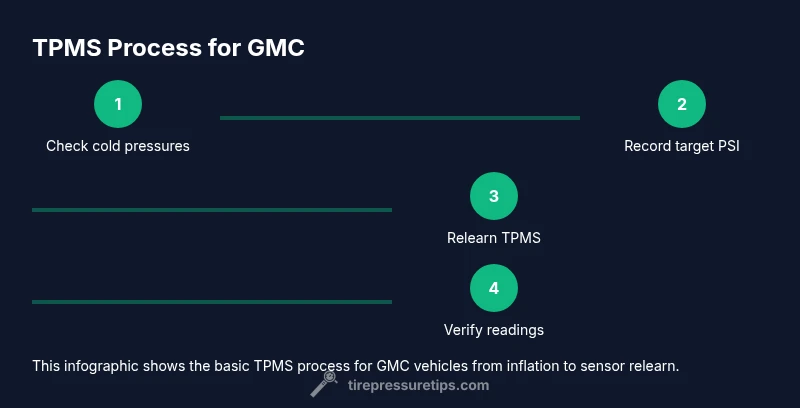
To ensure accuracy, start with cold tires and check pressures using a reliable digital gauge. Compare each tire’s reading to the GMC-recommended value found on the door jamb placard or owner's manual. If a tire is underinflated, add air in small increments, then recheck after 1-2 minutes to allow the tire to settle. Do not exceed the maximum inflation pressure printed on the tire sidewall. Rotate or reposition tires if your readings are close to the limit and you notice uneven wear. After adjusting, recheck all four tires and verify that the TPMS warning light behaves as expected.
- Park on level ground and allow tires to cool for at least 3 hours if possible.
- Use a gauge with a stable head to prevent air loss during measurement.
- Record target PSI per tire to simplify future checks.
- If a tire reads unusually high after inflation, inspect the tire for damage or a defective valve core.
Tip: Keep a small notebook or app log of tire pressures between services to catch gradual leaks early.
Relearn and reset procedures for GMC TPMS
Most GMC vehicles require a relearn or calibration after tire rotation, sensor replacement, or wheel changes. The exact steps depend on the model year and trim, but the general idea is to reprogram the system to recognize each tire’s sensor and position. A dedicated TPMS tool or the vehicle’s settings menu typically initiates this process. In many cases, you’ll need to drive the vehicle for a specific distance or speed range after initiating relearn to complete the cycle. Always consult the GMC owner’s manual for model-specific guidance. If your model supports it, a short drive on a highway at moderate speeds can help the system stabilize as sensors communicate with the ECU.
Pro tip: If your car has a dedicated TPMS button, you can start the relearn by pressing and holding it until the light blinks. Warning: Do not attempt to relearn with a tire visibly underinflated; correct pressures first.
Verify TPMS status after relearn
After a relearn attempt, confirm the system acknowledges each tire’s new sensor data. Check the dashboard for a steady TPMS indicator—not blinking or staying off. A successful relearn typically means the light stays off and the readings reflect actual tire pressures. You can cross-check with your digital gauge to ensure the door placard pressures match the measured values. If the light remains on, re-check tire pressures and reinitiate the relearn sequence according to your GMC’s manual. Persistent issues may indicate a faulty sensor or a more complex ECU fault that requires a dealer-level diagnostic tool.
Always document the tire positions during rotation so you can map sensors correctly during relearns and avoid mix-ups.
Maintenance tips to prevent TPMS problems
Preventive care reduces TPMS problems before they start. Regularly check tire pressures monthly and after temperature swings. Keep tire temperatures stable by avoiding aggressive driving that overheats tires, which can distort readings or accelerate wear. Replace batteries in direct TPMS sensors only when necessary; some sensors are designed for long service life and are replaced as a complete unit rather than via battery swaps. Maintain clean valve stems; corrosion can inhibit accurate readings. When rotating tires, confirm sensor positions so relearn events don’t confuse the system. Finally, schedule periodic diagnostics with a GMC-specific tool during routine service to catch sensor drift or calibration issues early.
In all cases, trust the combination of the TPMS light, gauge readings, and the owner’s manual guidance to maintain safe tire inflation.
Common pitfalls and safety reminders
Rushing the inflation process can lead to overshoot, causing overinflation and unpredictable handling. Do not ignore a TPMS warning light, as underinflated tires can reduce traction and increase the risk of a blowout. If a tire appears visually damaged or has a slow leak, stop driving and inspect the tire, then consult a professional. When working around wheels and tires, wear eye protection and ensure the vehicle is securely supported if you need to lift a corner. If you are unsure about TPMS relearn steps, seek professional service rather than guessing, as incorrect relearn can create more warning signals.
Tools & Materials
- Digital tire pressure gauge(Calibrated and reads to at least 0.5 psi)
- GM service manual or GMC TPMS relearn instructions(Model/year specific)
- Vehicle-specific TPMS scan tool(OE-grade preferred)
- Valve core removal tool(Used to access valve cores)
- Replacement TPMS sensors (if necessary)(Only if sensor is faulty)
- Door placard or owner's manual for PSI targets(Know correct values)
- Tire inflator with gauge, or air compressor(Keep steady inflation)
Steps
Estimated time: 60-120 minutes
- 1
Identify tire positions and targets
Consult the GMC owner’s manual or door placard to confirm the recommended cold tire pressures for each wheel. Mark or note which tire is which to avoid mix-ups during rotation or diagnostic checks.
Tip: Take a photo or jot down each PSI target. - 2
Check cold tire pressures
Park on level ground and let tires cool for at least 3 hours if possible. Use a digital gauge to measure each tire; ensure the gauge is not leaking and read consistently.
Tip: Record readings and compare to target values. - 3
Adjust pressures as needed
If any tire is below target, add air in small increments and recheck after 1–2 minutes to allow the tire to settle. Do not exceed the tire’s maximum inflation pressure printed on the sidewall.
Tip: Inflate gradually and recheck to avoid overshooting. - 4
Inspect tires and valve stems
Look for visible damage, cracks, or corrosion on valve stems. Ensure valve caps are in place to prevent dirt ingress. Replace any damaged components before proceeding.
Tip: A leaky valve stem can defeat inflation checks. - 5
Initiate TPMS relearn (if required)
If your GMC model requires relearn after rotation or sensor work, use the scan tool or the vehicle’s settings menu to start the process. Follow on-screen prompts and complete the sequence as directed by your model/year.
Tip: Some models require a specific drive pattern after relearn. - 6
Drive to finalize relearn
If the relearn process calls for it, drive the vehicle at a stable speed for a short distance to allow sensors and ECU to communicate. Monitor the TPMS light for changes and ensure it turns off after a successful relearn.
Tip: Avoid sharp accelerations during relearn. - 7
Verify TPMS status
After completing the relearn, verify that each tire’s pressure matches the target on the placard and that the TPMS light remains off. If readings diverge, recheck the tires or consider sensor testing.
Tip: Use a handheld gauge to confirm numbers before concluding.
Frequently Asked Questions
What is a TPMS and how does it function on GMC vehicles?
TPMS uses wheel-mounted sensors or ABS data to monitor tire pressure and alert you if inflation departs from the recommended range. Direct sensors report actual pressure values; indirect systems infer underinflation from wheel speeds.
TPMS watches your tire pressure and warns you if it drops; some GMCs use wheel sensors, others use speed data to infer issues.
Why did my TPMS light come on even though my tires look fine?
A warning light can indicate underinflation, a faulty sensor, a dead sensor battery, or a need for relearn after wheel work. Always verify with a gauge and check for sensor issues.
If the light stays on, check pressures with a gauge and look for sensor or battery issues; you might need a relearn.
Can I perform a TPMS relearn myself?
Many GMC models support a DIY relearn using the vehicle’s settings or a dedicated TPMS tool. Model year and trim determine the exact steps, so consult your manual or a GMC-specific guide.
Yes, many GMCs allow a DIY relearn with the right tool or in-car menu. Check your manual for exact steps.
How long should TPMS sensors last?
Sensor life depends on usage and battery health; if a sensor repeatedly reports incorrect readings, replacement may be needed. Battery life varies; monitor for warning signs and consult a professional if unsure.
Sensor life varies; if readings are unreliable, a replacement may be needed. Consult a pro if unsure.
What tools do I need for TPMS maintenance?
A digital tire gauge, a vehicle-specific TPMS scan tool, and a method to access valve cores are essential. Have the door placard PSI targets handy as a reference.
You’ll need a gauge, a TPMS tool, and basic valve tools to perform maintenance.
Does outside temperature affect TPMS readings?
Yes. Temperature changes can alter tire pressure readouts. Recheck pressures after cold starts and adjust as needed to maintain the recommended PSI.
Temperature can affect readings; always verify pressures after weather changes and adjust accordingly.
Watch Video
What to Remember
- Check cold pressures before driving
- Differentiate direct vs indirect TPMS
- Use a proper TPMS tool for relearns
- Verify readings after any tire work
- Follow model-specific GMC procedures