Honda Tire Pressure Sensor Replacement: Step-by-Step Guide
Learn how to replace a Honda TPMS sensor with confidence. This guide covers tools, sensor compatibility, relearn procedures, safety tips, and maintenance insights from Tire Pressure Tips.


As a practical guide, you will learn how to replace a Honda tire pressure sensor (TPMS) safely and accurately, including tools, when to replace, and calibration. You'll need the right replacement sensor, a tire iron, a torque wrench, and a relearn procedure for your Honda model. The Tire Pressure Tips team notes that proper TPMS maintenance improves safety.
Honda TPMS basics for Honda vehicles
According to Tire Pressure Tips, the tire pressure monitoring system (TPMS) in Honda vehicles uses wheel sensors and a central receiver to track tire pressure and alert you when pressure drops. This system helps prevent under-inflation, which can affect safety and fuel economy. Understanding how TPMS works in your specific Honda model will make future maintenance smoother and prevent mistaken readings. The goal is to keep all four tires within the manufacturer’s recommended range and ensure the sensors communicate reliably with the car's ECU. When a sensor fails or its battery dies, you may see a warning light, errant readings, or an inconsistent display on the dash. Consistency matters because erratic TPMS behavior leads to unnecessary tire checks and potential safety risk. Tire Pressure Tips analysis shows that regular TPMS maintenance reduces nuisance warnings and helps catch slow leaks early.
When to consider replacing a TPMS sensor on Honda
A failing TPMS sensor can manifest as a dimming or flickering warning light, inconsistent pressure readings, or a sensor that won’t relearn after maintenance. Physical damage to a wheel or valve stem, battery degradation inside the sensor, or corrosion can trigger warnings. If a scan confirms a faulty sensor rather than a failed relay or ECU issue, replacement is typically the next step. Note that some Honda models require a relearn or calibration sequence after sensor installation to restore accurate readings.
Tools, parts, and prep for Honda TPMS replacement
Before you start, gather essential items and prepare the workspace. A proper replacement TPMS sensor (valve stem included) that matches your Honda’s wheel type is critical. You’ll also need a torque wrench, tire iron or breaker bar, wheel chocks, a valve core tool, a TPMS relearn tool or compatible scanner, and an air source to reach the correct tire pressure after installation. Keep soapy water handy to check for leaks around the valve after seating the new sensor, and label wheels if you are working on multiple tires.
Sensor selection and compatibility
Choose a sensor that is compatible with your specific Honda model and year. Some aftermarket sensors offer lower cost, but compatibility and battery type matter for reliable operation. Verify that the sensor’s thread size and stem style match your wheel, and confirm if your model requires a direct (sensor in each wheel) or indirect (ABS/ESP-based) TPMS approach. If in doubt, consult the owner’s manual or a trusted service guide from Tire Pressure Tips.
Relearn and calibration process
After installing the new TPMS sensor, perform the relearn or calibration procedure specified for your Honda. This is usually done with a TPMS relearn tool or a vehicle-specific scan tool. The process may require driving for a short distance or performing a sequence of in-car steps, depending on the model year. Proper relearn ensures the dashboard warning light clears and that the system tracks tire pressures accurately across all wheels.
Safety tips and common mistakes
Take safety seriously: lift the car only on a level surface, use wheel chocks on both sides of the opposite wheel, and never work under a raised vehicle without jack stands. Common mistakes include over-tightening sensor mounting hardware, using incompatible sensors, or skipping the relearn step. Following the correct procedure minimizes the risk of leaks, sensor damage, and erroneous readings.
Tools & Materials
- Replacement TPMS sensor (valve stem included)(Choose a sensor compatible with your Honda model and wheel type)
- Torque wrench(Use to tighten lug nuts and sensor mounting to spec)
- Tire iron or breaker bar(To break bead and remove tire from wheel as needed)
- Wheel chocks(Place on both sides of the wheel opposite the tire being serviced)
- Valve core tool(For deflating and resealing valve stems)
- TPMS relearn tool or scanner(Needed to complete the relearn procedure for most Hondas)
- Air compressor or tire inflator(To reach the vehicle's recommended pressure after install)
- Soapy water and a cloth(Helpful to check for leaks around the valve stem)
- Marker or zip ties(Label wheels for reassembly accuracy)
Steps
Estimated time: 60-90 minutes
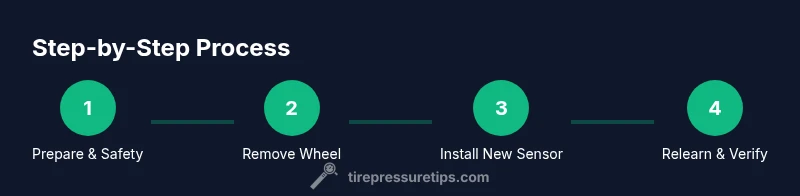
- 1
Prepare the vehicle and safety setup
Park on a flat surface, engage the parking brake, and chock the wheels. Loosen the lug nuts just enough while the car is still on the ground to prevent the wheel from turning once lifted. Then, lift the vehicle and support it with jack stands for stability.
Tip: Always chock the opposite wheel and keep a hand on the tire as you lift to prevent rolling. - 2
Remove wheel and access TPMS
Remove the wheel’s lug nuts and take the wheel off the hub. Deflate the tire enough to safely separate the bead or remove enough air to move the tire bead if needed. Access the TPMS sensor at the valve stem and inspect for any visible damage.
Tip: Document wheel orientation before removal to ensure correct reinstallation. - 3
Replace the TPMS sensor
Detach the old sensor from the wheel and install the new unit, ensuring the stem sits properly and the sensor is seated without cross-threading. Clean the seating area to remove dirt that can cause leaks. Reassemble the tire bead if you had to separate it.
Tip: Lubricate the threads if required and torque to the manufacturer’s specification. - 4
Reassemble wheel and prepare to relearn
Mount the wheel back onto the vehicle, tighten lug nuts in a crisscross pattern, and lower the car. Inflate the tire to the recommended pressure and use the TPMS relearn tool to initiate the sensor learn cycle if your model requires it.
Tip: Double-check the tire pressure before relearn to ensure accuracy. - 5
Relearn, test, and verify
Drive the car for a short distance to complete the relearn process, or run the relearn procedure exactly as your Honda model requires. Confirm that all four sensors display correct pressures on the dash and on a scan tool if available.
Tip: If the light stays on, recheck sensor seating and repeat relearn steps or consult a professional.
Frequently Asked Questions
Can I replace a Honda TPMS sensor myself?
Yes, with the right tools and relearn procedure. Some Hondas may require dealer software for a full relearn. Follow the official service notes for your model year.
Yes, you can replace it at home if you have the right tools and relearn steps. Some models might need dealer software for a complete relearn.
Do I need to replace all TPMS sensors at once?
Usually you replace only the faulty sensor. If others show signs of failure, you may plan a broader replacement after diagnosing with a TPMS scanner.
Usually only the bad sensor is replaced. If others show issues later, evaluate replacement then.
What are common signs of a failing TPMS sensor?
Warning lights, inconsistent pressure readings, or a sensor that refuses to relearn are common indicators of sensor failure.
Common signs are a warning light, erratic readings, or relearn failures.
How long does TPMS replacement take?
Time varies by model and access; plan for a process that could take roughly an hour per wheel with relearn considerations.
It depends on the model, but expect about an hour per wheel including relearn steps.
Differences between OEM and aftermarket TPMS sensors?
OEM sensors guarantee compatibility with your Honda, but aftermarket options can work if they match size, thread, and electronics. Verify with a trusted source before purchasing.
OEM sensors fit most Honda wheels perfectly, but compatible aftermarket options can work if they match the specs.
Will replacing the sensor reset the warning light automatically?
Not automatically; you typically must perform a relearn with a tool or follow the vehicle's reset sequence to clear the warning.
Usually you need to relearn the system to clear the warning light.
Watch Video
What to Remember
- Verify sensor compatibility before replacement.
- Follow the relearn procedure to reset the TPMS.
- Inspect for leaks and recheck pressures after install.
- Document parts and maintain tooling for future maintenance.