Tire Pressure Gauges for Motorcycles: A Practical Guide
Learn how to choose, use, and calibrate tire pressure gauges for motorcycles. This guide covers gauge types, TPMS considerations, and best practices for accurate, safe riding.


Learn how to choose and use tire pressure gauges for motorcycles, including how to read readings, how to calibrate gauges, and how to account for TPMS and temperature effects. This guide covers types of gauges, maintenance, and safety tips to ensure accurate pressures for safe riding.
What makes a good motorcycle tire pressure gauge
A good motorcycle tire pressure gauge is not just about measuring numbers; it’s about reliability, durability, and consistency. For riders, the most important qualities are a tight seal on the valve stem, a readable scale, and a gauge that does not wobble under normal handling. According to Tire Pressure Tips, choosing a gauge with a secure seal and a readable scale is essential for trustworthy readings. The Tire Pressure Tips team found that most riders gain confidence and better maintenance habits when they rely on a single gauge that stays accurate over time. This reduces the chance of conflicting readings between gauges and helps you stay within recommended front and rear pressures. In practical terms, look for a gauge that feels sturdy in your hand, is easy to read at a glance, and supplies a consistent result across multiple tests on the same tire.
To satisfy TPMS considerations, select a gauge that can read low, mid, and high PSI ranges common to motorcycle tires. A durable construction and a comfortable grip reduce user fatigue during checks after long rides. Regular checks with a dependable gauge also make it easier to document changes in tire pressure over time, which supports safer riding and longer tire life.
Tools & Materials
- Tire pressure gauge (digital or analog)(Choose a gauge with a clear scale and a stable seal on motorcycle valve stems)
- Air pump with PSI gauge(Needed to adjust pressure to the recommended range)
- Valve core tool(Useful for valve stem maintenance or minor leaks)
- Clean rag(Wipe stems and valve caps before and after readings)
- Reading log (paper or app)(Track cold readings and adjustments over time)
Steps
Estimated time: 15-30 minutes
- 1
Find your motorcycle's recommended tire pressures
Consult the owner's manual or the tire placard on the bike to locate the cold tire pressure for front and rear tires. These values are your starting point and can vary with load, riding style, and tire type. Knowing the exact spec helps you avoid over- or under-inflation.
Tip: Always start from the manufacturer’s recommended cold pressure before riding. - 2
Check the gauge for accuracy
Inspect the gauge for visible damage, cracks, or worn seals. If possible, compare its reading against a known reference gauge. A miscalibrated gauge will mislead tire inflation decisions and compromise safety.
Tip: Test against a known reference before use, especially if the gauge is older. - 3
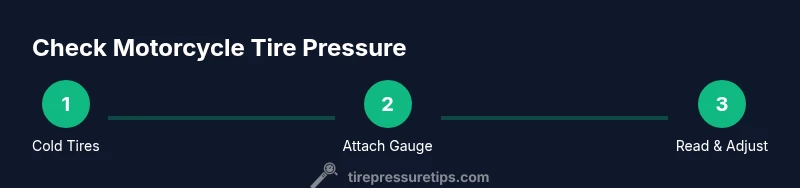
Prepare the tires (they should be cold)
Park the bike in a shaded area and wait at least 3 hours after riding before taking readings. Hot tires read higher than cold tires due to heating under operation, skewing results and potentially masking underinflation.
Tip: Cold readings are the baseline for accuracy. - 4
Remove valve caps and attach the gauge
Carefully remove the valve caps and press the gauge onto the valve stem until you hear a seal. Ensure no air leaks and that the gauge is perpendicular to the stem for a stable reading.
Tip: A loose seal will produce fluctuating or low readings. - 5
Read the current pressure
Note the reading on the gauge without moving the gauge or releasing air. For digital gauges, wait for the display to stabilize; for analog gauges, read at eye level to avoid parallax error.
Tip: If the needle bounces, re-seat and re-check after a moment. - 6
Compare with the recommended pressure and adjust
If the reading is too low, add air in small increments and recheck. If it’s too high, release air until you reach the target. Always refer to the exact front and rear specs for proper inflation.
Tip: Inflate in small steps to avoid overshooting the target. - 7
Recheck after adjustment
Take another measurement after making adjustments to verify accuracy. This confirms you haven’t under- or over-inflated due to gauge error or slow leaks.
Tip: Recheck with a second gauge if possible for extra confidence. - 8
Reinstall valve caps and log the reading
Replace valve caps to prevent dust ingress and record the cold readings, including the date and tire position. Tracking changes helps with routine maintenance and troubleshooting.
Tip: A simple log makes it easier to detect slow leaks or gradual pressure loss. - 9
Store the gauge properly for longevity
Keep the gauge in a protective case or pouch, away from direct heat and moisture. Regularly inspect the gauge’s seal and avoid exposing it to extreme temperatures.
Tip: Consistent storage reduces drift and extends gauge life.
Frequently Asked Questions
What is the best type of gauge for motorcycles?
Digital gauges are fast and precise, but analog gauges offer reliable readings with no batteries. Choose based on your preference and how often you ride.
Digital gauges are fast and precise, but analog gauges are reliable and battery-free. Pick what fits your riding style.
Should I trust TPMS readings or check with a gauge?
TPMS readings provide a warning of pressure change, but they can be affected by temperature and sensor drift. Always verify with a calibrated gauge for accuracy.
TPMS warnings are helpful, but always verify with a gauge for accuracy.
How often should I calibrate my gauge?
Calibrate when you buy the gauge and periodically thereafter, especially if readings drift or you notice inconsistency between measurements.
Calibrate when you buy it and every few months if readings drift.
What is the safe PSI range for common motorcycle tires?
Follow the motorcycle manufacturer’s spec printed on the placard or sidewall. The range varies by model and tire type, so refer to the official guidance.
Follow the maker’s spec on your bike’s placard or sidewall for the safe range.
Can I use a car gauge for motorcycle tires?
It’s not ideal. Car gauges may not fit motorcycle valves securely and can give inaccurate readings. Use a motorcycle-specific gauge or a universal gauge calibrated for smaller valves.
A car gauge isn’t ideal for motorcycles; use a gauge designed for bikes.
What maintenance steps should I follow after checking tire pressure?
Replace the valve caps, wipe the stems, and log the reading. Regular upkeep helps detect slow leaks and maintain accuracy.
Replace caps, clean the stems, and log the readings after every check.
Watch Video
What to Remember
- Check cold tire pressure before rides
- Use the right gauge for motorcycle tires
- Record readings to track changes
- Know front vs rear recommended pressures
- Calibrate gauges regularly