Motorcycle Tire Pressure PSI: A Practical Guide for Riders
Learn how to check and set motorcycle tire pressure psi for safety, grip, and wear. Understand cold vs hot readings, front vs rear targets, and how to use gauges and pumps effectively.


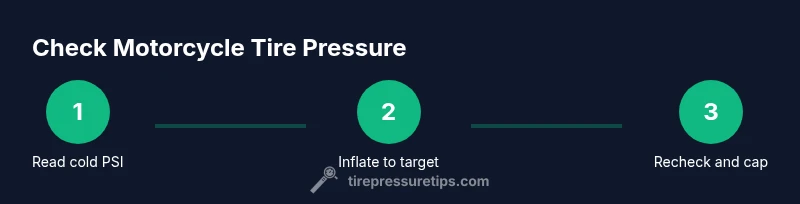
You will learn how to check and adjust motorcycle tire pressure psi correctly for safe handling and longer tire life. This guide covers front and rear targets, how temperature affects readings, and the best tools to use, plus quick checks you can perform every ride. By following these steps, you’ll improve grip, stability, and fuel efficiency.
Why motorcycle tire pressure psi matters
Maintaining the correct motorcycle tire pressure psi is essential for safe handling, predictable steering, and even tire wear. Proper pressure helps the tire contact the road correctly, improving grip in dry and wet conditions. It also affects fuel efficiency and ride comfort. The Tire Pressure Tips team emphasizes that consistent, accurate readings reduce unpredictable behavior at cornering and braking. In practice, riders who check cold tires before each ride see fewer flats and longer tire life. This is a core part of responsible motorcycle maintenance and a key factor in overall riding safety.
How cold vs hot readings work
Tire pressure psi changes with temperature. When tires heat up from riding, psi increases. Reading a hot tire can lead to underinflation when you cool down, or overinflation if you inflate after a ride and the tire is warm. The best habit is to check when the tire is cold or has cooled for at least three hours. This ensures readings reflect the factory or manufacturer recommendations. Tire Pressure Tips analysis shows that consistent cold readings correlate with more stable tire profiles and safer braking performance across weather conditions.
Front vs rear tire pressure targets
Most motorcycles have different recommended pressures for the front and rear tires. The front tire generally requires slightly less pressure than the rear, but this varies by model and riding style. A typical street setup might be in the range of mid-20s to mid-30s psi for the front and low-30s to mid-30s psi for the rear. Always consult the owner’s manual or tire manufacturer charts for your exact model. Underinflation can cause headshake and instability, while overinflation can reduce grip and increase ride harshness.
PSI units and gauge types
PSI is the standard unit in the United States, while many countries use kPa. Choose a gauge with at least 0.5 psi resolution for accuracy. Digital gauges are convenient and generally more precise than simple pencil gauges, but any gauge should be calibrated occasionally. When checking, place the gauge squarely on the valve stem and press down firmly to avoid air leaks. If you plan long trips, carry a compact gauge and a small air pump so you can verify pressures wherever you ride.
How to read and interpret the numbers
Read the number on the gauge while the tire is cold. Compare it to the manufacturer’s recommended range for your motorcycle. If the reading is below the target, add air in small increments (no more than 1–2 psi at a time) and recheck. If it’s above the target, release air gradually until you’re within range. Remember that load, passenger gear, and tire wear can shift the ideal PSI, so adjust after considering your typical riding conditions.
Inflation safety and maintaining range
Never exceed the tire’s maximum pressure printed on the sidewall, even for high-load trips. Underinflation is a common issue on motorcycles, especially after long rides or in hot weather. Regular maintenance routines should include checking pressures monthly or before long trips, plus additional checks after significant temperature changes or when you switch tire brands. A well-inflated tire maintains shape under load, optimizing grip and stability.
Temperature effects and seasonal considerations
Temperature swings can move the PSI by roughly 1–2 psi per 10°F change, depending on tire composition and load. In cold weather, pressures drop; in hot weather, pressures rise. Plan checks for mornings or after a cooldown to avoid false readings due to heat buildup. For winter riders, consider slightly higher cold readings within the recommended range to compensate for cooling at high speeds or after long stints in cold air.
Common mistakes and how to avoid them
Avoid inflating immediately after a ride; always let tires cool. Don’t rely on one-off checks; pressure changes as you load your bike with gear. Using an inaccurate gauge is a frequent issue, so calibrate your gauge with a known reference. Do not mix gauge types, and avoid letting air out through the valve stem repeatedly, which can introduce moisture and measurement errors. A consistent routine is the best defense against inconsistent handling.
Special cases: sport bikes and tubed tires
High-performance and sport motorcycles often run higher front pressures and slightly different rear pressures to optimize cornering and stability at speed. Tubed tires require careful monitoring to avoid pinch flats, while tubeless tires can lose air more slowly but still require regular checks. Adventure bikes and dual-sport machines may see wider target ranges depending on luggage weight and riding terrain. Always verify model-specific guidance for these categories.
Maintenance routine and long-term care
Make tire pressure checks part of your pre-ride routine. Record the readings when you set pounds per square inch targets and note deviations after street or track use. Inspect tires for punctures, uneven wear, and valve stem integrity as part of a broader maintenance habit. Consistent PSI ensures predictable steering response, reliable grip, and longer tire life, reducing the risk of sudden tire failures on the road.
Tools & Materials
- Tire pressure gauge (digital or analog)(Choose one with at least 0.5 psi resolution and a simple, durable design)
- Air pump or portable compressor(Prefer a unit with a built-in gauge to avoid extra tools)
- Owner's manual and tire manufacturer charts(Contains model-specific front/rear psi targets)
- A clean rag(For wiping valve stems before reading to avoid debris)
- Notebook or app for recording pressures(Helpful to track changes over time and with load)
Steps
Estimated time: 15-25 minutes
- 1
Identify recommended PSI
Consult your owner’s manual or tire chart to locate the correct cold psi for front and rear tires. Reasons vary by model and riding style, so don’t assume a single value fits all conditions.
Tip: If in doubt, start at the lower end of the indicated range and adjust after a short ride. - 2
Ensure tires are cold
Begin measurements when tires have cooled for several hours to avoid heat-induced pressure inflation.
Tip: Check after a night of rest or before a ride in the morning. - 3
Remove valve caps and prepare the gauge
Take off the valve stem caps and inspect them for damage. Attach the gauge firmly to the valve to prevent air leaks during reading.
Tip: Keep caps in a pocket; losing them can expose valves to dirt. - 4
Read the current PSI
Read the gauge and compare with the recommended range. If the reading is too low, plan for a controlled inflate.
Tip: If a reading seems off, try re-seating the gauge or using a second gauge to verify. - 5
Inflate or deflate to target
Add or release air in small steps (1–2 psi) until the reading aligns with the target for each tire.
Tip: Don’t overshoot; air in small increments and recheck after each adjustment. - 6
Recheck after adjustment
Re-measure both tires to confirm the target is achieved, and ensure there are no leaks around the valve stem.
Tip: If the tire quickly loses pressure, inspect for punctures or faulty valves. - 7
Replace valve caps
Reinstall caps snugly to keep dirt out and to prevent air loss through the valve core.
Tip: Always carry spare caps on trips in case of loss. - 8
Document and monitor
Record the setup for future reference and monitor changes with load, weather, and tire wear.
Tip: Note seasonal changes that affect pressure to anticipate adjustments.
Frequently Asked Questions
What is the recommended motorcycle tire pressure psi?
The recommended psi varies by motorcycle model and tire type. Always consult your owner’s manual or tire manufacturer charts for the exact front and rear targets. Use cold readings for accuracy and adjust for load and riding style.
Check your manual to get the exact front and rear PSI for your bike, and remember to read when cold for accuracy.
Why do cold readings matter?
Cold readings reflect the tire’s undisturbed state before heat buildup from riding. They are the baseline used to set targets. Reading hot tires can overstate the PSI and lead to underinflation after cooling.
Read when cold; it gives the best baseline before heat from riding changes the pressure.
How often should I check tire pressures?
Check pressures at least monthly and before long trips. Do so after you’ve stored the motorcycle cooled down and after any long ride to catch changes due to heat or load.
Check regularly, at least monthly and before trips, especially after weather or load changes.
Do motorcycles use TPMS (tire pressure monitoring) sensors?
Some motorcycles have TPMS, but most bikes rely on manual pressure checks with a gauge. If your bike has TPMS, follow the system’s calibration and maintenance guidelines.
Not all bikes have TPMS. If yours does, follow the calibration guide in the manual.
What should I do if a tire is consistently losing air?
Persistent air loss indicates leaks, valve issues, or damaged rims. Inspect for punctures, replace valve cores if needed, and consult a professional if the leak persists.
If air keeps leaking, get the tire inspected for punctures or valve issues.
Can load and rider position change PSI targets?
Yes. Heavier loads or aggressive riding can shift the ideal PSI. Adjust within the recommended range to maintain grip and stability.
Yes—more load means you may need to adjust within the target range for stability.
Watch Video
What to Remember
- Check cold tires for accurate PSI.
- Front and rear targets differ by model.
- Use a reliable gauge and proper technique.
- Don’t exceed max PSI printed on the tire.
- Account for temperature and load when adjusting.