Tire Pressure Over Recommended: Risks, Fixes, and Prevention
Learn what happens when tire pressure sits over the recommended level, how to diagnose it quickly, and safe fixes. Practical steps, TPMS tips, and prevention from Tire Pressure Tips.


According to Tire Pressure Tips, over the recommended tire pressure is usually caused by recent overinflation, quick temperature rise, or measurement error. The quick fix is to release air gradually until you reach the vehicle’s specified psi for that tire and load, then recheck with a precise gauge. If TPMS warns, reset after adjusting.
Why over-recommended pressure happens
When tires sit above the vehicle manufacturer's recommended pressure, they experience less-than-ideal contact with the road and uneven load distribution. The most common causes include recent overinflation during a routine check, measurements taken with a hot tire or using a faulty gauge, or sudden temperature changes that raise the air inside the tire. The Tire Pressure Tips team notes that even small deviations from the spec can grow into noticeable handling changes over time. By understanding the root causes, you can prevent chronic overinflation and keep your tires safer, longer, and more predictable in diverse driving conditions. Always start by verifying the pressure when tires are cold and before you drive to ensure accuracy.
Immediate risks of overinflation
Overinflation can make the ride feel harsh and jumpy, reduce the tire’s contact patch with the road, and cause uneven wear along the center of the tread. The increased internal pressure also raises the risk of damage from potholes or hitting a curb, and can make braking feel less predictable in wet conditions. In severe cases, sustained overinflation can lead to a blowout or rim contact during aggressive driving or heavy loads. The practical takeaway is simple: keep tires within the recommended range to preserve grip, wear, and overall safety.
How to verify correct pressure without guessing
The most reliable method is to measure cold tires with a high-quality gauge. Check all tires, including the spare, on a flat surface away from direct sun or heat. Compare each reading to the vehicle’s door jamb placard or owner’s manual for the correct psi. If you recently drove, wait at least three hours for tires to cool before rechecking. Remember to account for load and tire size, as different tires on the same vehicle can have different targets. Quick checks with a warm tire can yield falsely high readings.
Temperature, load, and seasonal effects
Air inside a tire expands with heat, so a hot day or prolonged driving can push the pressure above the cold-ideal value. A fully loaded vehicle also tends to raise tire pressure slightly. In winter, cold temperatures can drop pressure significantly, creating a false impression of underinflation when the tires are actually at an acceptable cold reading. Baseline checks should be done cold, and adjustments made based on the spec for the current season and load.
How overinflation affects handling and braking
Overinflated tires tend to ride hard, making steering feel overly sensitive and reducing the tire's ability to conform to road irregularities. Handling becomes more unforgiving on rough pavement, and braking distances can increase in wet conditions due to the narrower contact patch. Operators may notice a darting or twitchy feel in straight-line driving, especially at higher speeds or on uneven road surfaces. Maintaining the correct pressure helps restore predictable steering response and safer braking behavior.
Visual cues and TPMS signals you might notice
You may notice a visibly rounded center of the tire with flatter shoulders, or a slightly mushroomed tread profile on some tires when inflated too high. The TPMS light is a key signal, but don’t rely on it exclusively—sensor accuracy and calibration can vary. If you see inconsistent readings between tires or suspect sensor drift, verify with a manual gauge and recheck after adjustments. Safety-first means confirming pressure with a trusted instrument.
Step-by-step quick fixes to correct high pressure
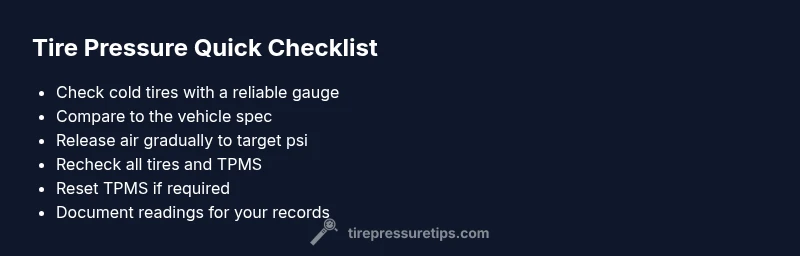
High-pressure correction should be done gradually to avoid over-correction. Begin by parking on a level surface and letting the tires cool. Use a precise gauge to measure current psi, then release air in small increments until the tire reaches the recommended value. Recheck all tires, including the spare, and reinstall valve caps. If your TPMS was triggered, reset only after confirming the correct pressures and performing a relearn if your vehicle requires it.
Long-term prevention strategies
Set a regular schedule to check tire pressure, at least monthly and before long trips. Use a reliable gauge, and compare readings against the vehicle’s official psi. Record seasonal adjustments if your tires or loads frequently change. Replace worn-out tires and faulty valves promptly, and consider TPMS calibration after tire rotations or replacements. Consistent checks save money by extending tire life and improving fuel efficiency.
When to seek professional help
If you cannot bring pressures within the recommended range, if you hear unusual hissing sounds, or notice rapid pressure loss from a single tire, seek professional inspection. A persistent high-pressure condition could indicate a faulty valve core, a damaged sidewall, or TPMS sensor issues. A tire shop can perform a thorough inspection, valve service, and TPMS relearn if necessary.
Common myths vs. facts about tire pressure
- Myth: Higher pressure always gives better fuel efficiency. Reality: benefits are marginal and can reduce grip and wear.
- Myth: TPMS guarantees perfect pressure. Reality: sensors can drift or fail; verify with a gauge.
- Myth: One tire is always correct while others differ. Reality: tire pressure should be checked across all tires and matched to the vehicle spec.
Steps
Estimated time: 15-25 minutes
- 1
Prepare your tools
Gather a reliable tire pressure gauge, a clean rag, and a safe place to work. Ensure the vehicle is on a flat surface and the engine is off. Remove any wheel covers if needed to access the valve stems.
Tip: Use a gauge you trust; cheaper gauges can give inconsistent readings. - 2
Check cold tire pressures
Measure when tires are cold (not driven for at least 3 hours). Take note of each tire's current psi and compare with the spec in your owner’s manual or door placard.
Tip: Record readings to track changes over time. - 3
Release air to the recommended level
If any tire reads above the spec, release air in small increments. Recheck after each adjustment to avoid underinflation.
Tip: Do not let air escape too quickly; small steps prevent overcorrection. - 4
Recheck all tires
Once adjustments are done, recheck every tire and the spare. Ensure all pressures match the vehicle’s recommended psi for current load and conditions.
Tip: Even if one tire was high, verify all others for consistency. - 5
Reset/ relearn TPMS if needed
If your TPMS shows a warning after pressure changes, reset or relearn the system per your vehicle manual. Some systems require driving a short distance for the relearn to take effect.
Tip: Don’t drive far before confirming TPMS status after adjustments. - 6
Test-drive and verify
Take a short, cautious test drive to confirm stable readings. Recheck pressures after the car has cooled down again.
Tip: If readings drift quickly, there may be a leak you should inspect. - 7
Document and monitor
Log your readings and any adjustments. Monitor tire condition and consider a professional inspection if pressure repeatedly deviates.
Tip: A simple log helps catch gradual changes early. - 8
Safety check
Ensure all valve stems are intact and that there are no sidewall bulges or punctures. Replace damaged tires or valves promptly.
Tip: If you notice sidewall damage, stop driving and seek help.
Diagnosis: Tires look visibly overinflated and the TPMS light is on or flickering
Possible Causes
- highRecent overinflation during maintenance or adding air with a gauge error
- mediumAmbient temperature rise increasing internal tire pressure
- lowGauge inaccuracy or TPMS sensor drift
Fixes
- easyPark on level ground and let tires cool before adjusting
- easyRelease air in small increments to reach the recommended psi
- easyRecheck all tires with a trusted gauge and reset TPMS if required
Frequently Asked Questions
What does it mean if my tires are over the recommended pressure?
Over the recommended pressure means the air inside the tire is higher than the manufacturer specifies. This can reduce grip, increase wear in the center, and affect handling. Always verify with a precise gauge and adjust accordingly.
If your tires are over the recommended pressure, it means the air in the tire is higher than what the manufacturer suggests. This can reduce grip and change wear patterns. Check with a precise gauge and adjust as needed.
Is it safe to drive with slightly overinflated tires?
A small overinflation might not fail immediately, but it can reduce traction and increase the risk of a tire blowout on rough roads. Drive carefully and correct pressure as soon as possible.
A little overinflation can reduce traction and increase risk on rough roads, so correct the pressure soon and drive cautiously.
How do I adjust tire pressure correctly?
Check the tire when cold, compare against the spec, release or add air in small increments, recheck, and reset TPMS if needed. Repeat until all tires meet the manufacturer’s recommended psi.
Check cold tires, compare with the spec, adjust in small steps, recheck, and reset TPMS if needed.
Will TPMS always warn if tires are overinflated?
TPMS can warn if a tire is above the threshold, but readings can vary due to sensor drift or calibration. Always verify with a gauge beyond relying on TPMS alone.
TPMS might warn, but readings can drift. Always confirm with a gauge and adjust as needed.
How do temperature changes affect tire pressure?
Temperature affects air volume; hot weather inflates tires, cold weather deflates them. Check pressures in cold conditions and adjust to the correct psi for your season.
Temperature changes can make tires seem over- or under-inflated; check in the cold and adjust to the right psi.
When should I seek professional help for tire pressure issues?
If pressures won’t stay within range, you notice leaks, or the TPMS behaves erratically, consult a tire professional. Replacing faulty valves or sensors may be necessary.
If pressure won’t stay correct or you hear leaks, see a tire professional.
Can overinflation cause flats?
While less common than underinflation, overinflation can weaken the tire sidewalls and increase damage risk from road hazards, potentially leading to a puncture or blowout.
Overinflation weakens sidewalls and can lead to damage from road hazards, increasing blowout risk.
Should I adjust tire pressure with a digital or analog gauge?
Both work well if calibrated correctly. Choose a gauge you consistently trust, and verify readings with the other type if you have access to it.
Use a gauge you trust, and double-check readings with another gauge if possible.
What to Remember
- Check cold tires with a reliable gauge.
- Match pressures to the vehicle’s specification, not feel alone.
- Reset TPMS only after confirming correct pressure.
- Regular checks prevent wear, improve safety, and save fuel.