Warning Light for Tire Pressure: Quick Troubleshooting Guide
Urgent, step-by-step troubleshooting for the tire pressure warning light. Learn to check pressures, reset TPMS, inspect for leaks, and decide when to seek professional help to prevent flats and protect safety.


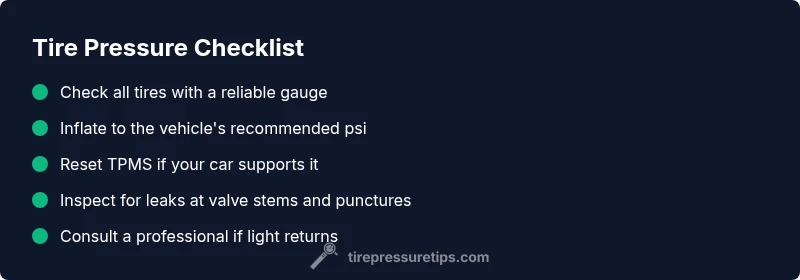
The warning light for tire pressure usually means one or more tires are under-inflated or the TPMS sensor has a fault. First, check all tire pressures with a gauge and inflate to the vehicle’s recommended psi. If the light stays on after a correct reset, inspect TPMS sensors and valve stems or seek professional help.
Understanding the warning light for tire pressure
The tire pressure warning light on your dashboard is a safeguard designed to alert you to potential under-inflation, a TPMS sensor issue, or a rapid drop in tire pressure. Driving with low pressure risks heat buildup, increased wear, and a higher chance of a blowout. In this guide, you will learn how the system works and how to interpret the light across different vehicles and conditions. The Tire Pressure Tips team emphasizes that tire pressures are not one-size-fits-all; your model, load, and even outdoor temperature can influence the ideal psi. According to Tire Pressure Tips, maintaining accurate tire pressure improves handling, fuel efficiency, and tire longevity, so timely action is essential when the light appears.
Common causes of the TPMS warning light
There are several reasons the warning light can illuminate. The most common cause is under-inflation in one or more tires. A second frequent cause is a faulty TPMS sensor or a dead sensor battery, which can trigger a false alert even when tires are correctly inflated. Temperature shifts—especially rapid cooling—can also make pressures drop enough to trigger the light. Finally, a slow leak from a nail, puncture, or damaged valve stem can produce gradual pressure loss that the TPMS detects. In some cases, the light can stay on due to a temporary sensor fault that resets after correcting inflation and driving for a short period. The key is to verify pressures first, then inspect the TPMS components.
Quick tests you can perform safely
Begin with a cold tire pressure check using a reliable gauge. Compare each wheel’s reading to the manufacturer’s recommended psi (usually found on a door jamb sticker or owner’s manual). If any tire is below target, inflate to spec and recheck. If the light persists after inflation and a TPMS reset (if your vehicle supports it), inspect the valve stems for leaks, look for nail holes, and examine the wheel rim for damage. Do not rely on a single wheel reading; test all four corners and the spare if applicable. Remember to perform checks when the tires are cold for accuracy.
Step-by-step troubleshooting flow
- Safely pull over and turn on hazard lights. 2) Check all tire pressures with a gauge and adjust to the recommended psi. 3) If a tire cannot reach target psi, inspect for a puncture or slow leak and consider sealing/repairing. 4) If pressures are correct, perform the TPMS reset (per your owner’s manual) and drive for 10–15 minutes to let the system re-check. 5) If the light remains, inspect TPMS sensors and battery health, and consider professional diagnosis. 6) Record readings and any error codes for service.
When to seek professional help
If you cannot locate a clear cause, or if the TPMS light returns after inflation and a reset, seek professional service. A tech can test TPMS sensor power, battery life, and signal integrity, and they can check wheel seals and leaks with appropriate equipment. If a slow leak is suspected, a professional repair or tire replacement may be required to ensure safe driving.
Preventing future TPMS warnings
To minimize future warnings, keep tires inflated to the recommended pressure, inspect tires monthly, and check after long trips or temperature changes. Rotate tires as recommended and replace faulty TPMS sensors before they fail completely. Regular maintenance, including valve stem checks and ensuring TPMS battery health, can reduce the likelihood of nuisance alerts and improve overall tire safety.
Steps
Estimated time: 30-45 minutes
- 1
Safely pull over and prepare to inspect
Turn on hazard lights and park on a flat surface. Gather a reliable tire gauge and your vehicle’s PSI specification from the door jamb sticker or manual. This step prevents accidents and ensures accurate readings.
Tip: Always perform checks when tires are cold for accuracy. - 2
Check all four tires
Slowly measure each tire’s cold pressure with your gauge. Note any readings that fall below the recommended PSI and compare across all tires. Temperature, load, and driving distance can influence readings.
Tip: Record the numbers for reference and to monitor changes. - 3
Inflate and verify
Inflate any under-inflated tires to the recommended PSI. Recheck after a few minutes to allow the tire to settle and the gauge to reflect accurate pressure.
Tip: Avoid over-inflation—use the target PSI and recheck. - 4
Reset TPMS (if applicable)
If your vehicle supports it, use the onboard menu or button to reset TPMS after inflating. Take a short test drive to give the system time to re-evaluate pressures.
Tip: Not all cars require a manual reset; consult your manual. - 5
Inspect for leaks
Look for visible nails, cuts, or punctures. Check valve stems and the bead area for leaks using soapy water or a leak detector spray.
Tip: If you see bubbles, you likely have a leak needing repair. - 6
Assess TPMS sensors
If the light remains after correct inflation, sensor issues or battery failure may be the cause. A professional can test signal strength and battery health.
Tip: Keep service records and readings handy for diagnostics.
Diagnosis: Warning light for tire pressure is on
Possible Causes
- highLow tire pressure in one or more tires
- highTPMS sensor fault or battery failure
- mediumRecent temperature changes causing pressure fluctuations
- lowSlow puncture or leak in a tire
Fixes
- easyCheck all tires with a gauge and inflate to the recommended psi
- easyReset the TPMS after inflating to spec (if supported by vehicle)
- mediumInspect tires for punctures, leaks, or valve stem damage and repair/replace as needed
- hardReplace a faulty TPMS battery or sensor if diagnosis confirms fault
Frequently Asked Questions
What does a warning light for tire pressure mean?
The warning light typically signals under-inflation or a TPMS fault. Start by verifying all tires are inflated to the recommended pressure, then reset the TPMS if supported. If the light stays on, have the TPMS checked by a professional.
It usually means your tires may be under-inflated or there's a TPMS fault. Start by checking all tires to the recommended pressure and reset TPMS if you can; if the light remains, seek professional help.
How do I reset the TPMS on my car?
Reset procedures vary by vehicle. Generally, inflate tires to the specified pressure, then use the vehicle’s menus or a reset button to initiate a relearn. Drive for a short distance to allow the system to recalibrate.
Reset procedures depend on your car model. Inflate to spec, then use the onboard menu or reset button and drive a bit to re-learn the sensors.
Can temperature changes trigger TPMS warnings?
Yes. Temperature drops lower air pressure, which can trigger the warning light even if tires were recently inflated. Recheck pressures after cooling and adjust as needed.
Yes, colder temperatures can cause pressure to drop and trigger the light. Recheck and adjust the pressures after they cool down.
When should I replace TPMS sensors?
Sensor batteries wear out over time and some sensors fail. If a professional confirms a faulty sensor or weak battery, replacement is typically recommended.
Sensor batteries can die or sensors fail. If diagnosed, replacement is usually necessary.
Is it dangerous to ignore the warning light?
Yes. Driving with under-inflated tires can cause poor handling, increased wear, and blowouts. Address the warning promptly to protect safety and avoid costly repairs.
Ignoring it can be risky; it may lead to unsafe handling or a blowout. Fix it promptly.
What if the light comes back after inflation and reset?
A recurring light suggests a slow leak, faulty sensor, or both. Have the tires and TPMS system re-evaluated by a technician to pinpoint the exact cause.
If it returns, there could be a slow leak or a sensor fault. A technician should check the tires and TPMS again.
Watch Video
What to Remember
- Check all tires to the recommended psi.
- Reset TPMS after inflating if your model supports it.
- Inspect for punctures, leaks, or sensor faults if the light persists.
- Regularly monitor tire pressures to prevent warnings.